Term, Whole & Variable Life
Overview
Life insurance helps make sure family members and/or other beneficiaries are financially supported if a person dies. This is especially important in households that rely heavily on one primary income earner. Many life insurance products exist, each with its own benefits and risks.
Topics:
- Term life insurance
- Whole life insurance
- Variable life insurance
- Universal life insurance
- Universal variable life insurance
🔑 Master comparison table — all five policy types
| Feature | Term life | Whole life | Variable life | Universal life | Universal variable life |
|---|---|---|---|---|---|
| Coverage period | Specific term (commonly 10, 15, or 20 years) | Entire (“whole”) life of policyholder | Entire life of policyholder | Entire life of policyholder | Entire life of policyholder |
| Premium structure | Fixed (non-variable) | Fixed | Fixed | Flexible | Flexible |
| Death benefit | Fixed, guaranteed | Guaranteed | Guaranteed minimum death benefit (can rise/fall with performance above the minimum) | Flexible (some maintain minimums) | Flexible (some maintain minimums) |
| Cash value | None — never accumulates cash value | Yes | Yes — no minimum guaranteed cash value | Yes | Yes — no minimum guaranteed cash value |
| Where cash value is invested | N/A | Insurer’s general account | Separate account | Insurer’s general account | Separate account |
| Who directs the investment | N/A | Insurance company invests it (policyholder owns the cash value) | Policyholder chooses how funds are invested | Insurance company invests it | Policyholder controls the investments |
| How cash value grows | N/A | Guaranteed fixed rate | Based on investment performance | Guaranteed fixed rate | Based on investment performance |
| Who bears investment risk | N/A | Insurance company | Policyholder | Insurance company | Policyholder |
| Is it a security? | ❌ Not a security | ❌ Not a security | ✅ Considered a security | ❌ Not a security | ✅ Considered a security |
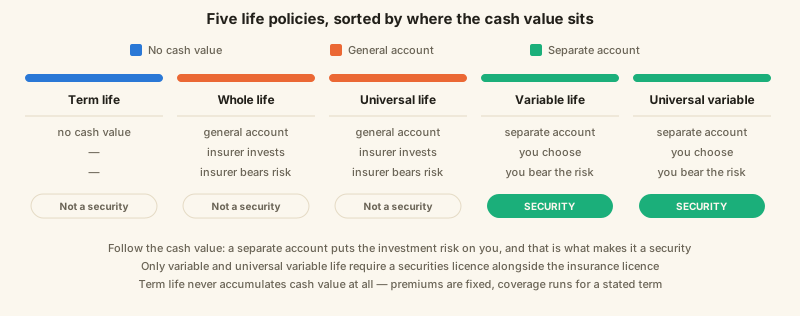
⚠️ Securities status and licensing — guaranteed exam content
Which life insurance products ARE securities:
| Product | Security? | Why |
|---|---|---|
| Term life insurance | NOT a security | No cash value, fixed guaranteed death benefit |
| Whole life insurance | NOT a security | “Due to the guaranteed return of the general account, whole life insurance is not considered a security.” |
| Universal life insurance | NOT a security | Cash value in general account, guaranteed fixed rate |
| Variable life insurance | IS a security | Cash value in separate account; “Insurance products with variable features are considered securities, so they are subject to registration and securities regulations.” |
| Universal variable life insurance | IS a security | Cash value in separate account; subject to registration |
Practical test point: “any insurance product with the word ‘variable’ in its name can generally be treated as a security.”
Licensing required to sell the variable products:
To offer variable life insurance, a professional must hold both securities and insurance licenses. This typically involves FINRA and NASAA licensing (e.g., Series 6, 7, 63, 65, and/or 66) plus a state insurance license.
For universal variable life insurance: the product is subject to registration, and the professionals who sell it must be properly registered with both securities regulators and insurance regulators.
Non-variable products (term, whole, universal) do not require a securities license — an insurance license alone suffices.
Term life insurance
Term life insurance provides coverage for a specific period of time (the term). It’s typically the simplest and least expensive type of life insurance. Common terms are 10, 15, or 20 years.
- If the policyholder dies during the term, the insurer pays a death benefit to the beneficiaries.
- If the policyholder is still alive when the term ends, the coverage expires.
- The policy can often be renewed, but only up to a certain age; 🔑 most insurers won’t renew after age 80.
Definitions
| Term | Definition (word-for-word) | Example |
|---|---|---|
| Death benefit | > Benefit (money) received by beneficiaries in the event of the insured person’s death | A $500,000 policy pays $500,000 to the beneficiaries when the insured dies |
| Beneficiary | > Person(s) and/or entities designated to receive the death benefit | A spouse, child, or entity named on the policy |
Premiums
- To keep coverage in force, you pay premiums to the insurance company.
- With term life insurance, premiums are fixed (non-variable).
- Those premiums pay only for the death benefit — there are no additional benefits.
- Premiums generally increase as a person gets older. This is especially noticeable at renewal.
Example: suppose someone buys a 20-year term policy at age 30. When the term ends, they’re 50. Renewing at 50 can be much more expensive because the probability of death is higher at 50 than at 30.
Cash value
Unlike every other type of life insurance here, term life insurance has no cash value.
Cash value is the “extra” amount paid above the cost of the death benefit.
Term life insurance never accumulates cash value.
Whole life insurance
Whole life insurance is designed for people who want coverage for their entire lifetime. Coverage lasts for the “whole” life of the policyholder as long as premiums are paid. Like term life insurance, whole life uses fixed premium payments.
Unlike term life, whole life insurance builds cash value over time:
- Part of each premium pays for the death benefit.
- Any amount paid above that cost goes into cash value.
Example: suppose a 30-year-old buys whole life insurance with a fixed $200 monthly premium. Early on, the cost of the death benefit might be $50 per month, so the remaining $150 would be cash value. As the policyholder ages, the cost of the death benefit typically rises, leaving less of the premium to contribute to cash value. At age 60, the death benefit cost might be $160 per month, leaving $40 for cash value.
The general account
| Fact | Detail |
|---|---|
| Where cash value goes | The insurance company’s general account |
| Who owns the cash value | The policyholder |
| Who invests it | The insurance company |
| Return | Insurance company guarantees a fixed rate of return |
| Typical investments | Relatively safe securities like US government bonds or commercial paper |
| Who bears investment risk | The insurance company — it must credit the promised growth regardless of market conditions |
From the policyholder’s perspective, the specific investments matter less than the guarantee. If the insurer credits a 4% fixed return, the cash value grows at 4% even if the insurer’s investments perform poorly.
Due to the guaranteed return of the general account, whole life insurance is not considered a security.
Accessing cash value
- In most cases, the policyholder can access cash value only while the insured person is alive.
- 🔑 After the policy has been in force for a period of time (often 3 years), cash value may be withdrawn or borrowed.
- Any cash value withdrawn or borrowed and not repaid is generally subtracted from the death benefit.
- 🔑 Ordinary income taxes are generally due on distributed cash value above the investor’s contributions (basis).
Example: suppose an investor contributes $50,000 to cash value and it grows to $75,000. If the investor distributes $60,000, they generally owe ordinary income tax on the $10,000 of growth distributed, but not on the $50,000 basis.
🔑 Four options if a policyholder wants to stop paying premiums
| Option | What happens |
|---|---|
| Keep death benefit for a shorter period | The policyholder can surrender the whole life policy and use the cash value to buy the equivalent of term life insurance. This option is typically only available to policyholders below age 80, since most insurers don’t offer term life to very elderly applicants. |
| Retain insurance with a lower death benefit | The policyholder can stop paying premiums in exchange for a lower death benefit. Depending on the contract and agreement, the cash value may or may not be adjusted. |
| Surrender and receive cash value | The policyholder can surrender the policy and receive the cash value minus any applicable surrender fees. Surrender fees are charges paid to the insurance company when the policy is canceled. Many surrender fee schedules decline over time (higher in early years and lower in later years). Any gains above the basis (amount contributed) are taxable to the policyholder. |
| Perform a life (viatical) settlement | The policyholder sells the life insurance policy to a third party. |
Life (viatical) settlements
In some situations, the policyholder can sell the life insurance policy to a third party. This is called a life settlement or viatical settlement and is typically associated with a policyholder who is near death. People diagnosed with terminal illnesses commonly use these settlements.
If someone expects to die within a short period of time, they may sell the policy and use the proceeds for medical or end-of-life expenses.
Example: a $500,000 policy might be sold for $300,000. The third party takes over premium payments and receives the full death benefit ($500,000 in this example) when the original policyholder dies.
🔑 Sidenote — Life insurance taxes (capture exactly)
| Item | Tax treatment (as stated) |
|---|---|
| Death benefit | “One of the biggest benefits of life insurance is that the death benefit is generally not subject to income tax. When the policyholder dies, the beneficiary typically receives the payout with no income tax obligation.” |
| Estate tax on the policy | “However, the value of the life insurance policy may be included in the policyholder’s estate and could be subject to estate taxes.” |
| Spouse beneficiary | “This is generally not the case when the beneficiary is the policyholder’s spouse. The unlimited marital exemption allows assets inherited by a surviving spouse to avoid estate taxation.” |
| Cash value growth (while in policy) | Grows at a guaranteed fixed rate (general account) or based on investment performance (separate account); taxation arises on distribution. |
| Cash value withdrawn / distributed | “Ordinary income taxes are generally due on distributed cash value above the investor’s contributions (basis).” Basis is not taxed. |
| Cash value borrowed (policy loans) | “Any cash value withdrawn or borrowed and not repaid is generally subtracted from the death benefit.” |
| Surrender | “Any gains above the basis (amount contributed) are taxable to the policyholder.” |
Variable life insurance
Variable life insurance shares several features with whole life insurance:
- Coverage lasts for the policyholder’s lifetime.
- Premiums are fixed.
- The contract provides a minimum death benefit.
The key difference is how the cash value (and potentially the death benefit) can change over time.
The separate account
Instead of placing cash value in the insurer’s general account, variable life insurance places it in a separate account. This works similarly to the separate account in variable annuities. The policyholder chooses how the funds are invested, often from options that include different asset classes such as common stock, preferred stocks, and bonds.
🔑 Separate accounts have two major consequences:
| Consequence | Detail |
|---|---|
| 1. Risk shifts | “The policyholder accepts the investment risks (e.g., market risk), rather than the insurance company.” |
| 2. Securities status | “Insurance products with variable features are considered securities, so they are subject to registration and securities regulations.” |
To offer variable life insurance, a professional must hold both securities and insurance licenses — typically FINRA and NASAA licensing (e.g., Series 6, 7, 63, 65, and/or 66) plus a state insurance license.
Effect on cash value and death benefit
Because the separate account’s value fluctuates, both the cash value and the death benefit can increase when investments perform well and decrease when investments perform poorly.
Variable life insurance contracts typically provide a minimum guaranteed death benefit regardless of how far the separate account declines, but there is usually no minimum guaranteed cash value.
Universal life insurance
Universal life insurance is similar to whole life insurance in several ways:
- Coverage lasts for the policyholder’s lifetime.
- The policy provides a death benefit.
- Cash value is invested in the insurer’s general account.
- It is not considered a security.
The main difference is premium flexibility.
The word “universal” is a good cue for flexibility. Universal life insurance premiums can change over time. The policyholder may:
| Action | Consequence |
|---|---|
| Increase premium payments | To pursue a larger death benefit |
| Decrease or skip premium payments | Typically in exchange for a lower death benefit or a deduction from cash value |
If enough cash value accumulates, some policyholders pay premiums from the general account until the cash value is depleted. If cash value is exhausted and premiums aren’t paid, the policy will lapse (terminate).
This flexibility can be useful for people whose financial situation changes over time. For example, if income or family responsibilities increase, the policyholder can increase premiums rather than applying for a new policy to raise the death benefit.
Universal variable life insurance
Universal variable life insurance combines features of universal life and variable life insurance. Like universal life insurance, it:
- Covers the policyholder for life.
- Provides a flexible death benefit.
- Allows flexible premium payments.
The main differences involve where cash value is invested and whether the product is a security.
- Instead of investing cash value in the general account, universal variable life insurance places it in the separate account.
- As with variable life insurance, the policyholder controls the investments and bears the investment risk.
- Because both cash value and the death benefit can be affected by investment performance, there is no guarantee of growth.
- ⚠️ It’s even possible (though very unlikely) for cash value to fall to zero if the investments become worthless.
- However, many universal variable life insurance contracts provide a minimum guaranteed death benefit.
Universal variable life insurance is considered a security. As a practical test point, any insurance product with the word “variable” in its name can generally be treated as a security. This means the product is subject to registration, and the professionals who sell it must be properly registered with both securities regulators and insurance regulators.
Key points
Term life insurance
- Coverage for a specific term
- Fixed premiums
- Fixed, guaranteed death benefit
- No cash value
- Not considered a security
Whole life insurance
- Coverage for the “whole” life of policyholder
- Fixed premiums
- Guaranteed death benefit
- Cash value invested in general account
- Cash value grows at a guaranteed fixed rate
- Insurance company subject to investment risk
- Cash value may be
- Withdrawn or borrowed
- Returned to the insurance company upon death
- Kept upon surrender of the policy
- Retained and potentially paid with a death benefit
- Not considered a security
Viatical (life) settlements
- Policyholder sells life insurance to a third party
- Typically involves policy holders with terminal illnesses
- Third party takes over premium payments
- Third party receives a death benefit
Variable life insurance
- Coverage for the entire life of policyholder
- Fixed premiums
- Guaranteed minimum death benefit
- No minimum guaranteed cash value
- Cash value invested in the separate account
- Cash value grows based on investment performance
- Policyholder subject to investment risk
- Cash value may be:
- Withdrawn or borrowed
- Returned to the insurance company upon death
- Kept upon surrender of the policy
- Retained and potentially paid with a death benefit
- Considered a security
Universal life insurance
- Coverage for the entire life of policyholder
- Flexible premiums
- Flexible death benefit (some maintain minimums)
- Cash value invested in general account
- Cash value grows at a guaranteed fixed rate
- Insurance company subject to investment risk
- Cash value may be:
- Withdrawn or borrowed
- Returned to the insurance company upon death
- Kept upon surrender of the policy
- Retained and potentially paid with a death benefit
- Not considered a security
Universal variable life insurance
- Coverage for the entire life of policyholder
- Flexible premiums
- Flexible death benefit (some maintain minimums)
- No minimum guaranteed cash value
- Cash value invested in the separate account
- Cash value grows based on investment performance
- Policyholder subject to investment risk
- Cash value may be:
- Withdrawn or borrowed
- Returned to the insurance company upon death
- Kept upon surrender of the policy
- Retained and potentially paid with a death benefit
- Considered a security
Sources
Primary/official references for the material on this page. Every link was fetched and returned HTTP 200 on 2026-08-15.
| # | Source | Publisher |
|---|---|---|
| 1 | Variable life insurance — separate account, death benefit, charges | SEC / Investor.gov |
| 2 | Pub 525 — taxable/nontaxable income, ISOs and NQSOs | IRS |
| 3 | Investment product categories | SEC / Investor.gov |
| 4 | Achievable Series 65 — chapter 1.6.3 | Achievable (course text) |