Class A vs. B vs. C mutual fund shares
Class A shares charge the sales load at purchase, Class B shares charge it at redemption (a declining CDSC), and Class C shares charge a level ongoing fee through 12b-1 fees. Over a long hold, Class A usually costs the least for a large investment, and Class C is meant for short holding periods. The table gives the full comparison, and the sections after it cover breakpoints, the letter of intent and the 12b-1 rules the exam tests.
Class A vs. B vs. C comparison table
| Feature | Class A | Class B | Class C |
|---|---|---|---|
| Sales charge type | Front-end load | Back-end load | Level load (ongoing marketing fees) |
| When the charge is collected | At purchase | At redemption (sale) | Continuing cost rather than a one-time sales charge |
| CDSC behavior over time | No CDSC — charge is paid up front | Contingent deferred sales charge (CDSC) that declines the longer the investor holds the shares, eventually reaching 0% (5+ years in the sample schedule). Deducted from redemption proceeds before paying the investor | Typically no front-end or back-end sales charge, although some Class C shares impose a one-year CDSC — investors avoid the back-end charge if they hold at least one year |
| Breakpoints / LOI / ROA | Subject to breakpoint schedules, LOI, rights of accumulation, combination privilege, householding | Not breakpoint-based (CDSC schedule instead) | Not breakpoint-based |
| 12b-1 fees | Low or no 12b-1 fees (0.25% in the Summit example) | Moderate 12b-1 fees (1.00% in the Summit example) | Maximum 12b-1 fees (up to 1%) |
| Share class conversion | — | Many fund companies convert Class B shares to Class A once the CDSC period ends | — |
| Suitable investor / time horizon | Longer-term investors making larger investments | Intermediate- to longer-term investors making smaller investments | Short-term investors — long-term investors typically want to avoid this class because 12b-1 fees continue year after year |
Class A shares (front-end)
- Class A shares assess a front-end load, a sales charge collected when an investor purchases shares.
- This share class is subject to breakpoint schedules, which reduce the sales charge as the investment amount increases.
🔑 Breakpoint schedule example
Sample Class A Breakpoint Schedule
Volume Sales Charge $0 - $24,999 8.5% $25,000 - $49,999 6.5% $50,000 - $99,999 5.0% $100,000+ 3.5%
- Breakpoint schedules reward larger purchases with lower sales charges.
- 🔑 Funds must offer breakpoint schedules if they assess the maximum sales charge of 8.5%.
Letter of intent (LOI)
If a customer doesn’t currently have enough money to reach the next breakpoint, they can sign a letter of intent (LOI). An LOI is a pledge to invest the additional amount (the shortfall) within the next 13 months. Signing an LOI lets the investor receive the lower sales charge immediately.
Worked example:
Using the schedule above, say a customer has $21,000 to invest. They could sign a $4,000 LOI, pledging to invest another $4,000 within 13 months. That qualifies them for the 6.5% sales charge today instead of 8.5%.
Backdating:
An LOI can be backdated up to three months to count earlier purchases. For example, if the investor bought $800 of the fund a few weeks before investing the $21,000, the LOI amount drops to $3,200.
Backdating does not extend the LOI period. If an LOI is backdated three months, the investor has only ten months left to complete the shortfall deposit. If the investor misses it, the fund retroactively applies the higher sales charge.
| LOI rule | Detail |
|---|---|
| Duration | 13 months |
| Effect | Lower sales charge assessed immediately |
| Backdating | Up to 3 months (90 days) to include prior purchases |
| Backdating and the clock | ⚠️ Backdating does not extend the LOI period — backdate 3 months and only 10 months remain |
| Failure to fulfill | Fund retroactively applies the higher sales charge |
| Appreciation | ⚠️ LOIs cannot be satisfied through asset appreciation. If the investment grows in value, that growth doesn’t replace the required shortfall deposit |
Sidenote — The LOI & holding shares in escrow
Financial firms that facilitate the purchase of class A shares bought with an LOI typically require a small portion of the investor’s shares to be held in escrow*. For example, a firm requires 5% of the purchased shares to be held in a side (escrow) account. This provides the firm with some collateral if the investor fails to fulfill the LOI. If an LOI is not fulfilled by the end of the designated period (13 months), the firm can simply liquidate enough shares held in the escrow account to pay for the higher sales charge.
*An escrow account is a legal holding account for capital (money) that may be spent later.
Rights of accumulation
However, funds may offer rights of accumulation, which can reduce sales charges on future purchases. For example, if a customer already has $40,000 invested in a fund and wants to invest an additional $10,000, the new purchase qualifies for the $50,000 breakpoint.
$40,000 already invested + $10,000 new = $50,000 breakpoint (5.0% tier in the schedule above).
LOI = a forward-looking pledge; rights of accumulation = credit for what is already invested.
Breakpoint sales (violation)
Financial professionals must inform customers when they are close to a breakpoint. For example, if a customer wants to invest $23,500 in the XYZ fund, the registered representative must explain how the customer could qualify for the next breakpoint (they’re only $1,500 away). The customer’s options include:
Investing the additional $1,500 now Signing an LOI for the $1,500 shortfall Doing nothing and accepting the higher sales charge
The incentive math:
A financial professional can have an incentive to steer a customer away from a breakpoint, because the firm earns more when the sales charge is higher. Using the same schedule:
Sales charge if the customer buys $23,500 at 8.5% = $1,997.50 Sales charge if the customer buys $25,000 at 6.5% = $1,625.00
That’s a $372.50 difference. A representative who fails to tell the customer about the breakpoint is committing a violation called a breakpoint sale, which can bring regulator-imposed fines and/or suspensions. The representative must act as a fiduciary and put the customer’s interests ahead of their own.
Note the counterintuitive result: investing more money ($25,000) results in a lower dollar sales charge ($1,625.00) than investing $23,500 ($1,997.50).
Who gets breakpoints
| Eligible / rule | Detail |
|---|---|
| All individuals | Breakpoints are available to all individuals and some groups |
| Householding | Many funds offer householding, which allows family members living at the same address to combine purchases to qualify for lower breakpoints |
| Across firms | Breakpoints apply regardless of where the fund is purchased. If you invest $10,000 in the same fund through five different firms, it’s treated as a $50,000 purchase for breakpoint purposes |
| Investment clubs | ⚠️ Not granted breakpoints and are assessed the highest possible sales charge |
Sidenote — Investment clubs:
An investment club is a group of friends or colleagues who pool money to invest together, much like a joint account shared by people with common interests. Clubs are not granted breakpoints and are charged the highest possible sales charge.
Combination privilege
Investors may also use the combination privilege, which allows purchases across multiple funds within the same fund family to be combined for breakpoint purposes. For example, an investor buying $9,000 of the XYZ Stock Fund, $9,000 of the XYZ Corporate Bond Fund, and $7,000 of the XYZ US Government Bond Fund would qualify for a $25,000 breakpoint.
$9,000 + $9,000 + $7,000 = $25,000 breakpoint (6.5% tier).
Suitability
- Class A shares are generally most suitable for long-term investors investing larger amounts.
- Because the front-end load can be substantial, selling too soon can make the sales charge a large drag on returns. A longer holding period gives the investment more time to potentially earn returns that outweigh the initial sales charge.
Class B shares (back-end)
- Class B shares assess back-end loads, meaning the sales charge is paid when the investor sells (redeems) shares.
- This type of back-end load is also called a contingent deferred sales charge (CDSC).
- A CDSC typically declines the longer the investor holds the shares.
🔑 CDSC schedule example
Sample Class B CDSC Schedule
Years of ownership Charge 1 year 6% 2 years 5% 3 years 3% 4 years 1% 5+ years 0%
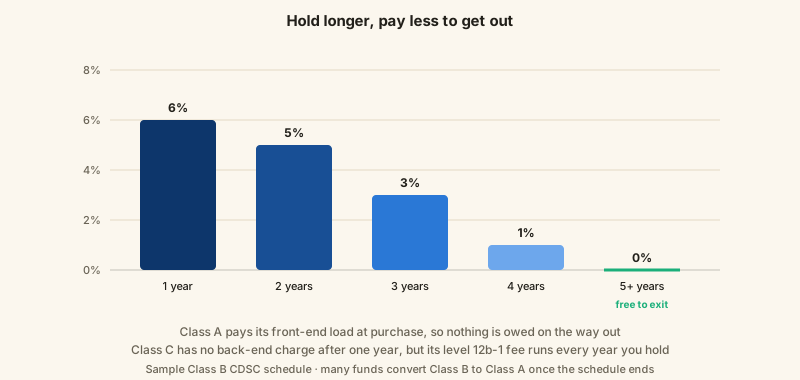
- A CDSC schedule reduces the sales charge for longer holding periods.
- If a CDSC applies at redemption, the fund deducts the charge from the redemption proceeds before paying the investor.
- Most CDSC schedules eventually reach a point where no sales charge is due. In this example, shares held for 5 years or longer can be redeemed with no CDSC.
- Many fund companies convert Class B shares to Class A shares once the CDSC period ends.
Suitability
- Class B shares are generally suitable for intermediate- to long-term investors investing smaller amounts.
- Investors with larger amounts to invest often benefit more from Class A shares because breakpoint schedules can reduce the front-end load.
Sidenote — Class A vs. B for long-term investors
It can be hard to tell whether Class A or B suits a long-term investor. The general rule:
Class A - suitable for long-term investors with large amounts to invest Class B - suitable for long-term investors with small amounts to invest
Class B shares often look like the better choice: held past the CDSC period, they carry no front or back-end load. The Summit Utilities Fund example shows why Class A can still win.
Summit Utilities Fund — fee structures:
Summit Utilities Fund Class A Shares
Breakpoint schedule:
Sales charge Volume 5.50% $0 - $49,999 4.50% $50,000 - $99,999 3.50% $100,000 - $249,999 2.50% $250,000 - $499,999 1.50% $500,000 - $999,999 0.00% $1,000,000+ 0.25% 12b-1 fees (annual)
Summit Utilities Fund Class B Shares
Contingent deferred sales charge schedule:
CDSC Years 5.00% 1 year 4.00% 2 years 4.00% 3 years 3.00% 4 years 2.00% 5 years 1.00% 6 years 0.00% 7 years 1.00% 12b-1 fees (annual)
🔑 The worked comparison:
Say an investor plans to hold shares for eight years and has $750,000 to invest. Which share class costs less?
Class A shares. The $750,000 purchase sits in the $500,000 - $999,999 tier, so the investor pays a 1.50% front-end load plus an annual 0.25% 12b-1 fee. Ignoring compounding, the total is 3.50% (1.50% front-end load + 0.25% × 8 years).
With Class B shares the investor would pay 8.00% in fees even with no back-end load (1.00% 12b-1 × 8 years). If the Class B shares converted to Class A after the 7-year CDSC period, the total would still be 7.25% (1.00% × 7 years + 0.25% × 1 year).
Apart from the sales charge structure, the big difference between the two classes is the 12b-1 fee. That is why a long-term investor with a large amount to invest does better paying a front-end load than choosing Class B, even without a CDSC.
| Scenario ($750,000, 8-year hold) | Total fee cost | Components |
|---|---|---|
| Class A | 3.50% | 1.50% front-end load + (0.25% × 8 years) |
| Class B (no conversion) | 8.00% | 1.00% 12b-1 × 8 years (no back-end load) |
| Class B converting to A after 7 years | 7.25% | (1.00% × 7 years) + (0.25% × 1 year) |
Exam trap: Class B “no load after the CDSC expires” still loses to Class A over long horizons because of ongoing 12b-1 fees.
Class C shares (level load)
- Class C shares are best known for ongoing marketing fees, which create a level load (a continuing cost rather than a one-time sales charge).
- This share class typically does not impose a front-end or back-end sales charge, although some Class C shares impose a one-year CDSC. With that structure, investors avoid the back-end charge if they hold the shares for at least one year.
- The most significant expense for Class C shares is typically 12b-1 fees — a marketing fee intended to lower a fund’s expense ratio by attracting more investors.
Why 12b-1 fees exist
Many mutual funds have operating expenses that barely move as assets grow. Say a fund has $80 million in assets and $1.2 million in annual operating expenses, an expense ratio of 1.5%. If the fund doubled its assets to $160 million while expenses stayed at $1.2 million, the expense ratio would fall to 0.75%.
$1,200,000 ÷ $80,000,000 = 1.5%; $1,200,000 ÷ $160,000,000 = 0.75%.
🔑 12b-1 fee components
12b-1 fees are used to grow a fund’s assets in hopes of lowering expenses on a per-investor basis. There are two components:
| Component | Purpose | Maximum |
|---|---|---|
| Distribution fees | Pay for marketing and promotional services, including advertisements and payments to brokers who place customers into these funds | 0.75% |
| Service fees | Pay representatives to answer questions and discuss fund features, since advertisements include contact information (for example, “Call us if you have questions!”) | 0.25% |
| Total 12b-1 fee | — | 1% annual maximum |
12b-1 fees by share class
| Share class | 12b-1 fee level |
|---|---|
| Class A | Low or no 12b-1 fees |
| Class B | Moderate 12b-1 fees |
| Class C | Maximum 12b-1 fees |
“No load” marketing rule
Regulators recognize that ongoing 12b-1 fees can reduce investor returns over time. Because of that, a fund charging more than 0.25% in 12b-1 fees cannot market itself as a “no load” fund. Otherwise, an investor might buy a fund expecting low costs while paying an ongoing marketing fee that doesn’t go away. So even if many Class C shares don’t have a front-end or back-end sales charge, they generally can’t be marketed as “no-load” due to their higher 12b-1 fees.
>0.25% 12b-1 fee = cannot be called “no load”, even with no front-end or back-end sales charge.
Sidenote — 12b-1 fee impact on loads
Funds assessing the maximum 12b-1 fee (1%) cannot also impose the maximum 8.5% on front or back-end loads. Instead, the maximum possible load is reduced to 7.25%. The regulators impose this rule to ensure investors are not subject to extraordinary fee schedules.
Max 12b-1 (1%) → max load drops from 8.5% to 7.25%.
Suitability
- Class C shares are generally suitable for short-term investors. Because 12b-1 fees continue year after year, long-term investors typically want to avoid this share class.
- Even though a 1% annual fee may sound small, it’s charged repeatedly. If an investor holds Class C shares for ten years, they will pay the 1% annual fee ten times!*
*Technically, 12b-1 fees are assessed quarterly, although the fee is expressed as an annual percentage. For example, assume an investor owes an annual 12b-1 fee of $100. The fund would charge $25 per quarter instead of a one-time $100 fee.
Related pages
- NAV, POP & Forward Pricing shows how the front-end load enters the public offering price.
- Mutual Fund Structure & Expense Ratio explains the expense ratio that 12b-1 fees feed into.
- Closed-End & Interval Funds covers funds whose shares trade at market price instead of carrying these loads.
Practice questions
Q1. When is the sales charge collected for Class A, B, and C shares?
Show answer
Class A: at purchase (front-end). Class B: at redemption (back-end/CDSC). Class C: ongoing level load via 12b-1 fees rather than a one-time charge.
Q2. A customer has $21,000 to invest but needs the $25,000 breakpoint (6.5% vs. 8.5%). What can they sign?
Show answer
A letter of intent (LOI) pledging to invest the $4,000 shortfall within 13 months, qualifying for the lower charge immediately.
Q3. An LOI is backdated three months to include prior purchases. How much time remains to fulfill the pledge?
Show answer
Ten months. Backdating does not extend the 13-month LOI period.
Q4. What is a breakpoint sale?
Show answer
A violation when a representative fails to notify a customer they are close to a breakpoint and could qualify for a lower sales charge. Subject to fines and/or suspensions.
Q5. Are investment clubs eligible for breakpoint discounts?
Show answer
No. Investment clubs are assessed the highest possible sales charge and are not granted breakpoints.
Q6. How do Class B CDSC schedules typically work?
Show answer
The contingent deferred sales charge declines the longer shares are held, eventually reaching 0% (e.g., 0% after 5+ years in the sample schedule). Many funds convert Class B to Class A after the CDSC period.
Q7. A long-term investor with $750,000 to hold eight years — Class A or Class B?
Show answer
Class A. Despite no back-end load on Class B after the CDSC period, higher ongoing 12b-1 fees (1.00% vs. 0.25%) make Class A cheaper over time (3.50% total vs. 8.00% in the worked example).
Q8. What are the maximum 12b-1 fee components?
Show answer
Distribution fees up to 0.75%, service fees up to 0.25%, for a 1% annual maximum total.
Q9. Can a fund charging more than 0.25% in 12b-1 fees market itself as “no load”?
Show answer
No. Ongoing 12b-1 fees above 0.25% prevent “no load” marketing even if there is no front-end or back-end sales charge.
Q10. If a fund charges the maximum 1% 12b-1 fee, what is the maximum allowable sales load?
Show answer
7.25% (reduced from 8.5%) to prevent extraordinary combined fee schedules.
Sources
Primary/official references for the material on this page. Every link was fetched and returned HTTP 200 on 2026-08-15.
| # | Source | Publisher |
|---|---|---|
| 1 | Mutual funds and ETFs — NAV, fees, share classes | SEC / Investor.gov |
| 2 | 12b-1 distribution fees | eCFR (17 CFR 270.12b-1) |
| 3 | Open-end vs closed-end vs UIT classification | Cornell LII (15 U.S.C. 80a-5) |
| 4 | Achievable Series 65 — chapter 1.3.2.4 | Achievable (course text) |