Business, Financial & Concentration Risk
⚠️ Category orientation — read first
This chapter covers NON-SYSTEMATIC risk (also called unsystematic risk) — the security-specific category, not the market-wide systematic category.
🔑 The category definition, word-for-word from the companion systematic risks chapter:
Non-systematic risks occur when a circumstance or event affects a specific security or a small sector of the market and may cause investment losses. This risk tends to apply on a security-by-security basis.
Does diversification eliminate/reduce it? ⚠️ Yes — this is the defining contrast with systematic risk. The page’s Key points state non-systematic risks “can be reduced through diversification,” and the body text says: “A common theme across non-systematic risks is that diversification can reduce their impact.” Diversification is listed as a hedge for every named risk in this chapter except counterparty risk, for which the page lists no hedge.
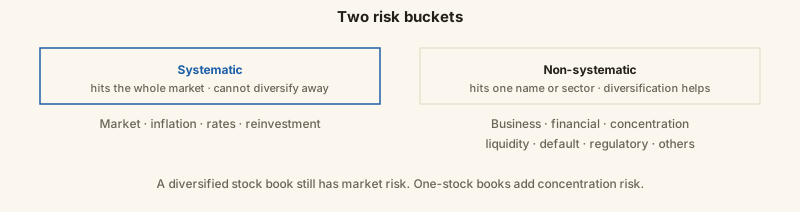
🔑 Complete list of non-systematic risks
There are numerous non-systematic risks, or unsystematic risks, to be aware of:
- Business risk
- Financial risk
- Concentration risk
- Currency exchange risk
- Liquidity (marketability) risk
- Default (credit) risk
- Call risk
- Regulatory risk
- Legislative risk
- Political risk
- Counterparty risk
Complete non-systematic risk table
| Risk | Definition (word-for-word) | Applies to | Ways to hedge |
|---|---|---|---|
| Business risk | “A company’s business revenue declines, typically due to competition or mismanagement.” | Common stock | Diversification |
| Financial risk | “A company’s ability to function is impacted by the amount of money it owes to creditors.” | Common stock | Diversification |
| Concentration risk | “A lack of diversification negatively impacts an investor’s overall portfolio when the few securities owned lose value.” | All securities | Diversification |
| Currency exchange risk | “Currency value fluctuations negatively impact the value of a security.” | Foreign investments | Diversification |
| Liquidity (marketability) risk | “The inability to sell a security, or the need to offer it at a significant discount in order to sell it.” | Penny stocks; Municipal bonds; Junk bonds; Hedge funds; Structured products; Limited partnerships | Diversification |
| Default (credit) risk | “An issuer is unable to make required interest and/or principal payments on its debt obligations.” | Debt securities (in general); Junk bonds (in particular) | Diversification |
| Call risk | “Interest rates fall, leading issuers to refinance by calling older securities with high coupons and reissuing new securities with lower coupons. Investors whose securities are called are then forced to reinvest at a lower rate of return.” | Callable debt securities; Callable preferred stock | Diversification |
| Regulatory risk | “A government agency creates a new rule or regulation that negatively impacts a business or an issuer’s securities.” | Common stock (sector) | Diversification |
| Legislative risk | “A law approved by Congress and signed into law by the President negatively impacts a business or an issuer’s securities.” | All securities | Diversification |
| Political risk | “An unstable government structure negatively impacts a business or issuer’s security.” | Foreign investments | Diversification |
| Counterparty risk | “Counterparty risk is the risk that the other party in a financial transaction (the counterparty) will fail to fulfill their end of the agreed-upon deal, resulting in a default on a payment or delivery.” | OTC trades; OTC derivatives like swaps and forwards | (No hedge listed on the page) |
Note the pairs that are easy to confuse: regulatory risk = an agency rule (e.g., the EPA) vs. legislative risk = a law passed by Congress and signed by the President. And political risk = unstable government structure, which the page ties to foreign investments.
Business risk
A company’s business revenue declines, typically due to competition or mismanagement.
Applies to: Common stock
- Common stock values tend to decline when business revenues decline because investors often expect lower future earnings, which can reduce demand for the stock.
- This is a common risk for common stocks because issuers are required to report their financial results quarterly (on Form 10-Q). Stock prices can fall quickly if those results show declining business revenue.
- Example given: PayPal’s stock price dropped 25% after reporting disappointing revenue in early February 2022.
Ways to hedge: Diversification
A common theme across non-systematic risks is that diversification can reduce their impact. If you want to avoid being heavily exposed to business risk in one company (like PayPal), you generally wouldn’t put all your money into that single stock.
Financial risk
A company’s ability to function is impacted by the amount of money it owes to creditors.
Applies to: Common stock
- Borrowing too much money can significantly hinder business operations. The more a company borrows, the more its interest and repayment obligations can reduce earnings (profitability).
- 🔑 Common stock investors pay close attention to earnings, and stock indicators like EPS (earnings per share) are closely tracked. When a company’s EPS declines due to large debt levels, the stock price is also likely to decline.
Ways to hedge: Diversification
Concentration risk
A lack of diversification negatively impacts an investor’s overall portfolio when the few securities owned lose value.
Applies to: All securities
- Concentration risk can apply no matter what type of security an investor holds. When a portfolio isn’t diversified, a large decline in one or a few holdings can have an outsized impact on the overall portfolio.
Ways to hedge: Diversification
Currency exchange risk
Currency value fluctuations negatively impact the value of a security.
Applies to: Foreign investments
- ⚠️ An investor may be subject to currency exchange risk whether a currency weakens or strengthens.
Ways to hedge: Diversification
Liquidity (marketability) risk
The inability to sell a security, or the need to offer it at a significant discount in order to sell it.
Applies to:
-
Penny stocks
-
Municipal bonds
-
Junk bonds
-
Hedge funds
-
Structured products
-
Limited partnerships
-
🔑 A simple way to think about this risk is: if a security is difficult (or impossible) to sell at a reasonable price, it has liquidity (marketability) risk.
| Security | Why it carries liquidity risk |
|---|---|
| Penny stocks and junk bonds | High-risk securities only suitable for the most aggressive investors. When only a small portion of the market is suitable for a security, trading tends to occur less frequently |
| Municipal bonds | Generally traded only by residents of the state they’re issued from, which can result in a smaller market and less liquidity |
| Hedge funds | Typically have lock-up periods that prevent investors from liquidating for lengthy periods of time |
| Structured products | Not generally traded in the secondary market — ⚠️ except for ETNs |
| Limited partnerships | Not generally traded in the secondary market |
Ways to hedge: Diversification
Default (credit) risk
An issuer is unable to make required interest and/or principal payments on its debt obligations.
Applies to:
-
Debt securities (in general)
-
Junk bonds (in particular)
-
If you lend your friend money and they never pay you back, your friend has defaulted on the loan. The same idea applies when an investor lends money to an organization by purchasing a bond.
-
🔑 Junk bonds, which are rated BB or below, have a higher risk of default. In general, the lower the debt rating, the more likely a default will occur.
Ways to hedge: Diversification
Call risk
Interest rates fall, leading issuers to refinance by calling older securities with high coupons and reissuing new securities with lower coupons. Investors whose securities are called are then forced to reinvest at a lower rate of return.
Applies to:
-
Callable debt securities
-
Callable preferred stock
-
⚠️ Call risk is the worst version of reinvestment risk, but it only applies to callable securities.
🔑 The securities most likely to be called tend to share these characteristics:
| Characteristic |
|---|
| Long maturities |
| High coupons |
| Low call premiums |
Ways to hedge: Diversification
Regulatory risk
A government agency creates a new rule or regulation that negatively impacts a business or an issuer’s securities.
Applies to: Common stock (sector)
- ⚠️ Regulations tend to apply on a sector-by-sector basis. For example, the Environmental Protection Agency (EPA) regulates energy companies (e.g. oil, natural gas) in order to protect the environment. If the EPA created a rule requiring higher standards for cleaning up drilling sites, energy companies could see declining profits (even if the rule benefits the environment). Declining profits typically lead to lower stock prices.
Ways to hedge: Diversification
Legislative risk
A law approved by Congress and signed into law by the President negatively impacts a business or an issuer’s securities.
Applies to: All securities
New laws can negatively impact all types of securities. For example, a new law might:
| Example new law | Securities harmed |
|---|---|
| Require the IRS to tax income on municipal bonds | Municipal bonds |
| Require the SEC to regulate hedge funds | Hedge funds |
| Disallow many of the tax benefits provided by limited partnerships | Limited partnerships |
Any of these scenarios would negatively impact the securities involved.
Ways to hedge: Diversification
Political risk
An unstable government structure negatively impacts a business or issuer’s security.
Applies to: Foreign investments
- Although the US has faced its own governmental issues, truly unstable governments tend to be outside of the US. A lack of a strong or independent governmental structure can lead to coups, nationalization of sectors, or invasions from other countries. These actions could result in losses for securities issued by these governments or by businesses within these countries.
Ways to hedge: Diversification
Counterparty risk
Counterparty risk is the risk that the other party in a financial transaction (the counterparty) will fail to fulfill their end of the agreed-upon deal, resulting in a default on a payment or delivery.
- 🔑 This risk is most common in over-the-counter (OTC) trades because a central clearinghouse does not back the contracts, and they are privately negotiated.
- Without a third-party guarantee, one side could default, especially during times of market stress and instability.
- ⚠️ OTC derivatives like swaps and forwards carry counterparty risk.
Key points
Non-systematic risks
- Risks unique to specific companies or securities
- Can be reduced through diversification
- Includes: business, financial, concentration, currency exchange, liquidity, default, call, regulatory, legislative, political, counterparty risks
Business risk
- Company revenue declines due to competition/mismanagement
- Impacts common stock values
- Hedge: diversification
Financial risk
- Company burdened by excessive debt
- Reduces earnings and stock price
- Hedge: diversification
Concentration risk
- Lack of diversification in portfolio
- Large losses if few holdings decline
- Hedge: diversification
Currency exchange risk
- Value affected by currency fluctuations
- Applies to foreign investments
- Hedge: diversification
Liquidity (marketability) risk
- Difficulty selling security at reasonable price
- Applies to penny stocks, municipal bonds, junk bonds, hedge funds, structured products, limited partnerships
- Hedge: diversification
Default (credit) risk
- Issuer fails to make interest/principal payments
- High in debt securities, especially junk bonds (rated BB or below)
- Hedge: diversification
Call risk
- Callable securities redeemed early when rates fall
- Investors reinvest at lower rates
- Applies to callable debt and preferred stock
- Hedge: diversification
Regulatory risk
- New government agency rules harm business/securities
- Often sector-specific (e.g., EPA and energy companies)
- Hedge: diversification
Legislative risk
- New laws negatively affect securities
- Applies to all securities (e.g., tax law changes)
- Hedge: diversification
Political risk
- Unstable government impacts foreign investments
- Includes coups, nationalization, invasions
- Hedge: diversification
Counterparty risk
- Other party in transaction defaults on obligations
- Common in OTC trades and derivatives (swaps, forwards)
- No central clearinghouse backing
Sources
Primary/official references for the material on this page. Every link was fetched and returned HTTP 200 on 2026-08-15.
| # | Source | Publisher |
|---|---|---|
| 1 | Markowitz/Sharpe — portfolio theory and CAPM, the source work | Nobel Prize |
| 2 | Interest-rate risk — bond prices fall when rates rise, duration | SEC |
| 3 | Bonds — coupon, maturity, price/yield, credit risk | SEC / Investor.gov |
| 4 | Achievable Series 65 — chapter 3.6 | Achievable (course text) |