Administrator Powers & Limits
Scope of this chapter
- Although the Securities and Exchange Commission (SEC) has broad regulatory power, the this material tends to focus on the state administrator. This unit primarily covers enforcement under state rules and regulations. When a federal rule or regulation applies, it will be noted.
What the administrator CAN and CANNOT do
- The Uniform Securities Act (USA) is enacted by lawmakers, and the administrator enforces the provisions in that law.
- 🔑 The administrator CAN’T change the USA, but they DO interpret and enforce it.
- A helpful comparison is a police officer: they don’t write the law, but they do have discretion in how they apply and enforce it.
| The administrator CAN | The administrator CANNOT |
|---|---|
| Interpret and enforce the USA | Change / write the USA (that’s the lawmakers’) |
| Deny, suspend, or revoke registrations — if in the public interest | Deny, suspend, or revoke a registration if the action cannot be argued to benefit the public in some way |
| Conduct public or private investigations, within or outside the state | Investigate without jurisdiction |
| Require a person to testify, file a statement, or produce a record (subpoena power) | Violate a person’s 5th amendment right against self-incrimination — under the immunity procedure, can’t force a person to testify if that testimony could lead to criminal proceedings against them |
| Issue a cease and desist order | Issue an injunction directly — that power belongs to the courts; the administrator must petition a court |
| Publish information about an action, proceeding, or investigation | (Is not required to publicly disclose information about an investigation) |
| Issue rules, orders, forms, and notices | Regulate a federal covered adviser beyond requiring a notice filing — except the administrator may investigate a covered adviser if fraud is suspected in that state |
The administrator’s central role
- The administrator’s most important role is enforcing the USA’s anti-fraud provisions.
- Their central job is to prevent investors from being taken advantage of by financial professionals, issuers of securities, and even other investors.
🔑 To do that, the USA gives the administrator these powers:
| # | Power |
|---|---|
| 1 | Registration oversight |
| 2 | Authority to investigate |
| 3 | Ability to issue rules, orders, forms, and notices |
Registration oversight
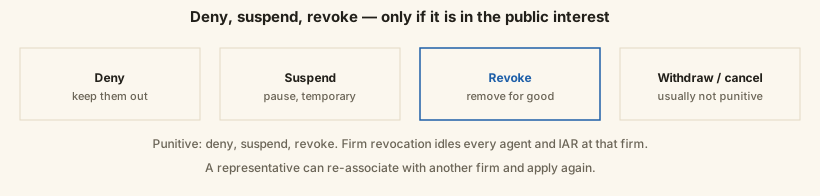
- Registration gives the administrator a “gatekeeper” role. If the administrator can show that an action affecting a person’s registration status is in the public interest*, they have broad authority to keep that person out of the industry (temporarily or permanently).
*Any action taken against a person’s registration status must qualify as “in the interest of the public.” Technically, if it cannot be argued to benefit the public in some way, the administrator cannot deny, suspend, or revoke a registration.
- If an applicant has a checkered past, the administrator may deny registration. That’s why the application process requires extensive disclosure: it’s designed to keep bad-faith actors from entering the securities industry.
- Once registration is effective, the administrator continues to supervise the activities of registered persons and issuers to ensure compliance with securities laws and regulations. Certain events or conduct can put a person’s (or a security’s) registration at risk. If the issue is serious enough, registration can be suspended or revoked.
Suspension vs. revocation
| Action | Effect |
|---|---|
| Suspension | Temporarily prohibits a registered person from operating in a state, or a security from being sold in a state |
| Revocation | Permanently removes registration, effectively barring a person from operating in a state or a security from being sold in a state |
The specifics of denials, suspensions, and revocations are covered later in this unit.
Effect on the firm vs. the representative
| Whose registration is suspended/revoked | Effect |
|---|---|
| Agent or investment adviser representative (IAR) | Does NOT affect the firm’s registration |
| Broker-dealer or investment adviser (revoked) | ⚠️ ALL employee registrations become inactive — an agent or IAR must be associated with a BD or IA to be properly registered; if the firm loses its registration, the representative can’t operate on that firm’s behalf |
- A representative may re-associate with a different firm and then apply for registration again.
Punitive vs. non-punitive
| Type | Actions |
|---|---|
| Punitive (punishments the administrator can take against an applicant or registered person) | Denials, suspensions, and revocations |
| Typically NOT punitive | Registration withdrawn or canceled (covered in Withdrawal, Cancellation & Retained Jurisdiction) |
- Bottom line: managing registration is one of the administrator’s core powers, and it directly affects which professionals and securities can interact with the investing public.
Authority to investigate
- If the administrator has reason to believe an unethical or illegal action has occurred in their state, they have broad investigatory powers. In many cases, investigations begin with complaints and tips from the public.
🔑 According to NASAA’s 2025 report:
| Metric | Figure |
|---|---|
| Complaints received by state administrators | 8,309 |
| Investigations that resulted | 8,833 |
| Enforcement actions | 1,183 |
The USA’s language
The administrator may conduct public or private investigations within or outside of this State that the administrator considers necessary or appropriate to determine whether any person has violated, is violating, or is about to violate [the USA]
- An investigation may be public (announced broadly) or private. It may occur within or outside the administrator’s state, but the administrator must have jurisdiction.
- The jurisdiction analogy: police officers generally have authority only within the city or state where they operate. If conduct occurs outside that area, they typically can’t prosecute it. The same concept applies to the state administrator.
🔑 When jurisdiction exists
The administrator has jurisdiction if a financial professional (registered person) and/or client was physically in their state during:
| # | Triggering event |
|---|---|
| 1 | An offer of securities* |
| 2 | A sale of securities* (a.k.a. an acceptance of the offer) |
*📌 The legal definitions of offers and sales matter — “The details are important!”
Federal covered advisers
- Federal covered advisers are typically larger advisers based on assets under management. The SEC primarily regulates covered advisers.
- ⚠️ A state administrator MAY investigate a covered adviser if the administrator suspects the adviser is committing fraud in that state. Otherwise, the administrator’s authority over a federal covered adviser is generally limited to requiring a notice filing.
Sidenote: Media programs
- Securities can be offered personally (for example, in a conversation or letter) or through media programs. The USA explains how jurisdiction applies to offers made through media, including radio broadcasts, TV shows, electronic (internet) communications, and publications (newspapers and magazines).
- 🔑 In general, jurisdiction is given only to the state where the media program ORIGINATED.
| Scenario | Who has jurisdiction |
|---|---|
| A radio broadcast originates in Florida and is broadcast to 10 other southeastern US states; a securities offer is made in a commercial | Only Florida’s state administrator |
| A TV show is nationally broadcast from New York City; a securities offer is made during the show | Only New York’s state administrator* |
| A newspaper is published in Wyoming, also circulated in both Dakotas and Montana; an offer of a private placement is made in the newspaper | Only Wyoming’s state administrator |
*Essentially, the same would apply to shows on the internet (e.g. YouTube). Only the state where the show is being broadcast from has jurisdiction.
The newspaper rule caveat: If more than 2/3 (66%) of the newspaper is circulated outside of the publishing state, that state doesn’t have jurisdiction either. Essentially, no state administrator retains jurisdiction in this scenario.
Sidenote: Forwarding of mail
Jurisdiction works differently when an offer is mailed but then forwarded to another state.
| Scenario | Jurisdiction |
|---|---|
| Agent registered in Alabama sends an offer of securities to a client who lives in Oregon, and the client receives the mail in Oregon | Both Alabama and Oregon |
| The client is temporarily staying in Idaho and has their mail forwarded from Oregon | Oregon does NOT have jurisdiction — nothing actually occurred in Oregon; the mail was simply forwarded. Idaho does NOT have jurisdiction either, even if the mail is opened in Idaho |
- ⚠️ Idaho lacking jurisdiction prevents entrapment. If the agent in Alabama didn’t know the offer would be forwarded to Idaho, it would be unfair to subject the agent to Idaho’s jurisdiction.
- 🔑 Bottom line: When mail is forwarded, only the state where the offer ORIGINATED (Alabama in our example) has jurisdiction.
What an investigation can lead to
- If jurisdiction exists, the administrator can investigate any registered person or issuer. An investigation may lead to punishment, such as a suspension or revocation, or it may result in no action. It depends on what the administrator finds.
Subpoena power and the 5th amendment
The administrator may require or permit a person to testify, file a statement, or produce a record, under oath or otherwise as the administrator determines, as to all the facts and circumstances concerning a matter to be investigated or about which an action or proceeding is to be commenced.
- The administrator has subpoena power and can require a person to provide information.
- ⚠️ However, the administrator may NOT violate a person’s 5th amendment right against self-incrimination. Under the immunity procedure, the administrator can’t force a person to testify if that testimony could lead to criminal proceedings against them.
Definitions
| Term | Definition | Example |
|---|---|---|
| Subpoena | > An official request for information from an authority figure | The administrator requiring a person to testify, file a statement, or produce a record |
Publication
The administrator may publish information concerning an action, proceeding, or an investigation… if the administrator determines it is necessary or appropriate in the public interest and for the protection of investors.
- The administrator may publicly disclose information about an investigation, but isn’t required to. If a punitive action is taken against a person or issuer, the results are usually made public.
Ability to issue rules, orders, forms, and notices
A key part of interpreting and enforcing the USA is issuing guidance and directives that support compliance.
| Instrument | Scope / purpose | Example given |
|---|---|---|
| Rules | 🔑 Apply generally. Used when a legal provision needs clarification or further interpretation for ALL registered persons and related parties. May be adopted across states through NASAA, or issued by a specific state administrator for that state only | An NASAA rule relating to investment advisory contracts — the USA addresses advisory contracts, but the topic needed additional detail |
| Orders | 🔑 Similar to rules, but typically apply to a specific person or situation | An order from New Mexico’s administrator relating to single-agent broker-dealers during COVID-19 — it doesn’t apply to all broker-dealers, only those with one agent |
| Forms | A major tool for making required disclosures. The administrator can create, change, or remove forms to support compliance with the USA | See form table below |
| Notices | Public statements about a situation or market condition | A notice from Colorado’s state administrator about operations during the COVID-19 crisis — staff primarily working from home, examinations performed remotely, licensing (registration) applications continue to be processed normally |
Cease and desist orders vs. injunctions
- A unique type of order is a cease and desist order. These are common in many areas of law, including securities regulation.
- 🔑 A cease and desist order is essentially a formal warning before legal action. If the administrator believes unethical or illegal activity may be occurring, they may issue a cease and desist as a warning. ⚠️ There’s no requirement that further action must follow, so it’s possible nothing happens after the order — especially if the conduct stops.
- If the administrator believes the conduct is continuing, they may petition a court for an injunction. If granted, an injunction legally requires the person to stop the activity.
- ⚠️ 🔑 The administrator CAN’T issue an injunction directly; that power belongs to the COURTS.
- The administrator may be investigating and may not yet be ready to suspend or revoke registration, since those actions are typically taken after an investigation is complete.
| Instrument | Who issues it | Nature |
|---|---|---|
| Cease and desist order | The administrator | Formal warning before legal action; no further action required to follow |
| Injunction | ⚠️ The courts (administrator must petition) | Legally requires the person to stop the activity |
- An injunction can help prevent further investor harm in the short term. After the investigation is complete, the administrator could pursue several actions:
| # | Post-investigation action |
|---|---|
| 1 | Suspending or revoking registration* |
| 2 | Pursuing criminal charges* |
| 3 | Facilitating restitution through civil liability* |
*📌 All of these actions are discussed in detail later in this unit.
🔑 Primary forms to know for the exam
| Form | Use |
|---|---|
| Form BD | Broker-dealer registration form |
| Form ADV | Investment adviser registration form |
| Form ADV-E | Audit result form for advisers taking custody |
| Form ADV-W | Investment adviser registration withdrawal form |
| Form U4 | Agent & IAR registration form |
| Form U5 | Agent & IAR registration withdrawal form |
🔑 Numbers & deadlines
| Number | What it applies to |
|---|---|
| 3 | Powers the USA gives the administrator: registration oversight; authority to investigate; ability to issue rules, orders, forms, and notices |
| 8,309 | Complaints received by state administrators (NASAA 2025 report) |
| 8,833 | Investigations those complaints led to (NASAA 2025 report) |
| 1,183 | Enforcement actions (NASAA 2025 report) |
| More than 2/3 (66%) | ⚠️ Newspaper rule: if more than 2/3 (66%) of a newspaper is circulated outside the publishing state, the publishing state has no jurisdiction — and no state administrator retains jurisdiction |
| 5th amendment | Right against self-incrimination the administrator may not violate (immunity procedure) |
| 10 other southeastern US states | Radio broadcast example — still only Florida (origination state) has jurisdiction |
| 6 forms | Form BD, ADV, ADV-E, ADV-W, U4, U5 |
Key points
Administrator’s powers
- Registration oversight
- Authority to investigate
- Ability to issue rules, orders, and notices
Registration oversight
- Applicants with checkered pasts may be denied registration
- Current registrations may be suspended or revoked if law or rule broken
- Any action taken must be in the public’s interest
Authority to investigate
- Administrator may investigate if jurisdiction exists
- Jurisdiction exists when a registered person and/or client reside in their state during:
- An offer of securities
- A securities transaction
- Administrator may conduct private or public investigations
- Administrator may require a person to testify (subpoena)
Jurisdiction over media programs
- Publishing or broadcasting state is generally given jurisdiction
- Newspaper rule
- If more than 66% circulated outside of the publishing state, no jurisdiction
Ability to issue rules, orders, forms, and notices
- Rules apply generally
- Orders apply to specific circumstances
Sources
Primary/official references for the material on this page. Every link was fetched and returned HTTP 200 on 2026-08-15.
| # | Source | Publisher |
|---|---|---|
| 1 | Uniform Securities Act 1956 with NASAA updates — the tested statute | NASAA |
| 2 | The federal securities statutes, in order | SEC |
| 3 | Adopted model rules archive | NASAA |
| 4 | Achievable Series 65 — chapter 4.4.1 | Achievable (course text) |