Maintenance Requirements & Day Trading
📌 Exam relevance note
- This chapter covers a lot of detail that’s usually tested lightly. While any of it could appear on the exam, it’s uncommon to see more than one or two questions focused on margin. Plan your study time accordingly, and don’t overinvest effort in memorizing every calculation.
- 📌 This material rarely involves calculation-heavy questions, but it may test the concepts behind them. Focus on what the numbers mean rather than memorizing the math.
Minimum maintenance — overview
- Margin accounts increase the normal risks of investing. If an investor buys shares in a margin account and those shares lose 100% of their value, the investor loses the value of the shares and still must repay the borrowed funds. That’s leverage: it increases both potential gains and potential losses.
- Minimum maintenance requirements are designed to keep margin accounts from becoming dangerously undercollateralized when the market moves against the investor.
- They also protect the broker-dealer from being left with unpaid debt (or, in a short account, an unwanted short position).
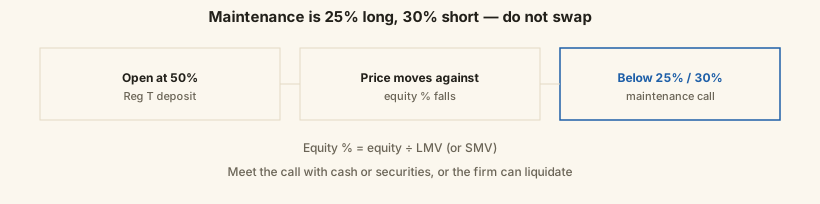
🔑 The two minimum maintenance percentages — DO NOT SWAP THESE
| Account type | Minimum maintenance requirement | Equity formula used |
|---|---|---|
| LONG margin account | 25% equity | Equity = LMV − Debit |
| SHORT margin account | 30% equity | Equity = Credit − SMV |
Long = 25%, Short = 30%. These are different numbers and are commonly swapped on the exam. Long is the LOWER number (25%); short is the HIGHER number (30%).
Equity percentage formula
🔑 To work with minimum maintenance, use the percentage form of the equity formula:
Equity % = Equity (in $) ÷ (LMV or SMV)
Worked example — basic equity percentage
An investor buys 200 shares at $30 per share and deposits the required initial margin.
Standard equity formula (in dollars):
$6,000 (LMV) − $3,000 (debit) = $3,000 (equity)
Equity as a percentage:
Equity % = $3,000 (equity) ÷ $6,000 (LMV) = 50%
That 50% makes sense: the investor owns $3,000 of a $6,000 position.
Minimum maintenance for LONG accounts
Market value changes will change the equity percentage.
Worked example — equity falling after a price drop
An investor purchases 200 shares of ABC stock at $300 and deposits the required margin. The market price then falls to $175. What is the equity amount in dollars and percent?
Start with the account at purchase:
$60,000 (LMV) − $30,000 (debit) = $30,000 (equity)
The investor buys $60,000 of stock (200 × $300). The initial margin deposit is 50% of the purchase price (or $2,000, whichever is greater). Here, 50% is greater, so the investor deposits $30,000 and borrows the other $30,000 (the debit).
Now update the LMV after the price drop to $175:
$35,000 (LMV) − $30,000 (debit) = $5,000 (equity)
- LMV falls to $35,000 (200 × $175).
- The debit stays at $30,000 because no loan repayment (or additional borrowing) occurred.
- Equity falls to $5,000.
Now compute the equity percentage:
Equity % = $5,000 (equity) ÷ $35,000 (LMV) = 14.3%
- At 14.3% equity, the account is close to being “underwater” (owing more than the account is worth). If the market keeps falling, the broker-dealer faces a higher risk of not being repaid. To limit that risk, FINRA sets minimum maintenance requirements.
The minimum maintenance for long accounts is 25% equity. If equity falls below 25%, the situation must be corrected.
🔑 Three ways to fix a LONG account below minimum maintenance
| Fix | Effect on the formula | Worked result (from the $35,000 LMV / $30,000 debit / $5,000 equity example at 14.3%) |
|---|---|---|
| Investor deposits more money | Cash is typically used to reduce the debit balance. Reducing the debit increases equity (in both dollars and percent). | Deposit $10,000 → $35,000 (LMV) − $20,000 (debit) = $15,000 (equity); Equity % = $15,000 ÷ $35,000 = 42.8% |
| Investor deposits “fully paid” stock | Transferring securities the investor already owns (often from another account) into the margin account. Increases LMV (market value / collateral). Debit doesn’t change. | Deposit $15,000 of fully paid stock → $50,000 (LMV) − $30,000 (debit) = $20,000 (equity); Equity % = $20,000 ÷ $50,000 = 40% |
| Securities are sold | Sale may be initiated by the customer or the broker-dealer. LMV falls; unless stated otherwise, sale proceeds reduce the debit. Dollar equity unchanged; percent rises. | Sell $25,000 of stock → $10,000 (LMV) − $5,000 (debit) = $5,000 (equity); Equity % = $5,000 ÷ $10,000 = 50% |
When the investor signs the margin agreement, the investor gives the broker-dealer the right to sell securities in the account (with or without notice) to protect the firm’s loan.
Buying or selling securities doesn’t change dollar equity by itself; it changes LMV and debit in offsetting ways. Only the percentage improves.
🔑 Market value at minimum maintenance — LONG accounts
Mkt value at min. maint. = Debit ÷ 0.75
Apply it (original purchase: $60,000 LMV − $30,000 debit = $30,000 equity):
Mkt value at min. maint. = $30,000 (debit) ÷ 0.75 = $40,000
So if LMV falls to $40,000, the account is exactly at 25% equity. Verify:
$40,000 (LMV) − $30,000 (debit) = $10,000 (equity)
Equity % = $10,000 (equity) ÷ $40,000 (LMV) = 25%
- This gives a quick way to estimate how far a long margin account can fall before action is required.
Sidenote — Restricted accounts
| Item | Detail |
|---|---|
| Trigger | Equity falls below 50% |
| Severity | Less severe than it sounds — just a rule change |
| Rule | Half of any sales proceeds must be used to pay down the debit balance |
| Contrast | In an unrestricted account, an investor could sell securities and withdraw the cash even with an outstanding debit balance. Once equity drops below 50%, that flexibility is limited by the restriction rule. |
Minimum maintenance for SHORT accounts
- The same basic idea applies to short accounts: minimum maintenance helps prevent the account from becoming undercollateralized. The key differences are the required percentage and how the account is structured.
Short accounts must maintain at least 30% equity (NOT 25% as in long accounts). If equity falls below 30%, the investor or broker-dealer must correct the deficiency.
Worked example — short account below maintenance
An investor has an already established margin account with a credit balance of $52,000 and a short market value of $20,000. The account value rises to $45,000. What is the equity amount (in $ and % form)?
Equity in dollars:
$52,000 (credit) − $45,000 (SMV) = $7,000 (equity)
Equity as a percentage:
Equity % = $7,000 (equity) ÷ $45,000 (SMV) = 15.5%
At 15.5%, the account is below the 30% minimum maintenance requirement. A short account becomes “underwater” if the SMV rises above the credit balance, because the cost to repurchase the shares would exceed the cash in the account.
🔑 Two ways to fix a SHORT account below minimum maintenance
| Fix | Effect on the formula | Worked result (from the $52,000 credit / $45,000 SMV / $7,000 equity example at 15.5%) |
|---|---|---|
| Investor deposits more money | A cash deposit increases the credit balance. SMV stays the same because the market value of the short position didn’t change. | Deposit $18,000 → $70,000 (credit) − $45,000 (SMV) = $25,000 (equity); Equity % = $25,000 ÷ $45,000 = 55.5% |
| Part or all of the short position is closed (repurchased) | Cash from the credit balance is used to repurchase, so credit falls; SMV falls because the short position is smaller. Dollar equity unchanged. May be done by the investor or the broker-dealer (the margin agreement gives them the right to do so). | Close $30,000 of the short position → $22,000 (credit) − $15,000 (SMV) = $7,000 (equity); Equity % = $7,000 ÷ $15,000 = 46.7% |
🔑 Market value at minimum maintenance — SHORT accounts
First, note that short account equity can exceed 100%:
Original setup: credit balance $52,000, short market value $20,000.
$52,000 (credit) − $20,000 (SMV) = $32,000 (equity)
Equity % = $32,000 (equity) ÷ $20,000 (SMV) = 160%
With short accounts, equity can exceed 100%.
Mkt value at min. maint. = Credit ÷ 1.3
Apply it:
Mkt value at min. maint. = $52,000 (credit) ÷ 1.3 = $40,000
So if SMV rises to $40,000, the account is exactly at 30% equity. Verify:
$52,000 (credit) − $40,000 (SMV) = $12,000 (equity)
Equity % = $12,000 (equity) ÷ $40,000 (SMV) = 30%
- This provides a quick way to estimate how far a short position can move against the investor before action is required.
Long vs short — side-by-side
| Item | Long account | Short account |
|---|---|---|
| Minimum maintenance | 25% equity | 30% equity |
| Equity formula | LMV − Debit = Equity | Credit − SMV = Equity |
| Market value at min. maint. | Debit ÷ 0.75 | Credit ÷ 1.3 |
| Danger direction | Market value falls | Market value rises |
| “Underwater” condition | Owing more than the account is worth | SMV rises above the credit balance |
| Fixes | (1) Deposit cash, (2) deposit fully paid stock, (3) sell securities | (1) Deposit cash, (2) repurchase (cover) part/all of the short position |
| Can equity % exceed 100%? | — | Yes |
Intraday margin standard for day traders
- Minimum maintenance also has a special standard for day trading in a margin account.
- 🔑 Under FINRA’s intraday margin standard (FINRA Rule 4210, effective June 4, 2026), a customer who day trades must maintain equity commensurate with their market exposure at any point during the trading day, not just at the close.
- If equity dips below what that exposure requires, the deficit must be satisfied promptly — such as by depositing funds or securities — rather than being given an extended grace period.
- Persistent failure to meet an intraday call can lead to account restrictions.
Sidenote — Pattern day trader (retired)
| Item | Retired PDT rule (before June 2026) |
|---|---|
| Trigger | A customer who made four or more day trades within five business days was labeled a pattern day trader |
| Equity requirement | Had to maintain at least $25,000 in equity |
| Buying power | Day-trading buying power capped at four times maintenance margin excess |
If you come across “pattern day trader” or a “$25,000 minimum” in older material, that’s this retired, account-level rule — the current standard ties the requirement to real-time intraday exposure instead.
Key points
Minimum maintenance overview
- Margin accounts use leverage: amplifies both gains and losses
- Minimum maintenance prevents accounts from becoming undercollateralized
- Protects broker-dealer from unpaid debt or unwanted short positions
Equity percentage formula
- Equity % = Equity (in $) ÷ (LMV or SMV)
- Long accounts: Equity = LMV − Debit
- Short accounts: Equity = Credit − SMV
Minimum maintenance for long accounts
- Requirement: 25% equity
- Below 25%, three fixes:
- Deposit more cash (reduces debit, raises equity)
- Deposit fully paid securities (raises LMV, raises equity)
- Sell securities (proceeds reduce debit; dollar equity unchanged, % rises)
- Formula for market value at minimum maintenance: Mkt value = Debit ÷ 0.75
Restricted accounts
- Triggered when equity falls below 50%
- Not as severe as it sounds — just a rule change
- Half of any sale proceeds must go toward reducing debit balance
Minimum maintenance for short accounts
- Requirement: 30% equity
- Account becomes “underwater” if SMV rises above credit balance
- Two fixes:
- Deposit more cash (raises credit balance, raises equity)
- Repurchase (cover) part/all of short position (dollar equity unchanged, % rises)
- Formula for market value at minimum maintenance: Mkt value = Credit ÷ 1.3
- Short account equity % can exceed 100%
Intraday margin standard for day traders (FINRA Rule 4210, eff. June 4, 2026)
- Day traders must maintain equity matching intraday market exposure, not just at close
- Deficiencies must be met promptly (no extended grace period)
- Persistent failures can lead to account restrictions
- Replaces old Pattern Day Trader (PDT) rule (retired): previously required $25,000 minimum equity if 4+ day trades in 5 business days, with buying power capped at 4x maintenance margin excess
Sources
Primary/official references for the material on this page. Every link was fetched and returned HTTP 200 on 2026-08-15.
| # | Source | Publisher |
|---|---|---|
| 1 | Rule 4210 — margin, minimum maintenance requirements | FINRA |
| 2 | Margin — borrowing to buy stock, maintenance calls | SEC |
| 3 | Regulation T — credit by brokers and dealers | eCFR (12 CFR Part 220) |
| 4 | Approval order replacing Rule 4210 day-trading margin (and the $25,000 pattern-day-trader minimum) with intraday margin standards | SEC (Federal Register, 17 Apr 2026) |
| 5 | Achievable Series 65 — chapter 2.9.6 | Achievable (course text) |