Index Crediting, Caps & Floors
Equity indexed annuities
Equity indexed annuities (EIAs) combine features of both variable and fixed annuities. Like a variable annuity, an EIA’s return is linked to an equity index such as the S&P 500. Like a fixed annuity, an EIA provides minimum guaranteed returns. EIAs generally aren’t considered securities because the investor doesn’t bear downside investment risk when the index declines.
🔑 EIA in the annuity family — master comparison
| Feature | Variable annuity | Fixed annuity | Equity indexed annuity (EIA) |
|---|---|---|---|
| Is it a SECURITY? | ⚠️ Yes | ⚠️ No | ⚠️ NO — “EIAs generally aren’t considered securities because the investor doesn’t bear downside investment risk when the index declines.” |
| Who bears investment (downside) risk | The investor | The insurance company | ⚠️ NOT the investor on the downside — investor doesn’t bear downside risk when the index declines |
| How the payout/credit is determined | Separate account performance vs. AIR | Guaranteed rate of return | Linked to an equity index (e.g. S&P 500), limited by participation rate / cap / spread rate, with a floor |
| Minimum guarantee | None | Guaranteed rate | Floor of at least 0%, sometimes higher (up to 3%) |
| Which features it borrows | — | — | Index linkage (like variable) + minimum guaranteed returns (like fixed) |
⚠️⚠️ WHICH ANNUITIES ARE SECURITIES — guaranteed exam question
| Annuity type | Security? |
|---|---|
| Variable annuity | ✅ IS a security |
| Fixed annuity | ❌ NOT a security |
| Equity indexed annuity (EIA) | ❌ NOT a security — “Not a security” (Key points) |
- Even though an EIA is linked to an index (during both the accumulation and distribution phases), the investor’s gains are limited.
🔑 The three ways insurers limit index-linked returns
Insurance companies typically limit index-linked returns in one of three ways:
- Participation rate
- Cap (ceiling)
- Spread rate (margin, asset fee)
| Term | Definition | Example |
|---|---|---|
| Participation rate | > An EIA with a participation rate credits only a portion of the index’s gain to the investor. | > For example, if the S&P 500 returns 10% and the EIA has an 80% participation rate, the annuity is credited with 8% (80% × 10%). |
| Cap (ceiling) | > An EIA with a cap (also called a ceiling) sets a maximum credited return. | > For example, with a 7% cap, the investor won’t be credited more than 7%, no matter how much the index increases. |
| Spread rate (margin, asset fee) | > An EIA with a spread rate (also called a margin or asset fee) subtracts a stated percentage from the index return. | > For example, if the index is up 12% and the spread rate is 3%, the annuity is credited with 9% (12% − 3%). |
| Floor | > A floor is the minimum growth rate guaranteed to the investor. | > A 0% floor means the investor won’t be credited with a negative return even if the linked index declines. |
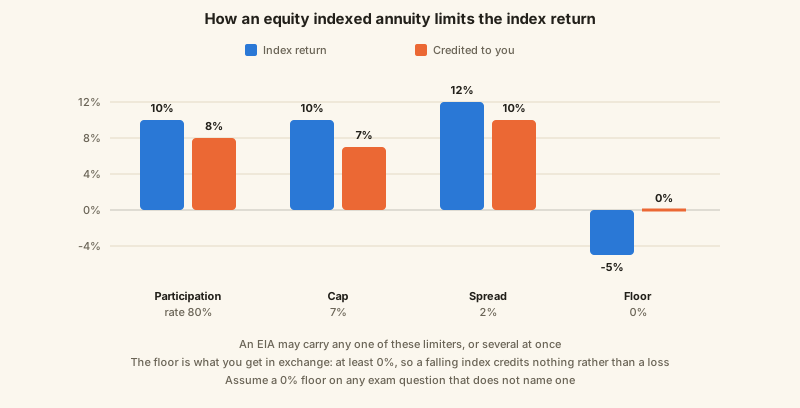
- ⚠️ An EIA may include any one of the above or a combination. For example, a participation rate and a cap may exist, but no spread rate. Or, a cap and spread rate exist, but no participation rate. Or, all three or just one. The combination of restrictions enforced depends on the contract between the investor and the insurance company.
Floors
In exchange for limiting index-linked gains, EIAs provide minimum growth guarantees. Specifically, EIAs include a floor of at least 0%*, and sometimes higher. A floor is the minimum growth rate guaranteed to the investor. A 0% floor means the investor won’t be credited with a negative return even if the linked index declines. Some EIAs offer floors as high as 3%, which can produce consistent positive credited returns. However, higher floors are usually paired with lower caps and participation rates and/or higher spread rates.
*Test questions may not specifically mention a floor. You should always assume a floor of 0% exists if a floor is not identified.
| Floor detail | Value |
|---|---|
| Minimum floor | At least 0% |
| Highest floor mentioned | As high as 3% |
| 📌 Exam assumption | ⚠️ “You should always assume a floor of 0% exists if a floor is not identified.” |
| Trade-off | Higher floors are usually paired with lower caps and participation rates and/or higher spread rates |
Worked example
An investor contributes to an equity-indexed annuity with an 80% participation rate, a 6% cap, and a 2% floor. The linked index returns a positive 9% over the period just before the contract is adjusted. What return is credited to the investor’s annuity? A) 5.0% B) 6.0% C) 7.2% D) 9.0%
Answer = 6.0% Start with the participation rate. The index returned 9%, so the initial credited return is 7.2% (9% × 80%). Next, check the cap and the floor:
- The cap is the maximum credited return. Since 7.2% is above the 6% cap, the credit is limited to 6%.
- The floor is the minimum credited return. Since 6% is above the 2% floor, the floor doesn’t change the result.
Bottom line: the investor is credited 6%.
| Step | Value |
|---|---|
| Index return | 9% |
| Participation rate 80% | 9% × 80% = 7.2% |
| Cap 6% | 7.2% is above the cap → limited to 6% |
| Floor 2% | 6% is above the floor → no change |
| Credited return | 6.0% |
🔑 Index crediting methods
How the insurance company measures the index return is another key contract feature. For example, does the contract measure returns from January 1 to December 31 and credit annually? Or does it use the highest or lowest index value during the period? The most common index crediting methods are:
- Annual reset
- Point-to-point
- High water mark
- Low water mark
| Method | Definition | Worked example (index starts at 4,000 on July 1, 2025) | Computed gain |
|---|---|---|---|
| Annual reset | > the insurer compares the index value at the start of the period to the index value one year later (typically measured on the contract anniversary) | On July 1, 2026 the index is 4,400. The 400-point increase | 10% (400 / 4,000) |
| Point-to-point | > works like annual reset, but the two measurement dates don’t have to be one year apart. The period could be as short as a month or as long as several years. | The index change between those two points is calculated | Varies |
| High water mark | > compares the starting index value (often the contract anniversary value) to the highest index value reached during a specified period (usually one year) | On July 1, 2026 the index is 4,400, but the index reached 4,600 in March 2026. The insurer uses 4,600 (the highest value) instead of 4,400. The 600-point increase | 15% (600 / 4,000) |
| Low water mark | > essentially the inverse of high water mark. It compares the lowest index value during the period to the ending index value. | On July 1, 2026 the index is 4,400, but the index fell to 3,500 in November 2025. The insurer uses 3,500 (the lowest value) instead of 4,000. The change from 3,500 to 4,400 is 900 points | 25.7% (900 / 3,500) |
- 📌 In every method: “Then any participation rate, cap, floor, and/or spread rate is applied.”
More examples
Annual reset — Suppose the contract starts on October 1, 2025 when the index is 5,000. On October 1, 2026 the index is 5,350. The 350-point increase is a 7% gain (350 / 5,000). After that, any participation rate, cap, floor, and/or spread rate is applied.
High water mark — Suppose the contract starts on October 1, 2025 when the index is 5,000. On October 1, 2026 the index is 5,350, but it peaked at 5,800 in February 2026. Under high water mark, the insurer uses 5,800 (the highest value) instead of 5,350 (the ending value). The 800-point increase is a 16% gain (800 / 5,000). Then any participation rate, cap, floor, and/or spread rate is applied.
Low water mark — Suppose the contract starts on October 1, 2025 when the index is 5,000. On October 1, 2026 the index is 5,350, but it fell to 4,200 in December 2025. Under low water mark, the insurer uses 4,200 (the lowest value) instead of 5,000 (the starting value). The change from 4,200 to 5,350 is 1,150 points, a 27.4% gain (1,150 / 4,200). Then any participation rate, cap, floor, and/or spread rate is applied.
Sidenote — Surrender charges
Annuities of all kinds are known for surrender charges, which are fees assessed if an investor withdraws funds before a specified period ends. For example, an investor begins contributing to a variable annuity at age 40 with a goal of annuitizing at age 65. They run into financial troubles at age 42 and request a withdrawal of half their contributions. In a scenario like this, insurance companies may impose surrender charges as high as 10%. The investor may also owe taxes and early withdrawal penalties on any gains.
In most circumstances, insurance companies impose surrender periods of at least 6 years, and often 10 years or more.
🔑 Surrender charge / surrender period facts (EXACT)
| Item | Value |
|---|---|
| Definition | “fees assessed if an investor withdraws funds before a specified period ends” |
| Maximum charge cited | ⚠️ As high as 10% |
| Surrender period | ⚠️ At least 6 years, and often 10 years or more |
| Applies to | Annuities of all kinds |
| Additional costs | “The investor may also owe taxes and early withdrawal penalties on any gains.” |
The figures above are the maximum charge (10%) and the minimum surrender period (6 years, often 10 or more).
Key points
Equity indexed annuity (EIA)
- Annuity with both variable and fixed features
- Returns are linked to an equity index (e.g. S&P 500)
- Returns are guaranteed at a minimum level even if the index declines
- Not a security
EIA features
- Participation rate
- Percent of index returns credited to the investor
- Cap (ceiling)
- Maximum return granted regardless of index gains
- Floor
- Minimum return granted regardless of index declines
- Spread rate (margin, asset fee)
- Fees deducted from index returns
EIA crediting methods
- Annual reset
- Beginning value vs. end value after 1 year
- Typically reset at the anniversary of EIA contract signing
- Point-to-point
- Beginning value vs. end value
- Points may vary (monthly, annual, every few years)
- High water mark
- Beginning value vs. highest index value over a specified period
- Low water mark
- Low index value vs. ending value over a specified period
Surrender charges
- Fees assessed if withdrawing funds prior to surrender period elapsing
Sources
Primary/official references for the material on this page. Every link was fetched and returned HTTP 200 on 2026-08-15.
| # | Source | Publisher |
|---|---|---|
| 1 | Indexed annuities — participation rate, cap, floor | SEC / Investor.gov |
| 2 | Annuities — fixed, variable, indexed | SEC / Investor.gov |
| 3 | Pub 575 — pension and annuity income, exclusion ratio | IRS |
| 4 | Achievable Series 65 — chapter 1.6.2 | Achievable (course text) |