Protective Puts & Protective Calls
🔑 Master hedge table
A hedging strategy protects a stock position by adding a long option.
| Hedge | Underlying position being hedged | What it protects against | Cost | What it caps |
|---|---|---|---|---|
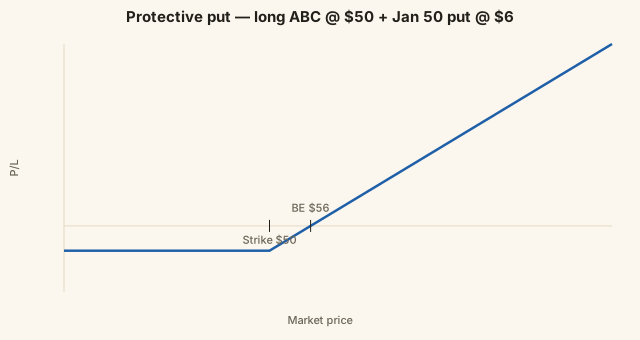
| Protective put (long stock & long put) | Long 100 shares of ABC @ $50 | The stock price declining, especially a sharp drop | The put premium — $600 ($6 × 100 shares) | Caps the loss at the premium ($600 max loss); the investor can liquidate at the $50 strike no matter how far the price drops. Upside remains unlimited, but the premium reduces stock profit (breakeven $56). |
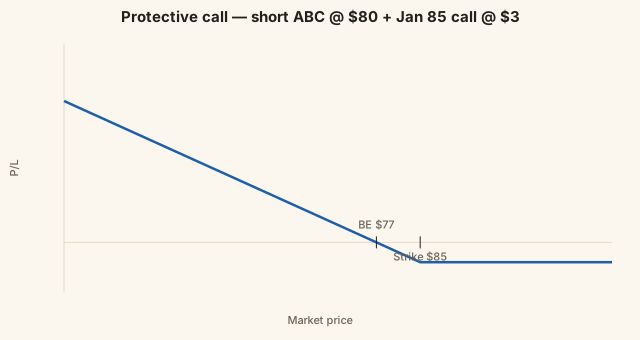
| Protective call (short stock & long call) | Short 100 shares of ABC @ $80 | The stock price rising — a short stock position otherwise has unlimited loss potential | The call premium — $300 ($3 × 100 shares) | Caps the worst-case loss at $800 in the page’s example; the investor can buy back at the $85 strike no matter how high the price goes. Gain is capped at the stock falling to $0 (max gain $7,700); premium reduces profit (breakeven $77). |
| Covered call | — | — | — | ⚠️ Not covered on this page. This chapter names only the two long-option hedges above. (Short calls covered by long shares are addressed in the short calls chapter.) |
| Collar | — | — | — | ⚠️ Not covered on this page. |
📌 The page’s own summary of the two strategies:
| Strategy | Positions | Market sentiment | Role of the option |
|---|---|---|---|
| Long stock hedge | Long stock & long put | Bullish | Put shields long stock from risk |
| Short stock hedge | Short shares & long call | Bearish | Call shields short stock from risk |
Definitions
| Term | Definition |
|---|---|
| Hedge | Any product, investment, or strategy used to reduce or mitigate risk |
In the securities industry, a hedge is anything you use to reduce risk in another position.
The page offers “a quick video introduction to this type of option strategy.”
Long stock with a long put hedge
A key risk for an investor with a long stock position is that the stock price declines, especially if it drops sharply. A long put options contract is a common hedge against this risk.
A long put gives you the right to sell the stock at a fixed price (the strike price), no matter how low the market price goes. The positions held:
- Long 100 shares of ABC stock @ $50
- Long 1 ABC Jan 50 put @ 6
The put costs $600 (a $6 premium × 100 shares). That premium is the cost of the insurance. In return, the contract gives the investor the right to sell ABC at $50 even if the stock falls far below $50. If the stock fell to $0, the investor could still exercise the put and sell at $50.
When you use a put as a hedge, the goal usually isn’t to exercise it. That can feel backwards if you’re thinking about options as profit-seeking trades, where a long option’s maximum loss is the premium paid if it expires worthless.
Here, the put’s job is protection. It’s like car insurance: you don’t buy it because you want to file a claim - you buy it so a bad outcome doesn’t become financially devastating. The investor still wants ABC to rise. The put is there to limit losses if ABC falls below $50.
Worked example 1 — ABC falls to $20
An investor purchases 100 shares of ABC stock at $50 and goes long 1 ABC Jan 50 put at $6. What is the gain or loss if ABC’s market price falls to $20 and the investor takes the most financially prudent action?
Answer = $600 loss
Action Result Buy shares -$5,000 Buy put -$600 Exercise - sell shares +$5,000 Total -$600 Because the market price ($20) is below the strike price ($50), the put is in the money (“put down”). The most financially prudent action is to exercise the put and sell the shares at $50, avoiding a much larger loss.
- Without the put, the stock loss would be $30 per share ($50 − $20), or $3,000.
- With the put, the investor sells at $50, so the stock purchase and sale price are a wash.
- The remaining loss is the put premium: $6 × 100 = $600.
This $600 is the investor’s maximum loss in this hedged position. Once the stock falls below $50, the investor can still liquidate at $50, no matter how far the market price drops.
Worked example 2 — ABC rises to $56 (breakeven)
An investor buys 100 shares of ABC stock at $50 and goes long 1 ABC Jan 50 put at $6. What is the gain or loss if ABC’s market price rises to $56?
Answer = $0 (breakeven)
Action Result Buy shares -$5,000 Buy put -$600 Sell value +$5,600 Total $0 Because the market price ($56) is above the strike price ($50), the put is out of the money and expires worthless. The shares are worth $56, creating a $6 per share gain ($600 total). That $600 stock gain is offset by the $600 premium paid for the put.
Even though the investor didn’t need the protection, the hedge still had a cost. Because of the premium, the stock must rise above $56 for the overall position to show a profit.
Worked example 3 — ABC rises to $90
An investor buys 100 shares of ABC stock at $50 and goes long 1 ABC Jan 50 put at $6. What is the gain or loss if ABC’s market price rises to $90?
Answer = $3,400 gain
Action Result Buy shares -$5,000 Buy put -$600 Share value +$9,000 Total +$3,400 Because the market price ($90) is above the strike price ($50), the put is out of the money and expires worthless. The shares are worth $90, creating a $40 per share gain ($4,000 total). Subtract the $600 premium, and the net gain is $3,400.
🔑 The trade-off in a protective put:
- The put premium reduces the stock profit.
- The upside is still unlimited because the stock can keep rising.
Short stock with a long call hedge
Investors with short stock positions often need a hedge even more than investors with long stock positions. A short seller borrows securities and sells them immediately. They hope the market price falls so they can repurchase the security at a lower price.
If the market price rises instead, the repurchase price is higher, which creates losses. Because there’s no ceiling on how high a stock can rise, short sellers face unlimited risk. (The text points to the short sales chapter for more on this type of transaction.)
A common hedge for a short stock position is a long call options contract, which gives the right to buy the stock at a fixed price. The positions held:
- Short 100 shares of ABC stock @ 80
- Long 1 ABC Jan 85 call @ $3
The call costs $300 ($3 × 100 shares). Without the call, the short stock position has unlimited loss potential. By buying the call, the investor caps the worst-case outcome.
Why the strike ($85) is higher than the short sale price ($80): Investors can choose among many strike prices. An $80 call would let the investor buy back at $80, but it would also cost more (a higher premium) than an $85 call. Choosing the $85 strike is a way to reduce the premium, while still limiting the most extreme losses.
In this strategy, the short stock position is still the main trade. The investor wants ABC to fall so they can buy back at a lower price and profit. The call is there for protection. The call is exercised only if the market price rises above the strike price (“call up”), allowing the investor to buy back at $85 in the worst-case scenario.
Worked example 1 — ABC falls to $50
An investor sells short 100 shares of ABC stock at $80 and goes long 1 ABC Jan 85 call at $3. What is the gain or loss if ABC’s market price falls to $50?
Answer = $2,700 gain
Action Result Sell short shares +8,000 Buy call -$300 Share buyback cost -$5,000 Total +$2,700 Because the market price ($50) is below the strike price ($85), the call is out of the money and expires worthless. The investor buys back the shares at $50, locking in a $30 per share gain ($3,000 total). Subtract the $300 premium, and the net gain is $2,700.
This example shows the gain potential of the strategy. The call premium reduces the profit, but the investor still benefits as the stock falls. If the market price fell to $0, the investor would realize their maximum gain ($7,700 in this example).
Worked example 2 — ABC falls to $77 (breakeven)
An investor sells short 100 shares of ABC stock at $80 and goes long 1 ABC Jan 85 call at $3. What is the gain or loss if ABC’s market price falls to $77?
Answer = $0 (breakeven)
Action Result Sell short shares +8,000 Buy call -$300 Buy back shares -$7,700 Total $0 Because the market price ($77) is below the strike price ($85), the call is out of the money and expires worthless. The investor gains $3 per share on the short stock ($300 total), which is exactly offset by the $300 premium.
The hedge wasn’t needed here, but it still had a cost. Because of the premium, the stock must fall below $77 for the overall position to show a profit.
Worked example 3 — ABC rises to $100 (maximum loss)
An investor sells short 100 shares of ABC stock at $80 and goes long 1 ABC Jan 85 call at $3. What is the gain or loss if ABC’s market price rises to $100 and the investor takes the most financially prudent action?
Answer = $800 loss
Action Result Sell short shares +8,000 Buy call -$300 Exercise - buy back shares -$8,500 Total -$800 Because the market price ($100) is above the strike price ($85), the call is in the money (“call up”). The most financially prudent action is to exercise the call and buy back the shares at $85 to avoid a larger loss.
- The short sale was at $80 and the buyback is at $85, creating a $5 per share loss ($500 total).
- Add the $300 premium, and the total loss is $800.
This is the investor’s maximum loss in this hedged position. Once the stock rises above $85, the investor can still buy back at $85, no matter how high the market price goes.
Key points
Hedging strategies
- Long option with a stock position
- Long option protects stock from risk
Long stock hedge
- Long stock & long put
- Market sentiment: bullish
- Put shields long stock from risk
Short stock hedge
- Short shares & long call
- Market sentiment: bearish
- Call shields short stock from risk
Sources
Primary/official references for the material on this page. Every link was fetched and returned HTTP 200 on 2026-08-15.
| # | Source | Publisher |
|---|---|---|
| 1 | Strategy catalogue — payoff, breakeven and risk for each | OCC / Options Industry Council |
| 2 | Covered call (buy/write) — income against a long stock position | OCC / Options Industry Council |
| 3 | Rule 2111 — suitability, reasonable-basis/customer-specific/quantitative | FINRA |
| 4 | Achievable Series 65 — chapter 1.4.1.10 | Achievable (course text) |