Earned, Investment & Passive Income
🔑 Numbers, ages & limits
| Item | Exact figure | Notes |
|---|---|---|
| Net capital loss deduction against earned income | 🔑 Up to $3,000 per year | Deducted in the current year |
| Carryforward of unused net capital loss | Unused portion carries forward (“rolls over”) to future years, with no stated expiration | Can offset future capital gains |
| Qualified dividend tax rates | 0%, 15%, or 20% | Lower rates |
| Non-qualified dividend tax rates | Ordinary income rates, up to 37% | — |
| Interest tax rate | Investor’s ordinary income tax bracket | Generally |
| Long-term capital gain tax rates | 0%, 15%, or 20% | — |
| Short-term capital gain tax rates | Up to 37% | — |
| Passive income tax rate | Same as ordinary income tax rates | Tracked separately |
| ⚠️ Passive loss offset rule | Passive losses can only offset passive gains | Cannot offset earned or portfolio income |
| AMT origin | Treasury Secretary Joseph Barr announced 155 high-income households paid no federal income taxes in the 1960s; Congress passed the Tax Reform Act of 1969 | Created the AMT |
| AMT payment rule | Taxpayer pays the higher of the two calculations | Standard vs. AMT |
Overview
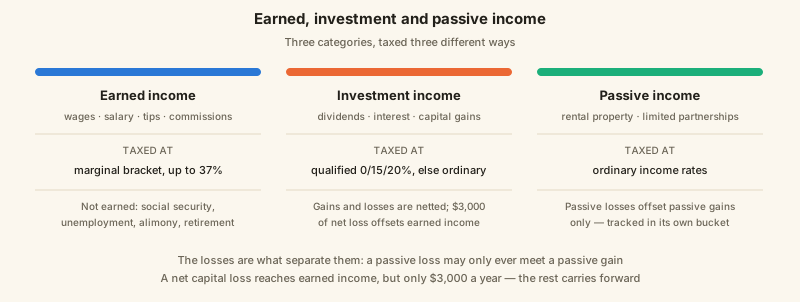
There are three basic categories of income a person can receive, and each is taxed differently. For tax purposes, it’s important to know how the Internal Revenue Service (IRS) classifies each type.
⚠️ Earned vs. passive vs. portfolio (investment) income
| Type | What it is | Sources | Tax treatment | Special rules |
|---|---|---|---|---|
| Earned income | Money you receive from working at a job or running a business as a self-employed person | Wages, salaries, tips, bonuses, commissions | Taxed using the taxpayer’s marginal tax bracket (progressive system — higher income taxed at higher rates) | NOT earned income: social security, unemployment benefits, alimony, child support, retirement benefits |
| Investment income (portfolio income) | Money you receive from investments | Dividends, interest, capital gains | Qualified dividends: 0%, 15%, 20%. Non-qualified dividends: ordinary rates up to 37%. Interest: ordinary income tax bracket. Capital gains: long-term 0%/15%/20%, short-term up to 37% | Realized gains and losses are netted; up to $3,000 of annual net capital losses deductible against earned income, remainder carries forward |
| Passive income | Income from a business you don’t manage or actively control | Rental real estate properties, limited partnerships | Same as ordinary income tax rates | ⚠️ Passive losses can only offset passive gains — tracked in its own category |
Earned income
Money you receive from working at a job or running a business as a self-employed person is earned income. This includes:
| Earned income includes |
|---|
| Wages |
| Salaries |
| Tips |
| Bonuses |
| Commissions |
Earned income is taxed using the taxpayer’s marginal tax bracket. The U.S. income tax system is progressive, meaning higher levels of income are taxed at higher rates.
⚠️ The IRS does not treat the following as earned income:
| NOT earned income |
|---|
| Social security |
| Unemployment benefits |
| Alimony |
| Child support |
| Retirement benefits |
Investment income
Money you receive from investments is investment income, also called portfolio income. Even though investments can generate returns in many ways, investment income is usually grouped into three forms:
- Dividends
- Interest
- Capital gains
Interest and dividends are taxed as we discussed previously:
| Income form | Tax treatment |
|---|---|
| Qualified dividends | Taxed at lower rates (0%, 15%, or 20%) |
| Non-qualified dividends | Taxed at ordinary income rates (up to 37%) |
| Interest | Generally taxed at the investor’s ordinary income tax bracket |
For capital gains, investors net realized gains and losses to determine whether they have a taxable gain or a deductible loss.
Example 1 — net capital gain
| Date | Transaction |
|---|---|
| January 30th | Sold ABC stock for a $2,000 capital gain |
| March 15th | Sold BCD stock for a $5,000 capital gain |
| July 10th | Sold CDE stock for $3,000 capital loss |
If these are the only trades for the year, the investor has a $4,000 net capital gain ($2,000 + $5,000 − $3,000). The investor owes tax on the net gain. The tax rate depends on whether the gains are:
- Long-term (0%, 15%, or 20%), or
- Short-term (up to 37%).
Example 2 — net capital loss
Use the same figures, but change the July 10th trade:
| Date | Transaction |
|---|---|
| January 30th | Sold ABC stock for $2,000 capital gain |
| March 15th | Sold BCD stock for $5,000 capital gain |
| July 10th | Sold CDE stock for $20,000 capital loss |
Now the investor has a $13,000 net capital loss ($2,000 + $5,000 − $20,000).
A net capital loss can reduce taxes. If an investor has a net capital loss, they can deduct up to $3,000 of that loss against earned income in the current year. For example, if the investor earned $100,000 from their job, they could deduct $3,000 and reduce taxable income to $97,000. That deduction lowers the tax owed.
In this example, $10,000 of the $13,000 net capital loss remains. Any unused portion carries forward (or “rolls over”) to future years. That carryforward can offset future capital gains. For instance, the investor could realize $10,000 of capital gains the next year and owe no capital gains tax on those gains because the $10,000 carried-forward loss offsets them.
Capital loss deduction & carryforward — summary
| Rule | Exact treatment |
|---|---|
| Netting | Net all realized capital gains against realized capital losses for the year |
| Annual deduction limit against earned income | $3,000 of net capital loss |
| Remaining (unused) loss | Carries forward / “rolls over” to future years |
| Use of carryforward | Offsets future capital gains |
Passive income
Income from a business you don’t manage or actively control is passive income. Passive income commonly comes from:
| Common sources of passive income |
|---|
| Rental real estate properties |
| Limited partnerships |
Passive income tax rates are the same as ordinary income tax rates, but passive income is tracked separately for an important reason: ⚠️ passive losses can only offset passive gains.
The IRS keeps passive income in its own category to limit the ability of high-income taxpayers to use passive losses to reduce taxes on other income. As discussed in the DPP chapter, limited partnerships can pass through losses to investors, and many businesses generate significant losses in their early years. If passive losses could offset earned or portfolio income without restriction, investors could use large limited partnership losses to reduce (or eliminate) taxes on wages, interest, dividends, and other income.
Sidenote — Alternative minimum tax (AMT)
For decades, ensuring wealthy citizens pay their “fair share” has been a challenge for policymakers. In the 1960s, Treasury Secretary Joseph Barr catalyzed a legislative movement when he announced 155 high-income households had paid no federal income taxes. This prompted Congress to pass the Tax Reform Act of 1969, which is responsible for creating the alternative minimum tax (AMT) system we still use today (although it has evolved).
Under the current system, some higher-income taxpayers must compute taxes two ways:
| Calculation | Description |
|---|---|
| Standard tax calculation | The system used by all Americans, which applies income and then reduces it using various deductions |
| AMT calculation | Similar but removes certain tax benefits |
Taxpayers subject to AMT may have:
| Tax preference item | Detail |
|---|---|
| Fewer deductions related to limited partnership investments | — |
| Incentive stock option (ISO) taxation at exercise* | *While ISOs are generally not taxable at exercise, taxpayers subject to AMT may pay taxes based on the intrinsic value (difference between the stock’s market price and strike price) at exercise. |
| Taxable interest on municipal private activity bonds** | **Municipalities issue private activity bonds to finance private (non-government) projects. For example, a private activity bond is issued by a city to fund the expansion of an airport terminal on behalf of a corporate airliner. While municipal bonds are typically tax-free, private activity bond interest may be taxable for investors subject to AMT. |
The items listed above are referred to as tax preference items. 🔑 Once both calculations are performed, the taxpayer must pay the higher of the two tax calculations.
Key points
Earned income
- Income from employment
- Includes wages, salaries, tips, bonuses, and commissions
- Taxable at the marginal income brackets
Investment income
- Income from securities
- Includes interest, dividends, and capital gains
- Up to $3,000 of annual net capital losses are deductible against earned income
Passive income
- Income from rental property and limited partnerships
- Passive losses only offset passive gains
Alternative minimum tax (AMT)
- Separate tax calculation for wealthier Americans
- Standard and AMT calculations required
- Taxpayer pays the higher of the two
- Removes tax benefits known as tax preference items
- Tax preference items include:
- Some limited partnership deductions
- ISO intrinsic value at exercise
- Private activity bond interest
Sources
Primary/official references for the material on this page. Every link was fetched and returned HTTP 200 on 2026-08-15.
| # | Source | Publisher |
|---|---|---|
| 1 | Pub 525 — taxable/nontaxable income, ISOs and NQSOs | IRS |
| 2 | Topic 409 — capital gains and losses, holding period, $3,000 limit | IRS |
| 3 | Pub 550 — investment income, wash sales, muni interest, OID | IRS |
| 4 | Achievable Series 65 — chapter 2.5.3 | Achievable (course text) |