Market, Inflation & Interest Rate Risk
⚠️ Category orientation — read first
This chapter covers SYSTEMATIC risk (the market-wide category), not non-systematic risk.
🔑 The two categories defined:
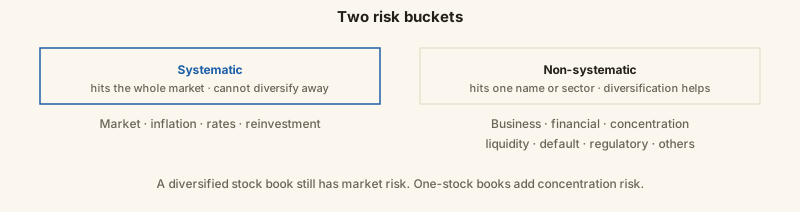
Systematic risks occur when a market-wide circumstance or event may cause investment losses. In general, all securities in a market are exposed to systematic risk.
Non-systematic risks occur when a circumstance or event affects a specific security or a small sector of the market and may cause investment losses. This risk tends to apply on a security-by-security basis.
Does diversification eliminate systematic risk? ⚠️ No. All securities in a market are exposed to systematic risk, so holding more securities within that market does not remove the exposure. The hedges for systematic risks are specific ones (index options, defensive stocks, precious metals, real estate, TIPS, common stock, money markets, zero coupon bonds). Non-systematic risks, by contrast, can be reduced through diversification.
Context: “We’ve already covered investment risks across multiple chapters. This chapter is meant to be a high-level review of those risks, with links to more detailed explanations.”
🔑 The four systematic risks
There are four systematic risks to be aware of:
- Market risk
- Purchasing power (inflation) risk
- Interest rate risk
- Reinvestment risk
Complete systematic risk table
| Risk | Definition (word-for-word) | Applies to | Ways to hedge |
|---|---|---|---|
| Market risk | “An economic or geopolitical event (for example, wars or changes in international relations) that causes a broad decline in stock values.” | Common stock; Rights; Warrants; Bullish options (long calls and short puts); Convertible preferred stock; Convertible bonds | Index options; Defensive stocks; Precious metals; Real estate |
| Purchasing power (inflation) risk | “Prices across the economy rise, which reduces the purchasing power of money.” | Debt securities; Preferred stock; Fixed annuities | Common stock; Treasury inflation-protected securities (TIPS); Precious metals; Real estate |
| Interest rate risk | “The market value of fixed-income securities declines when interest rates rise.” | Debt securities; Preferred stock | Common stock; Money markets |
| Reinvestment risk | “Interest rates fall, and income must be reinvested into new securities with lower yields.” | Debt securities; Preferred stock | Zero coupon bonds; Common stock |
Market risk
An economic or geopolitical event (for example, wars or changes in international relations) that causes a broad decline in stock values.
Applies to
-
Common stock
-
Rights
-
Warrants
-
Bullish options (long calls and short puts)
-
Convertible preferred stock
-
Convertible bonds
-
🔑 Market risk is primarily a common stock risk. It can also apply to any security that is exercisable or convertible into common stock. Rights, warrants, bullish options, and convertible securities all have a return component tied to common stock values. When stock values fall, the value of these securities typically falls as well.
-
⚠️ For convertible securities, only the conversion feature is subject to market risk. If market risk is present, it can reduce the security’s conversion value. The security’s other primary function (the income it produces) is not generally affected by market risk.
Ways to hedge
| Hedge | Why it works |
|---|---|
| Index options | Long index put options are often used to hedge market risk. If the overall market declines, index puts tend to gain value. Those gains can help offset losses in a stock portfolio |
| Defensive stocks | Issued by companies that tend to maintain a large portion of their revenue during economic downturns (a common driver of market risk) |
| Precious metals | Often have an inverse relationship with the stock market — if the market declines, these assets may rise in value, helping offset stock losses in a portfolio |
| Real estate | Same inverse-relationship logic as precious metals |
🔑 Defensive industries
| Defensive industry | Note |
|---|---|
| Basic food & clothing items | May be referred to as consumer staples |
| Pharmaceuticals (medication) | — |
| Utilities (electricity, water, etc.) | — |
| Alcohol and tobacco products | — |
Purchasing power (inflation) risk
Prices across the economy rise, which reduces the purchasing power of money.
Applies to
-
Debt securities
-
Preferred stock
-
Fixed annuities
-
Many investors — especially those near or in retirement — hold significant amounts of fixed-income securities. These investments often have lower overall risk, but inflation can erode their value. If a bond continues paying the same dollar amount while prices rise, that income buys less over time.
-
⚠️ In general, higher inflation leads to larger declines in the value of fixed-income securities, and long-term fixed-income securities are typically affected the most.
Ways to hedge
| Hedge | Why it works |
|---|---|
| Common stock | The stock market has historically outperformed inflation over long periods of time. Between 2006 and 2024, the S&P 500 outperformed the inflation rate 15 out of 19 years. ⚠️ Even so, inflation can still disrupt the stock market in the short term |
| Treasury inflation-protected securities (TIPS) | 🔑 TIPS are the only long-term debt security that does not face inflation risk. As inflation rises, the interest payments rise as well. ⚠️ Remember: the par value of TIPS is adjusted every six months, while the coupon stays fixed |
| Precious metals | Tend to have a positive relationship with inflation — when inflation rises, values often rise too |
| Real estate | Same positive relationship with inflation; recent real estate markets provide a clear example of this pattern |
Interest rate risk
The market value of fixed-income securities declines when interest rates rise.
Applies to
-
Debt securities
-
Preferred stock
-
🔑 Keep the core relationship in mind: interest rates up → fixed-income values down.
-
This risk is directly tied to price volatility and duration, and it’s most significant for long-term securities with low coupons.
Ways to hedge
| Hedge | Why it works |
|---|---|
| Common stock | When interest rates rise, borrowing becomes more expensive across the economy. That affects governments, businesses, and individuals, and profits can decline when financing costs increase. Similar to inflation’s short-term impact on stocks, rising interest rates can also contribute to short-term market declines. However, markets often recover after rate increases by the Federal Reserve. Some analysts also argue that rising rates benefit common stocks |
| Money markets | Money markets (debt securities with one year or less to maturity) tend to have low interest rate risk. Their short maturities mean proceeds can be reinvested relatively quickly at the new, higher interest rates |
Reinvestment risk
Interest rates fall, and income must be reinvested into new securities with lower yields.
Applies to
-
Debt securities
-
Preferred stock
-
⚠️ Income-producing securities with high coupons and frequent payments are the most susceptible to reinvestment risk. The logic is straightforward: the more income you receive, the more you may need to reinvest (if you don’t need the cash). The more you reinvest, the more exposure you have to reinvestment risk.
-
Most income-producing securities pay semiannually, but securities such as mortgage-backed securities that pay monthly are especially exposed.
Ways to hedge
| Hedge | Why it works |
|---|---|
| Zero coupon bonds | Not subject to reinvestment risk because they do not pay periodic income. Securities like STRIPS and Treasury receipts, which are long-term zero coupon bonds, pay no income over long periods. With no income to reinvest, reinvestment risk does not apply |
| Common stock | Common stock that does not pay dividends is similarly not subject to reinvestment risk. ⚠️ Dividend-paying stocks could be exposed to small levels of reinvestment risk, but dividend rates on common stock tend to have a loose correlation with interest rate changes. As a result, falling interest rates do not necessarily mean falling dividend rates on common stock |
Key points
Systematic risks
- Affect entire market or broad segments
- Four main types: market, purchasing power (inflation), interest rate, reinvestment risk
Market risk
- Broad economic/geopolitical events cause stock value declines
- Primarily affects common stock, rights, warrants, bullish options, convertible securities (conversion feature only)
- Hedged by: index options, defensive stocks (consumer staples, pharma, utilities, alcohol/tobacco), precious metals, real estate
Purchasing power (inflation) risk
- Rising prices erode money’s buying power
- Affects debt securities, preferred stock, fixed annuities (especially long-term)
- Hedged by: common stock, TIPS (inflation-adjusted), precious metals, real estate
Interest rate risk
- Fixed-income security values fall as interest rates rise
- Applies to debt securities, preferred stock (especially long-term, low coupon)
- Hedged by: common stock, money market securities (short maturities)
Reinvestment risk
- Falling interest rates force reinvestment at lower yields
- Affects high-coupon, frequent-payment debt and preferred stock (e.g., mortgage-backed securities)
- Hedged by: zero coupon bonds (no periodic income), non-dividend common stock
Sources
Primary/official references for the material on this page. Every link was fetched and returned HTTP 200 on 2026-08-15.
| # | Source | Publisher |
|---|---|---|
| 1 | Markowitz/Sharpe — portfolio theory and CAPM, the source work | Nobel Prize |
| 2 | Interest-rate risk — bond prices fall when rates rise, duration | SEC |
| 3 | Consumer Price Index — construction and release | BLS |
| 4 | Achievable Series 65 — chapter 3.5 | Achievable (course text) |