Common Stock Risk & Investor Profile
Overview: BRTI
- Suitability refers to the risks and benefits of an investment, and it helps determine whether an investment is appropriate for a particular investor.
- 📌 This unit dedicates a significant portion of the exam to suitability-based questions.
- 🔑 As you cover different investments, understand the BRTI of each product:
| Letter | Stands for |
|---|---|
| B | Benefits |
| R | Risks |
| TI | Typical investor |
- Once you understand these three areas for each investment product, you can make suitable recommendations on the exam and in real-world scenarios.
- This section covers the BRTI of common stock.
Benefits
🔑 Generally speaking, there are three benefits associated with common stock:
- Capital appreciation
- Dividend income
- Hedge against inflation
Capital appreciation
- Capital appreciation, also known as growth or a capital gain, occurs when an investment’s value rises above its original purchase price.
For example, a stock purchased at $50 and sold at $75 results in a $25 capital gain.
- Because there’s no ceiling on how high a stock’s price can rise, common stock has unlimited gain potential. The higher the market climbs, the more the investor gains.
- Capital appreciation is the most common form of return from a common stock investment.
- Gains are unrealized until the investment is sold. Stock prices can fluctuate significantly.
For example, consider the stock market’s performance in the early stages of COVID-19 in the United States. The S&P 500 was down 12.5% in March 2020, then rebounded and increased by 12.6% in April 2020. For context, the S&P averages around a 10% return annually. In other words, the market moved about a year’s worth of “typical” performance in a single month.
- ⚠️ The key point is that investors must sell a security to “lock in” capital gains. Once the investment is sold, the gain becomes a realized gain. Until then, the gain can disappear if the market declines.
| Term | Definition | Example |
|---|---|---|
| Unrealized capital gain | Current gain on an investment that has not been sold; gains at risk if the market declines | Stock bought at $50, now worth $75, still held |
| Realized capital gain | Locked-in gain; the investment has been sold, so gains are not at risk | Stock bought at $50 and sold at $75 → $25 realized gain |
Growth stocks
- Growth stocks are most likely to provide capital appreciation. These are stocks of companies focused on growing business revenue, typically at a faster rate than the overall economy.
- Many companies begin as growth companies as they expand operations and revenue. While not necessarily considered growth companies today, companies like McDonald’s, Walmart, and Home Depot were growth companies in their early stages. Today, they’re large companies that are likely beyond their most significant growth phase.
- Some large, well-established companies are still considered growth companies. While Amazon is wide-reaching and well-established, the company continues expanding its business operations and entering new industries. Amazon uses business profits to expand through mass hiring, acquisitions, and ongoing improvements to current operations.
- Amazon has never paid a cash dividend to its stockholders. Cash dividends represent corporate earnings shared with investors.
- ⚠️ Growth companies like Amazon generally don’t pay dividends because they prefer to reinvest profits into expansion. If the company believes it can create more value by reinvesting earnings back into the business, it may choose not to pay dividends.
Dividend income
- Income from cash dividends is another way to earn a return on common stock.
- While growth companies rarely pay dividends, larger, well-established companies that are beyond their major growth phase often do. McDonald’s, Walmart, and Home Depot all pay quarterly cash dividends to their investors.
- Many large dividend-paying companies focus on retaining or slowly building market share rather than pursuing major expansions.
For example, Walmart already has a global presence and generates around $500 billion annually in revenue, making it a blue chip company.
Definitions
| Term | Definition | Example |
|---|---|---|
| Blue chip companies | Large and successful companies that have been in business for several years | Walmart. The name “blue chip” comes from poker — the blue chip is the most valuable chip, so blue chip companies are the most valuable companies. |
Dividend payout ratio (DPR)
- Because Walmart isn’t spending as much of its earnings on major expansion, it can pay a larger portion of earnings to shareholders. In fact, its dividend payout ratio is usually around 40% annually. This ratio compares annual earnings to how much is paid out to investors.
DPR = annual dividend per share ÷ annual earnings per share
DPR=annual earnings per shareannual dividend per share
Continuing with Walmart, let’s look at its 2019 (fiscal year) financials and calculate the dividend payout ratio:
- Annual dividends paid (per share): $2.11
- Annual earnings made (per share): $5.19
What is Walmart’s dividend payout ratio?
Answer: 40.6%
DPR=annual earnings per shareannual dividend per share
DPR=$5.19$2.11
DPR=40.6%
Value stocks
- Value companies are also known for paying cash dividends to shareholders. If a stock is trading at a “bargain,” it’s a value stock.
- This is most likely to occur with larger, well-established companies. If a company doesn’t have a successful business model or meaningful revenue, it’s harder to argue that its stock is a “good deal.”
- Value companies often pay dividends that are large relative to their stock price.
- Investors can build large dividend-paying stock positions and live off the income. This can be especially useful for retired investors who want to replace employment income with dividend payments.
Dividends are not guaranteed
- ⚠️ Dividends are not guaranteed, which affects both risk and return. Companies can reduce or completely cut cash dividend payments at any time.
- This often happens during economic downturns; many companies reduced or ended dividend payments in the Great Recession of 2008 and throughout the COVID-19 crisis.
- While the risk of a reduced dividend exists, it also comes with a benefit: because dividends can be cut, common stock dividend yields are typically higher than bond yields.
- As covered later, companies are legally obligated to pay bond interest (or they can be sued). This is another example of the idea that higher risk can come with higher return potential.
Hedge against inflation
- Stock investments can also serve as a hedge against inflation. Inflation occurs when general prices across the economy rise, which reduces the purchasing power of the U.S. dollar.
- If you’ve heard older relatives talk about how inexpensive things were when they were younger, they’re describing inflation.
Definitions
| Term | Definition | Example |
|---|---|---|
| Hedge | Protection from risk | Holding stock as protection against rising prices |
- Over the long term, the stock market generally outpaces inflation. As prices of goods and services rise, stock prices tend to rise as well, often at a faster rate.
- For example, grocery prices may increase over the next 10 years, but stock values will likely grow more than those price increases. So, if you want protection from rising prices, the stock market may help preserve purchasing power over time.
Risks: systematic
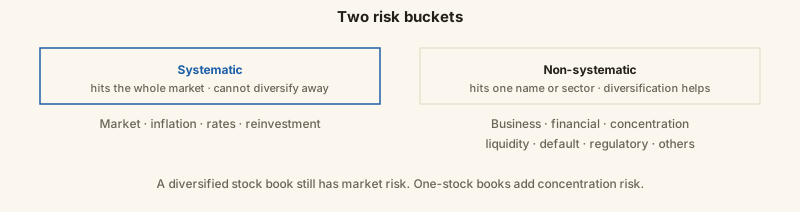
- Risks can generally be broken down into two main categories: systematic and nonsystematic.
- When an event or circumstance negatively affects the overall market, it’s a form of systematic risk.
Market risk
- Market risk is a type of systematic risk. It occurs when an investment falls in value due to a broad market or economic circumstance.
The Great Recession of 2008 is a good example. The S&P 500, an index (average) of 500 large domestically traded stocks, fell by 38% in 2008. When the market declines that much in one year, it’s a sign that nearly everything is falling in value.
Even Apple (symbol: AAPL) performed poorly in 2008. Although the first iPhone had been released in 2007, the company’s stock fell 56%. To put that in perspective, if you invested $1,000 in Apple on January 1, 2008, you would have $440 left at the end of the year.
- Apple was a strong company with a growing business model, but its stock value still fell dramatically due to the economic environment. That’s market risk.
- Although there were some exceptions, most stock prices fell drastically in 2008 due to market risk. Even well-diversified portfolios, which often “weather the storm” when faced with various risks, lost significant value.
- ⚠️ Investors cannot use diversification to avoid market risk. When an event negatively affects the overall market, it doesn’t matter how diversified an investor is.
Sidenote: Diversification
- To reduce many of the risks of investing, many investors diversify their portfolios. Although most common stocks face the same risks, individual stocks face varying levels of each risk at different points in time.
For example, BP (British Petroleum) experienced a significant decline during the Deepwater Horizon oil spill in 2010. In the 40 days after the oil spill, BP’s market price fell by 51%. If an investor had all of their money invested in BP, they would’ve lost more than half of their account value in less than 2 months.
- The Deepwater Horizon oil spill was a result of poor business decisions and environmental variables. Many companies face similar risks. In the right (or wrong) environment, a few bad choices can result in disaster.
- Owning BP stock in 2010 had the potential to severely damage a non-diversified investor. But what if BP only comprised 2% of an investor’s portfolio? Gains from other investments would likely help offset BP’s losses.
- Diversification avoids “keeping all your eggs in one basket.” You wouldn’t want your entire life’s savings tied to the performance of one company. Instead of betting everything on a single organization, it’s generally better to invest across many companies and asset classes (like stocks and bonds).
- 🔑 Diversification helps reduce many types of risks. One big exception is systematic risk, which cannot be avoided through diversification. Systematic risk affects the entire market. So, a well-diversified common stock portfolio will still be subject to market risk, no matter how many common stocks it holds.
Inflation risk
- Inflation risk, sometimes referred to as purchasing power risk.
For example, the median home price in 1950 was around $7,000 but rose to $120,000 50 years later in 2000. This is a result of inflation, which occurs naturally over time at an average rate of 2-3% annually.
- The government measures inflation through the CPI (consumer price index). Each month, the U.S. Bureau of Labor Statistics tracks price changes of goods and services. When prices rise on average, CPI rises (and vice versa).
- 📌 When this material refers to CPI, it’s referring to inflation.
Sidenote: Personal Consumption Expenditure (PCE) Price Index
- Technically, the Federal Reserve targets inflation based on the Personal Consumption Expenditure (PCE) Price Index, which is very similar to CPI but with nuanced differences in weighting and measurement.
- The text references an article: “PCE vs. CPI: What’s the difference and why it matters right now.”
Inflation effects
- Normal levels of inflation (2-3% annually) are healthy and expected. Higher-than-expected inflation can create problems for the economy.
- When prices rise faster than expected (for example, in late 2021-2022), corporations may struggle to maintain profits. Supplies become more expensive, businesses raise prices, and demand often falls.
- ⚠️ Bottom line: high inflation is typically a short-term problem for common stocks (market values may fall).
- Over the long term, the stock market tends to outpace inflation. Inflation may occur, but the Federal Reserve can take action to prevent prices from rising too much.
- Before late 2021/2022, the last period of significant U.S. inflation was in the 1980s. Eventually, prices stabilized and the economy recovered.
- Because inflation tends to occur in shorter bursts, the stock market typically experiences a higher long-term rate of return than the inflation rate.
Market risk and inflation risk are the two major types of systematic risk you’ll need to know. Market risk is referenced most often, but remember that higher inflation can also affect common stocks in the short term.
Risks: non-systematic
Non-systematic risk affects specific investments, companies, or sectors.
| Risk | Definition | Example |
|---|---|---|
| Financial risk | When a company runs into financial problems, often due to being over-leveraged (borrowed too much money) | Tesla (TSLA) faced financial risk for many years. Even if a company’s product is in high demand, it can still face serious problems if it owes too much to creditors. |
| Business risk | Similar to financial risk, but focused on the company’s operations rather than its debt levels; occurs when a company struggles with its core business | Radio Shack — business peaked in 1999, lost revenue and customers to Best Buy and Amazon, failed to adapt to changing technology; filed Chapter 11 bankruptcy in 2015, and again in 2017 after restructuring its finances |
| Regulatory risk | When a company faces challenges due to current or potential government regulation | Mark Zuckerberg (CEO of Meta/Facebook) testifying to Congress regarding privacy concerns. New privacy regulations could require millions of dollars updating training protocols, parts of its website, and general business practices. |
| Liquidity risk (marketability risk) | Whenever an investor has trouble turning stock into cash; to sell an investment with little demand, the investor may have to lower the asking price substantially | Lesser-known OTC stocks with lower trading volume than exchange-listed stocks |
| Concentration risk | Lack of diversification, which amplifies the non-systematic risks | Exposure to financial risk is much higher if an investor owns only one company with large debt levels |
- ⚠️ Even if regulation benefits society, it can still drive down the value of the company’s stock.
- Many common stocks trade on exchanges, like the New York Stock Exchange. A large amount of trading occurs on exchanges and it’s usually easy to buy or sell stocks there.
- Not all publicly traded stocks trade on exchanges. Many smaller or start-up companies trade in the OTC markets. OTC stocks tend to have lower trading volume than exchange-listed stocks. As a result, it may be difficult for an investor to sell a lesser-known OTC stock.
- When a common stock investment faces business risk, the stock value tends to decline.
Sidenote: Market capitalization
- The size of a company influences the risk profile of a stock investment. Smaller companies tend to be riskier, while larger companies are usually safer.
- When risk materializes, smaller companies often have less capital (money) and fewer resources to “weather the storm.” For example, the stock of a start-up company is traded far less than the stock of large, well-established companies, which can create liquidity risk.
- Company size is measured by market capitalization, found by multiplying the stock’s market price by the number of shares outstanding.
Let’s look at Nike (ticker: NKE), which was trading at roughly $41/share (as of mid-2026) with 1.48 billion shares outstanding. Let’s find its market cap.
MC=Shares outstanding x market price
MC=1.48 billion x $41
MC=$60.7 billion
- Nike is a large-cap company given its size. If a recession were to occur, Nike would most likely survive given its prominence, resources, and size.
- ⚠️ This won’t always be the case, as large companies have quickly imploded in the past. Lehman Brothers had a market cap of $60 billion in 2007, only to file for bankruptcy in 2008.
- 📌 From time to time, you may see a practice question referring to market capitalization. That’s a clue about the size of a company, and it often hints at the investment’s risk profile.
🔑 Market cap categories:
| Category | Market capitalization |
|---|---|
| Large-cap | More than $10 billion |
| Mid-cap | $2 billion to $10 billion |
| Small-cap | $300 million to $2 billion |
| Micro-cap | $50 million to $300 million |
| Nano-cap | Less than $50 million |
- 📌 You probably won’t be tested on the specific numbers, but remember the general relationship: the smaller the company, the higher the risk profile.
The chapter includes a video breakdown of a practice question on non-systematic risks.
Summary of non-systematic risk
- These are the non-systematic risks that affect specific investments or sectors or the market.
- ⚠️ Unlike systematic risks, non-systematic risks can be reduced through diversification. The more investments an investor owns, the less they rely on the performance of any one investment.
- When an investor lacks diversification, they face concentration risk, which amplifies the non-systematic risks. The risk is concentrated and amplified.
- 📌 For the exam, you’ll need to know the two big categories (systematic vs. non-systematic) and which risks fall into each category.
| Category | Risks | Diversifiable? |
|---|---|---|
| Systematic | Market risk, inflation (purchasing power) risk | No |
| Non-systematic | Financial risk, business risk, regulatory risk, liquidity (marketability) risk, concentration risk | Yes |
Sidenote: Penny stocks
- A penny stock is an unlisted stock trading below $5 per share. Often, these are issued by lesser-known and smaller companies.
- Due to their size and limited business history, penny stocks often present significant risk to the investor. ⚠️ The lower the stock price, the riskier the investment tends to be.
It can be tempting to purchase 1,000 shares of a stock trading at $0.10 per share (a total cost of $100). If the stock price rises to $0.20, the investor doubles their money.
- While that can happen, many investors experience extreme volatility because the risks discussed above tend to be amplified. Only the most aggressive investors who are willing to take significant risks should consider penny stock investments.
Typical investor
- Generally speaking, investing in common stock is often more appropriate for younger investors. Stocks are subject to numerous risks, and the market can fluctuate dramatically.
- Investors who cannot afford — or cannot tolerate — large swings in account value should generally avoid heavy stock exposure.
- Older investors can and often should keep a portion of their portfolio in common stock. However, their common stock allocation typically declines as they age.
Rule of 100
- 🔑 Many investors use the rule of 100 as a starting point: subtract your age from 100 to estimate an appropriate stock allocation.
| Age | Stock % | Bond % |
|---|---|---|
| 30 | 70% | 30% |
| 45 | 55% | 45% |
| 60 | 40% | 60% |
| 70 | 30% | 70% |
- The older an investor is, the less money they typically allocate to stocks and the more they allocate to fixed-income securities like bonds.
- ⚠️ Age isn’t the only suitability factor, but the rule of 100 is a useful starting point. Other factors determine whether a recommendation is appropriate. For example:
- It could be suitable for an 80-year-old investor to have 80% of their portfolio in stock if they have substantial assets and aren’t relying on the portfolio for living expenses.
- A 20-year-old might only be suitable for 20% in stocks if they’re disabled and living on Social Security.
Time horizon
- Another reason older investors often reduce stock exposure is time horizon. In the short term, the stock market is unpredictable.
COVID-19 is a good example. In late 2019 and early 2020, the market was near all-time highs, then experienced the fastest market decline in history in March 2020.
- Short-term market direction is difficult to predict. Over long periods, however, investors can reasonably expect the stock market to increase.
- Over the past 100 years, there have been numerous bear markets and major declines. The Market Crash of 1929, which led to the Great Depression, and the Great Recession of 2008 are examples of events that caused the market to plunge. Even after large declines, the market recovered and grew beyond previous highs.
The COVID-19 stock market recovery was relatively quick: the S&P 500 reached a new all-time high in September 2020, less than 6 months after the fastest decline in history.
- Recoveries may take a few months or several years, but history suggests that a recovery eventually occurs. If it doesn’t, there are broader economic concerns beyond investment performance.
Investor objectives
- The typical common stock investor may be seeking capital appreciation, income, or both.
- Some stocks primarily offer capital gain potential, which is common for smaller growth companies or larger companies that are expanding operations significantly. Amazon is an example of a growth company.
- Other companies, such as McDonald’s, Walmart, and Home Depot, pay quarterly dividends to shareholders. While these companies may not have the same growth potential as a company like Amazon, investors can still earn meaningful returns by collecting dividends over time. Their stock prices can also continue to grow, although typically not as rapidly as a growth company.
Key points
Benefits of common stock
- Capital appreciation
- Income from cash dividends
- Hedge against inflation
Capital appreciation
- Investment value rises above the cost
- Also known as:
- Growth
- Capital gains
Unrealized capital gain
- Current gain on an investment
- Investment has not been sold
- Gains at risk if the market declines
Realized capital gain
- Locked-in gain on an investment
- Investment has been sold
- Gains are not at risk
Growth stock
- Company with expanding business model
- Typical for smaller companies
- High capital appreciation potential
- Little or no dividend potential
Income
- Dividend payments from common stock
- Paid by larger, successful companies
Dividend payout ratio
- DPR=annual earnings per shareannual dividend per share
Value stock
- Company with a “bargain” stock price
- Usually well-established businesses
- Commonly pay cash dividends
Diversification
- Investing in multiple assets classes and investments
- Cannot diversify out of systematic risk
Systematic risk
- Occurs when an event or circumstance negatively affects the entire market
Market risk
- An investment is negatively affected by a general downturn in the stock market
Inflation risk
- Also known as purchasing power risk
- General prices rise more than expected
- Common stock tends to outpace inflation over long-term periods
Non-systematic risk
- Affects specific investment or sector
- Can be reduced by diversification
Financial risk
- High debt levels negatively affect company performance
Business risk
- Products or services in low demand due to competition or mismanagement
Regulatory risk
- Potential or current government regulation negatively affects an investment
Liquidity risk
- Also known as marketability risk
- Inability to sell a security without dropping price dramatically
Concentration risk
- Lack of diversification
- Amplifies relevant non-systematic risks
Common stock typical investors
- Younger, risk-tolerant investors
- Long time horizons
- Seeking capital appreciation or income
Practice questions
Q1. What does BRTI stand for in suitability analysis?
Show answer
Benefits, Risks, TIpical investor — know all three for each product to make suitable recommendations.
Q2. List the three main benefits of common stock from a suitability perspective.
Show answer
(1) Capital appreciation (unlimited gain potential; most common return), (2) Dividend income, (3) Hedge against inflation (stocks tend to outpace inflation long-term).
Q3. ⚠️ Can diversification eliminate market risk? Name the two major systematic risks.
Show answer
No — market risk cannot be diversified away. Systematic risks: market risk and inflation (purchasing power) risk. Non-systematic risks can be reduced through diversification.
Q4. Classify each risk: S&P down 38% in 2008, BP −51% after Deepwater Horizon, company with high debt, OTC stock hard to sell.
Show answer
2008 S&P = market risk (systematic). BP spill = business risk (non-systematic). High debt = financial risk (non-systematic). Hard to sell OTC = liquidity/marketability risk (non-systematic).
Q5. Walmart 2019: $2.11 dividend/share, $5.19 EPS. Dividend payout ratio?
Show answer
DPR = $2.11/$5.19 = 40.6%. DPR compares dividends paid to earnings per share. Walmart is a blue chip (~$500B revenue) paying dividends as a mature company.
Q6. Growth vs. value stocks — dividend behavior and capital appreciation?
Show answer
Growth (e.g., Amazon): expanding revenue, little/no dividends, high capital appreciation potential. Value: “bargain” price, well-established, large dividends relative to price — suits retirees seeking income.
Q7. Rule of 100 — stock/bond allocation for ages 30, 60, and 70?
Show answer
30 → 70% stock / 30% bond; 60 → 40%/60%; 70 → 30%/70%. Subtract age from 100 for stock %. ⚠️ Age alone isn’t sufficient — an 80-year-old with vast wealth may hold 80% stock; a disabled 20-year-old may hold only 20%.
Q8. What is a penny stock, and who is the typical investor?
Show answer
Unlisted stock trading below $5/share, often small/unknown issuers. Most aggressive investors only — amplified non-systematic risks and extreme volatility.
Q9. Nike: $41/share × 1.48B shares. Approximate market cap and cap category?
Show answer
~$60.7 billion → large-cap (>$10B). Smaller companies = higher risk profile. ⚠️ Large-cap isn’t foolproof — Lehman Brothers had ~$60B cap in 2007, bankrupt 2008.
Q10. Why are common stock dividend yields typically higher than bond yields despite dividend cut risk?
Show answer
Dividends are not guaranteed (higher risk); bond interest is a legal obligation. Higher risk can accompany higher return potential — companies cut dividends in 2008 and COVID-19 crises.
Sources
Primary/official references for the material on this page. Every link was fetched and returned HTTP 200 on 2026-08-15.
| # | Source | Publisher |
|---|---|---|
| 1 | Rule 2111 — suitability, reasonable-basis/customer-specific/quantitative | FINRA |
| 2 | Reg BI — the four obligations, Form CRS | FINRA |
| 3 | Stocks — common vs preferred, dividends, voting | SEC / Investor.gov |
| 4 | Achievable Series 65 — chapter 1.1.14 | Achievable (course text) |