Issuers & the Howey Test
Issuers
If you’ve studied for the SIE, Series 6, Series 7, or another FINRA or NASAA exam, you’ve likely seen the basic definition of a security. In plain terms, securities are investments that are initially sold to the public by issuers.
🔑 Issuer (definition, word-for-word):
Issuers are persons (usually companies, organizations, or governments) that raise capital (money) by selling securities.
Investors buy those securities, which provides funding for the issuer’s activities.
| Term | Definition | Example |
|---|---|---|
| Issuer | “persons (usually companies, organizations, or governments) that raise capital (money) by selling securities” | US Government; City of Los Angeles; Verizon; Microsoft; Visa |
An issuer must be a person — see the “Persons” chapter definition.
Why issuers raise capital
Issuers can be anything from a small start-up to a government. They raise capital when they identify a need, such as:
- Expanding a business
- Hiring a large number of employees
- Paying for deficit spending (as governments may do)
Real-world examples of issuers
| Issuer |
|---|
| US Government |
| City of Los Angeles |
| Verizon |
| Microsoft |
| Visa |
Securities
Issuers raise capital by selling securities to the public.
🔑 The Uniform Securities Act (USA) and the Securities Act of 1933 both explicitly identify the following as securities:
| Category | Items explicitly identified as securities |
|---|---|
| Stocks | Common stock; Preferred stock |
| Debt instruments | Notes; Bonds; Debentures |
| Certificates | Collateral trust certificates; Voting trust certificates; Pre-organization certificates; Certificate of deposit for a security |
| Contracts | Investment contracts |
| Certificate of interest or participation in any | Profit-sharing agreement; Oil, gas, or mining program |
| Derivatives | Options |
Full list:
- Stocks, including:
- Common stock
- Preferred stock
- Debt instruments, including:
- Notes
- Bonds
- Debentures
- Collateral trust certificates
- Voting trust certificates
- Pre-organization certificates
- Certificate of deposit for a security
- Investment contracts
- Certificate of interest or participation in any:
- Profit-sharing agreement
- Oil, gas, or mining program
- Options
The Howey Test
Thanks to a 1946 Supreme Court decision - SEC v. W. J. Howey Co - we also have a practical way to decide whether something is a security.
In that case, W. J. Howey Co. (a Florida citrus business) sold parcels of orange grove land and paired the sale with a leaseback arrangement. Buyers could purchase the land and then lease it back to an affiliated company to manage and harvest the groves. This structure allowed Howey to raise money from investors while keeping the groves in operation.
For exam purposes, the detailed facts aren’t the focus. What matters is the outcome: the Court treated the leaseback program as a security subject to Securities and Exchange Commission (SEC) and state (blue sky) regulation.
In the majority opinion written by Justice Murphy, the Court established a four-part standard known as the Howey Test. It’s used to determine whether an item or product meets the definition of a security.
A security exists when ALL FOUR elements are present.
| # | Prong | Definition | Example (Amazon.com Inc. common stock, ticker AMZN) |
|---|---|---|---|
| 1 | Investment of money | “the investor commits money (or something of value)” | “Buying Amazon stock requires paying the market price (approximately $234 per share as of June 2026).” |
| 2 | Common enterprise | “multiple investors are involved in the venture” | “Thousands (and likely millions) of investors own shares out of the 10+ billion shares outstanding.” |
| 3 | Expectation of profit | “the investor is seeking a financial return. Profit potential always comes with the risk of loss.” | “Stock purchases are typically made with the goal of earning a return. Amazon’s total return since it began publicly trading in 1997 has been roughly 312,000%.” |
| 4 | Third-party effort | “any profit is primarily due to the efforts of someone other than the investor” | “Investors’ profits depend primarily on Amazon’s business performance, driven by the work of Amazon’s employees and management (even though common stockholders can vote on certain matters).” |
Amazon common stock meets the four-prong Howey Test, so it’s a security.
For test purposes, you’ll want to know the legal definition and characteristics of a security, along with the common security types available in the market.
Non-securities (fail the Howey Test)
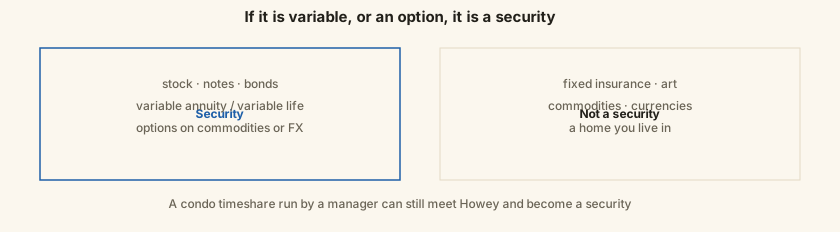
⚠️ The following may be cited on the exam as not meeting the Howey Test, and therefore not considered securities:
| NOT a security | Qualification / footnote |
|---|---|
| Insurance products (unless variable) | “There are two commonly cited variable insurance products - variable annuities and variable life insurance. If the word ‘variable’ is not in the name, then it’s not a security. Keep it simple!” |
| Collectibles | — |
| Art | — |
| Condominiums used as personal residence | “Condominiums might seem out of place, but they can meet the definition of a security if they satisfy all the Howey Test requirements.” (see below) |
| Commodities | “A commoditiy is an economic good. Examples include oil, corn, soybeans, gold, rice, and wheat.” |
| Currencies | “While currencies and commodities are not considered securities, options on them are. An option is a type of derivative that allows the purchase or sale of the currency or commodity at a fixed price for a short period of time.” |
Condominium trap: assume you own a condominium as a time share and rent it out through a third-party management service when you’re not using the property. In that situation, it can meet all four prongs: it’s an investment of money, it involves a common enterprise (the timeshare structure), there’s an expectation of profit (rental income), and profits depend on third-party effort (the management service).
Variable trap: if “variable” is in the name (variable annuity, variable life insurance), it IS a security. If not, it is not.
Commodity/currency trap: the commodity or currency itself is NOT a security — but an option on that commodity or currency IS a security.
Summary: security vs. non-security
| IS a security | Is NOT a security |
|---|---|
| Common stock, preferred stock | Insurance products (unless variable) |
| Notes, bonds, debentures | Collectibles |
| Collateral trust certificates | Art |
| Voting trust certificates | Condominiums used as personal residence (unless all four Howey prongs are met) |
| Pre-organization certificates | Commodities (oil, corn, soybeans, gold, rice, wheat) |
| Certificate of deposit for a security | Currencies |
| Investment contracts | |
| Certificate of interest/participation in a profit-sharing agreement | |
| Certificate of interest/participation in an oil, gas, or mining program | |
| Options (including options on commodities and currencies) | |
| Variable annuities, variable life insurance |
Transactions: issuer vs. non-issuer
Some test questions focus on the difference between an issuer transaction and a non-issuer transaction. If you’ve studied for another licensing exam before this one, you’ve probably seen this framed as the primary versus secondary market.
Issuer transaction:
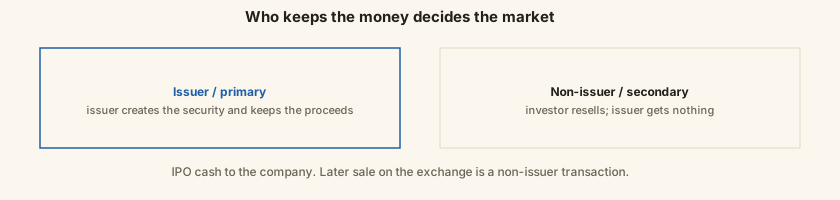
Issuer transactions occur in the primary market. When a security is created and sold by an issuer, investors pay money in exchange for the security, and the issuer receives the proceeds.
Non-issuer transaction:
If an investor who bought shares in the IPO later sells those shares, that sale is a non-issuer transaction. The proceeds go to the selling investor, not [the issuer].
| Term | Definition | Market | Who receives proceeds | Example |
|---|---|---|---|---|
| Issuer transaction | Security is created and sold by an issuer; investors pay money in exchange for the security | Primary market | The issuer | “AirBnB’s initial public offering (IPO)… The company raised $3.5 billion after selling over 50 million shares to the public.” |
| Non-issuer transaction | Shares trade between investors after the issuer’s original sale | Secondary market | Anyone other than the issuer (the selling investor) | An IPO buyer later sells those AirBnB shares; proceeds go to the selling investor, not Airbnb |
🔑 A simple way to tell the difference is to follow the money:
- If the issuer receives the proceeds, it’s an issuer transaction.
- If anyone else receives the proceeds, it’s a non-issuer transaction.
Key points
Issuers
- Persons that raise capital by offering securities to investors
Securities
- Formal name for an investment
- Common types:
- Stocks
- Bonds
Howey test
- Four-prong test determining if a product is a security
- Four requirements:
- Investment of money
- Common enterprise
- Expectation of profit
- Third-party effort
Issuer transactions
- Issuer receives sales proceeds
- Occur in the primary market
Non-issuer transactions
- Any person other than the issuer receives sales proceeds
- Occur in the secondary market
Sources
Primary/official references for the material on this page. Every link was fetched and returned HTTP 200 on 2026-08-15.
| # | Source | Publisher |
|---|---|---|
| 1 | Securities Act 1933 — definition of security, issuer | Cornell LII (15 U.S.C. 77b) |
| 2 | Uniform Securities Act 1956 with NASAA updates — the tested statute | NASAA |
| 3 | The federal securities statutes, in order | SEC |
| 4 | Achievable Series 65 — chapter 4.2.3 | Achievable (course text) |