Common Stock Ownership & Rights
What common stock is
- Common stock represents ownership in a company (the issuer).
- Because it represents ownership, common stock is an equity security.
- Buying one share (“going long”) makes you a stockholder — an owner.
- One share is usually a tiny slice. Coca-Cola has over 4 billion shares outstanding.
- All outstanding shares collectively represent the company’s ownership.
- Two types of stock exist: common stock and preferred stock. This chapter covers common.
Definitions
| Term | Definition | Example |
|---|---|---|
| Issuer | An organization that distributes and sells securities to investors | Coca-Cola is the issuer of Coca-Cola stock |
| Long | Jargon for owning a security | The investor is long 100 shares of GE |
| Going long | Jargon for purchasing ownership in a security | The investor goes long 100 shares of GE |
| Outstanding shares | The number of shares held by the company’s shareholders | — |
| Equity | Formal term for ownership | — |
| Security | Legal term for a specific type of investment | Common stocks, bonds, mutual funds, ETFs, options |
| Retained earnings | Profits retained by the company, not paid out as dividends; often used to expand and reinforce operations | — |
How common stock prices change
Prices rise and fall in the stock market based on supply and demand. Demand is usually influenced by the company’s success.
- Prices tend to rise when more shares are being purchased than sold.
- Prices tend to fall when more shares are being sold than purchased.
Two ways investors make money
Capital appreciation
Also called growth or capital gains. Buy at one price, sell higher later.
Example: Parsa buys Ford at $10/share. Ford outsells expectations, demand rises, price hits $25. Parsa sells and locks in $15/share profit.
Cash dividends
A cash dividend is company profit distributed to shareholders.
- Not all publicly traded companies pay them.
- Growth companies typically keep profits inside the business (retained earnings) to reinvest, expand, hire, and enter new industries. Amazon is cited as never having paid a dividend.
- Growth-company investments may offer capital appreciation but generally no income.
- Companies closer to the end of their growth cycle — less room to expand — are more likely to pay dividends. They distribute the “excess” not needed to fund operations.
- Ford has a long history of paying dividends.
Example continued: If Ford paid $1/share in dividends while Parsa held, the total profit is $16/share ($15 capital appreciation + $1 dividends).
To receive a dividend, investors must purchase shares before the company pays it. (Dividend timelines covered later in this unit.)
Stockholder rights
Common stockholders are partial owners, and ownership carries rights. More shares → larger ownership percentage → more voting power.
Right to a pro-rata share of dividends
- Common for large, well-established companies like Coca-Cola.
- Coca-Cola is a “dividend king” — at least 50 years of annually increasing cash dividends.
- ⚠️ Stockholders do NOT vote on whether dividends are paid. That’s the Board of Directors’ decision.
- If the board declares a dividend, shareholders have the right to their pro-rata share. Own 5% of the stock → receive 5% of the dividends.
Right to vote for the Board of Directors
Stockholders don’t manage day-to-day operations. They vote for the Board of Directors (BOD), who set direction by:
- Hiring and/or firing senior-level employees
- Managing senior-level employee compensation
- Creating and implementing general company policies
- Approving dividend payouts to investors
Analogy: Like a democratic republic — citizens don’t write laws, they elect the people who do, and can vote them out. Stockholders don’t run the company but choose who does.
Right to inspect books and records
Investors monitor company performance because it drives stock value. The SEC enforces reporting requirements on publicly traded companies:
| Filing | What it is | Audited? | Frequency |
|---|---|---|---|
| 10-K | Annual report | Audited | Annual |
| 10-Q | Quarterly report | Unaudited | Quarterly |
Right to maintain proportionate ownership
- If you own 10 of 100 outstanding shares (10%), and the company issues more stock, you may have the right to buy 10% of the new shares before anyone else.
- ⚠️ Not all issuers must offer this. It depends on how the stock was originally structured.
- Typically fulfilled through a pre-emptive rights offering (covered later in this unit).
- Dilutive actions reduce proportionate ownership and may require stockholder approval. Rights offerings avoid dilution.
Right to assets upon dissolution
A company can be liquidated due to bankruptcy: when it can’t pay its debts, creditors (including bondholders) may sue in bankruptcy court. If no agreement is reached, the company is typically liquidated.
Liquidation = sale of all company assets (buildings, factories, inventory, equipment, vehicles) to repay creditors as much as possible.
🔑 Corporate liquidation priority (memorize this order)
- Unpaid wages
- Unpaid taxes
- Secured creditors
- Unsecured creditors
- Junior unsecured creditors
- Preferred stockholders
- Common stockholders
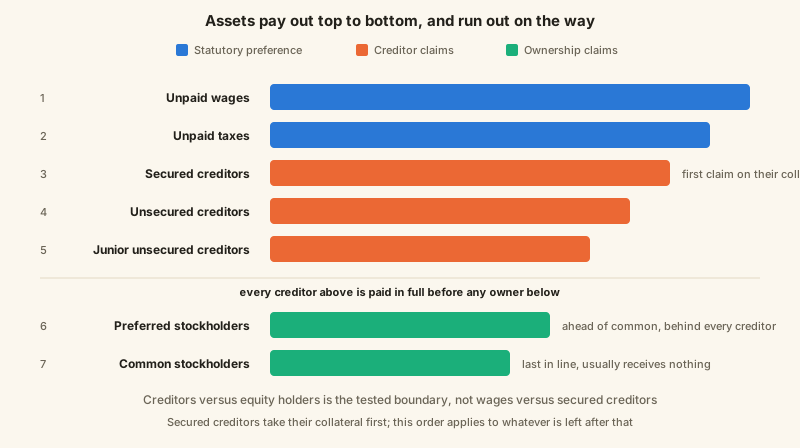
Stockholders are last in line. In most bankruptcies, common stockholders receive nothing.
Nuance on wages/taxes vs. secured creditors
Sources conflict on this ordering. Secured creditors have first rights to the collateral backing their loan. The priority list above applies to whatever is left after that collateral is applied.
Worked example: Secured creditor owed $1,000. Unpaid wages $100, unpaid taxes $100.
- Collateral liquidates for $600 → all $600 goes to the secured creditor → balance now $400.
- Remaining company assets liquidate for $500 → $100 to wages, $100 to taxes, remaining $300 to the secured creditor.
- Secured creditor ends up $100 unpaid.
Exam note: wages/taxes vs. secured creditors is not heavily tested. Creditors (bondholders) vs. equity holders (stockholders) priority is much more commonly tested.
Right to transfer ownership
- Common stock can generally be bought and sold freely — you aren’t required to hold it.
- Exception: unregistered (restricted) stock, covered later in this unit.
Key points
Common stock
- Equity security
- Represents ownership in a company
Issuers — persons that raise capital by offering securities to investors
Equity — represents ownership. Equity securities: common stock, preferred stock
Securities — formal name for an investment. Common types: stocks, bonds
Capital appreciation — a.k.a. growth or capital gains; occurs when stock prices rise; prices driven by supply and demand
Retained earnings — profits retained by the company
Stockholder rights
- Right to pro-rata share of dividends
- Right to vote for Board of Directors
- Right to inspect books and records
- Right to maintain proportionate ownership
- Right to assets upon dissolution
- Right to transfer ownership
Dilutive actions
- Reduce proportionate ownership
- May be required to be approved by stockholders
- Rights offerings avoid dilution
Corporate liquidation priority — wages → taxes → secured creditors → unsecured creditors → junior unsecured creditors → preferred stockholders → common stockholders
Practice questions
Q1. What does common stock represent, and what formal term describes this type of security?
Show answer
Ownership in the issuer. Common stock is an equity security (equity = ownership). Buying shares makes you a stockholder with a partial ownership stake.
Q2. An investor buys Ford at $10, sells at $25, and received $1/share in dividends while holding. What are the two return components and the total profit per share?
Show answer
Capital appreciation ($15/share) and cash dividends ($1/share) = $16/share total. Capital appreciation requires selling; dividends are company profit distributed to shareholders.
Q3. ⚠️ Who decides whether common stock dividends are paid — stockholders or the Board of Directors?
Show answer
The Board of Directors (BOD). Stockholders do not vote on dividend payments. If declared, shareholders receive a pro-rata share (5% ownership → 5% of dividends).
Q4. Which SEC filings must publicly traded companies provide for stockholders to inspect books and records, and which is audited?
Show answer
10-K (annual, audited) and 10-Q (quarterly, unaudited). The SEC enforces reporting requirements on publicly traded companies.
Q5. A company issues more stock. What right may let an existing holder buy a proportionate share of new issuance before others, and what corporate action reduces proportionate ownership?
Show answer
Pre-emptive rights (via a pre-emptive rights offering) may maintain proportionate ownership — but ⚠️ not all issuers must offer this. Dilutive actions reduce proportionate ownership; rights offerings avoid dilution.
Q6. List the corporate liquidation priority order from first to last claimant (full chain).
Show answer
(1) Unpaid wages → (2) Unpaid taxes → (3) Secured creditors → (4) Unsecured creditors → (5) Junior unsecured creditors → (6) Preferred stockholders → (7) Common stockholders. Stockholders are last; common stockholders often receive nothing in bankruptcy.
Q7. Why do growth companies like Amazon typically avoid paying cash dividends?
Show answer
They retain profits as retained earnings to reinvest in expansion, hiring, and new industries. Growth companies offer capital appreciation but generally no income from dividends.
Q8. How do supply and demand affect common stock prices?
Show answer
Prices rise when more shares are purchased than sold; prices fall when more are sold than purchased. Demand is usually influenced by the company’s perceived success.
Q9. What is the general exception to a stockholder’s right to freely transfer ownership?
Show answer
Restricted (unregistered) stock — covered later in the unit. Otherwise, common stock can generally be bought and sold freely.
Sources
Primary/official references for the material on this page. Every link was fetched and returned HTTP 200 on 2026-08-15.
| # | Source | Publisher |
|---|---|---|
| 1 | Stocks — common vs preferred, dividends, voting | SEC / Investor.gov |
| 2 | Securities Act 1933 — definition of security, issuer | Cornell LII (15 U.S.C. 77b) |
| 3 | Investment product categories | SEC / Investor.gov |
| 4 | Achievable Series 65 — chapter 1.1.1 | Achievable (course text) |