Market, Limit, Stop & Stop-Limit Orders
Investors must specify how a trade should be carried out when they place an order to buy or sell a security. This chapter covers four common order types:
- Market orders
- Limit orders
- Stop orders
- Stop limit orders
⚠️ MASTER TABLE — all order types (guaranteed exam topic)
| Order type | Placed relative to current market price | What triggers / activates it | What it guarantees |
|---|---|---|---|
| Market order | No price is specified at all — “A market order doesn’t include a price” | Nothing; “it executes at the next available market price” (often fills within seconds) | 🔑 Execution guaranteed, price NOT guaranteed |
| Limit order (general) | At a price better than the current market | Market reaching the specified price or better | 🔑 “limit orders guarantee that the trade will occur at a specific price or better. The trade-off is that execution is not guaranteed.” |
| Buy limit | ⬇️ Below the current market | “The order can execute once the stock trades at [limit] or lower” — executes when the price falls to or below the limit price | Price (or better), not execution |
| Sell limit | ⬆️ Above the current market | “The order can execute once the stock trades at [limit] or above” — executes when the price rises to or above the limit price | Price (or better), not execution |
| Stop order (general) | Away from the market in the loss direction | Two-step: Trigger (market reaches stop price) → Execution (becomes a market order, fills at next available price) | 🔑 Neither price nor execution guaranteed |
| Sell stop | ⬇️ Below the current market | “Sell stop orders trigger when the market price falls to the stop price or below” | Neither. After trigger it’s a market order — “could be above, at, or below the stop price” |
| Buy stop | ⬆️ Above the current market | “Buy stop orders elect (trigger) when the market price rises to the stop price or above” | Neither |
| Sell stop limit | Stop ⬇️ below the market | Triggers when market falls to or below the stop price; then becomes a sell limit that executes only at the limit price or higher | After trigger, price is guaranteed (limit), execution is not |
| Buy stop limit | Stop ⬆️ above the market | Triggers when market rises to or above the stop price; then becomes a buy limit that executes only at the limit price or lower | After trigger, price is guaranteed (limit), execution is not |
🔑 Placement summary (from the chapter’s Key points)
| Orders placed above the current market | Orders placed below the current market |
|---|---|
| Sell limits | Buy limits |
| Buy stops | Sell stops |
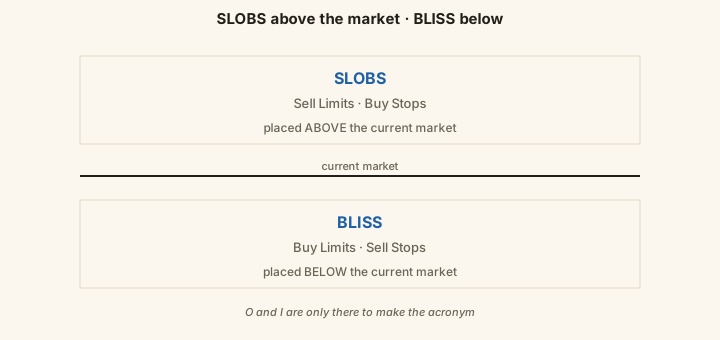
🔑 SLOBS / BLISS memory aid
“Many people use ‘SLOBS’ and ‘BLISS’ to remember the direction of stops and limits.”
- Sell Limits / O / Buy Stops — placed above the market
- Buy Limits / I / Sell Stops — placed below the market
- ⚠️ “the ‘O’ in ‘SLOBS’ and the ‘I’ in ‘BLISS’ are only there to make an acronym.”
Using the visual:
- Sell limits are above the line, meaning they execute when the market price is at or above the limit price.
- Buy limits are below the line, meaning they execute when the market price is at or below the limit price.
Stop orders don’t execute immediately. They trigger at a specific market price:
- Sell stops trigger when the market price is at or below the stop price.
- Buy stops trigger when the market price is at or above the stop price.
“The following visual is useful to memorize and rewrite on your scratch paper during this material.”
Market orders
- Market orders are used when the main goal is speed.
- A market order doesn’t include a price. Instead, it executes at the next available market price. In practice, market orders often fill within seconds.
🔑 When you place a market order:
- Execution is guaranteed (the trade will happen).
- Price is not guaranteed (you don’t control the exact fill price).
“That lack of price control is especially important when the market is closed.”
Worked examples
A biotech stock closes at $40. After the close, an investor enters a market order to buy 200 shares. Overnight the company announces that its drug won approval, and the stock opens at $120. The order fills at the open: 200 × $120 = $24,000, three times the $8,000 (200 × $40) the investor expected. Moves this large are rare, but overnight gaps of a few dollars are common.
The same gap can hurt a seller. A stock closes at $60 and a customer enters a market order to sell 100 shares after the close. Bad earnings arrive overnight and the stock opens at $42. The sale brings in 100 × $42 = $4,200 instead of the expected $6,000, a $1,800 shortfall. This is why investors generally avoid leaving market orders in overnight.
Order duration
| Duration type | Definition |
|---|---|
| Day order | > “Day orders are canceled at the end of the day if they remain unexecuted.” |
| Good-til-canceled (GTC) | > “GTC orders are only canceled once the customer requests, which could be days, weeks, or months.” |
- 🔑 “Market orders are designed to execute immediately, so broker-dealers typically default them to day orders.” (Key points: “Always day orders”)
Limit orders
- Limit orders are used when price control matters.
- 🔑 “Unlike market orders, limit orders guarantee that the trade will occur at a specific price or better. The trade-off is that execution is not guaranteed.”
- ⚠️ “If a price is specified and nothing else is added, it’s assumed to be a limit order (even if the word ‘limit’ isn’t written).”
Buy limit — worked example
Buy 100 shares of XYZ stock @ $32 limit
Trading tape: $32.06… $32.04… $31.98… $31.95… $32.01…
The investor wants 100 shares of XYZ but will not pay more than $32 per share, so the order can fill once the stock trades at $32 or lower.
Reading the tape from left to right, $32.06 and $32.04 are both above the limit. The first price at or below $32 is $31.98, so the order fills at $31.98.
Investors use limit orders to seek a better price. If XYZ trades at $38 and a customer places a buy limit at $32, a fill means paying $6 less per share, or $600 less on 100 shares. If the stock never trades at $32 or lower, the order does not execute.
Buy limit — practice question
Buy 100 shares @ $18 limit
Trading tape: $18.03… $18.02… $17.96… $18.00… $17.99…
At what price does the order go through?
Show answer
$17.96. A buy limit fills at the limit price or lower, and $17.96 is the first price on the tape at or below $18.
Sell limit — worked example
Sell 100 shares of QRS stock @ $45
Trading tape: $44.92… $44.97… $45.04… $44.99… $45.06…
At what price does the order go through?
This is a sell limit order, so the customer will sell only at $45 or higher. The first two prices on the tape are below $45. The first price at or above $45 is $45.04, so the order fills at $45.04.
Sell limit — practice question
Sell 100 shares @ $90
Trading tape: $89.94… $89.99… $90.00… $90.07… $89.98…
At what price does the order go through?
Show answer
$90.00. A sell limit fills at the limit price or higher, and a trade at exactly $90.00 meets the condition, so the order fills there.
Duration
Limit orders often take time to execute. Because of that, they can be placed as:
- Day orders (cancel at the end of the day if unexecuted), or
- GTC orders (remain open until executed or canceled by the customer).
Stop orders
- Stop orders, often called stop loss orders, can feel a bit “backward” at first:
- ⚠️ A buy stop triggers when the price rises.
- ⚠️ A sell stop triggers when the price falls.
- “Why buy higher or sell lower? Stop orders are commonly used to manage risk by automatically exiting a position once the market moves against you.”
🔑 The two-step process
| Step | What happens |
|---|---|
| 1. Trigger (elect) | “The order triggers when the market reaches the stop price.” |
| 2. Execution | “After triggering, the order becomes a market order and fills at the next available price.” |
Because a stop order turns into a market order after it triggers:
- Execution isn’t guaranteed (it only triggers if the stop price is reached).
- Price isn’t guaranteed (once triggered, it fills at the next available price, which could be above, at, or below the stop price).
Sell stop — worked example
Long 100 shares of DEF stock @ $60
Investor places a sell 100 shares of DEF stock @ $55 stop
A sell stop triggers (also called electing) when the market price falls to the stop price or below. Here the order triggers at $55 or lower, which limits the loss to about $5 per share.
Long 100 shares of DEF stock @ $60
Investor places a sell 100 shares of DEF stock @ $55 stop
Trading tape: $55.04… $55.01… $54.98… $54.95… $55.02…
The order triggers at $54.98, the first price at or below $55. It then becomes a market order and fills at the next available price, $54.95.
Sell stop — practice question
An investor goes long 100 shares of stock @ $40. They place a sell 100 shares @ $37 stop order.
Trading tape: $38.50… $37.40… $37.00… $36.80… $37.50…
At what price will the order trigger? At what price will the order execute?
Show answer
Trigger = $37.00. Execute = $36.80. A sell stop triggers when the price falls to or below the stop, and $37.00 is the first price that does. The order then becomes a market order and fills at the next available price, $36.80.
Buy stop — worked example
- Buy stop orders are also stop loss orders, but for short stock positions.
- Investors with short positions use buy stops to limit losses if the stock price rises.
Sell short 100 shares of GHI stock @ $50
Investor places a buy 100 shares of GHI stock @ $58 stop
A buy stop elects (triggers) when the market price rises to the stop price or above. Here the order elects at $58 or higher, which caps the loss on the short position at about $8 per share.
Sell short 100 shares of GHI stock @ $50
Investor places a buy 100 shares of GHI stock @ $58 stop
Trading tape: $57.96… $57.99… $58.03… $58.06… $57.94…
The order triggers at $58.03, the first price at or above $58. It then becomes a market order and fills at the next available price, $58.06.
Buy stop — practice question
An investor goes short 100 shares of stock @ $15. They place a buy 100 shares @ $16 stop order.
Trading tape: $15.40… $15.80… $16.05… $15.70… $15.90…
At what price will the order trigger? At what price will the order execute?
Show answer
Trigger = $16.05. Execute = $15.70. A buy stop triggers when the price rises to or above the stop, and $16.05 is the first price that does. The order then becomes a market order and fills at the next available price, $15.70, even though that is below the stop price.
Duration
Like limit orders, stop orders can be day or GTC orders. If placed as a day order, the order is canceled if it remains unexecuted by the end of the day. If placed as a GTC order, the order stays open until executed or canceled by the investor.
Stop limit orders
- Stop limit orders combine features of stop orders and limit orders.
- 🔑 “A stop limit order is a stop order that becomes a limit order after it triggers (elects).”
⚠️ The key difference from a regular stop order is what happens after the trigger:
| Order | After triggering it becomes… |
|---|---|
| Stop order | a market order |
| Stop limit order | a limit order |
- “Stop limit orders are used for the same general purpose as stop orders (often to limit losses), but they’re especially useful when the investor wants more control over the execution price.”
- 🔑 “In case you were wondering, both the stop and the limit price are the same when only one price is specified.”
Sell stop limit — worked example
Long 100 shares of JKL stock @ $48
Investor places a sell 100 shares of JKL stock @ $42 stop $40 limit
Start with the stop:
The sell stop triggers when the market falls to $42 or below. After triggering, the order becomes a sell limit, which can execute only at $40 or higher.
Long 100 shares of JKL stock @ $48
Investor places a sell 100 shares of JKL stock @ $42 stop $40 limit
Trading tape: $42.05… $42.01… $41.98… $41.95… $41.90…
The order triggers at $41.98, the first price at or below $42. It is now a limit order that can execute while the market is $40 or higher. The next available price, $41.95, meets that condition, so the order executes there.
The limit protects the investor from selling below $40 per share.
Sell stop limit — practice question
An investor goes long 100 shares of stock @ $90. They place a sell 100 shares @ $85 stop limit order.
Trading tape: $85.20… $84.80… $84.90… $85.10… $84.70…
At what price will the order trigger? At what price will the order execute?
Show answer
Trigger = $84.80. Execute = $85.10. With only one price given, the stop and the limit are both $85. The order triggers at $84.80, the first price at or below $85. It then becomes a sell limit that needs $85 or higher, so $84.90 is skipped and the order fills at $85.10.
Buy stop limit — worked example
Sell short 100 shares of MNO stock @ $55
Investor places a buy 100 shares of MNO stock @ $62 stop limit
Start with the stop. With only one price given, the stop and the limit are both $62.
The buy stop triggers when the market rises to $62 or higher. After triggering, the order becomes a buy limit, which can execute only at $62 or lower.
Sell short 100 shares of MNO stock @ $55
Investor places a buy 100 shares of MNO stock @ $62 stop limit
Trading tape: $61.94… $61.99… $62.04… $62.01… $61.96…
The order triggers at $62.04, the first price at or above $62. It is now a limit order that can execute while the market is $62 or lower. The next price, $62.01, is still above the limit, so the order skips it and executes at $61.96.
The limit ensures the customer will not buy above $62 per share.
Buy stop limit — practice question
An investor goes short 100 shares of stock @ $33. They place a buy 100 shares @ $36 stop $37 limit order.
Trading tape: $35.92… $36.03… $37.20… $36.80… $36.20…
At what price will the order trigger? At what price will the order execute?
Show answer
Trigger = $36.03. Execute = $36.80. A buy stop triggers when the price rises to or above the stop ($36), and $36.03 is the first price that does. The order then becomes a buy limit at $37 or lower. $37.20 is above the limit, so it is skipped, and the order fills at $36.80.
Duration
Just like limits and stops, stop limit orders can be day or GTC. If placed as a day order, the order will be canceled if it doesn’t execute by the end of the day. If placed as a GTC order, the order will stay open until executed or canceled by the investor.
Conclusion
“The key skill with order types is knowing what the market must do for an order to trigger or execute.”
Key points
Market orders
- Transaction request at the next possible price
- Guarantees execution, not price
- Always day orders
Day orders
- Cancelled at end of the day if not executed
GTC orders
- Cancelled when customer requests
Limit orders
- Seek better prices for investors
- Guarantee price, but not execution
- Day or GTC orders
Buy limit orders
- Execute when the price falls to or below the limit price
Sell limit orders
- Execute when the price rises to or above the limit price
Stop orders
- Typically utilized to “stop losses” on stock
- Do not guarantee price or execution
- Trigger (elect) first, then execute
- Become market orders after the trigger
- Day or GTC orders
Sell stop orders
- Trigger when the price falls to or below the stop price
Buy stop orders
- Trigger when the price rises to or above the stop price
Stop limit orders
- Normal stop orders up until the trigger
- After trigger, becomes a limit order
- Day or GTC orders
Orders placed above current market
- Sell limits
- Buy stops
Orders placed below current market
- Buy limits
- Sell stops
DNR (do not reduce) orders
- Never adjusted for cash dividends
Sources
Primary/official references for the material on this page. Every link was fetched and returned HTTP 200 on 2026-08-15.
| # | Source | Publisher |
|---|---|---|
| 1 | Understanding order types — market, limit, IOC, FOK, AON | SEC / Investor.gov |
| 2 | Stop, stop-limit and trailing stop orders | SEC / Investor.gov |
| 3 | Limit orders | SEC |
| 4 | Stop orders | SEC |
| 5 | Achievable Series 65 — chapter 2.9.4 | Achievable (course text) |