Denial, Suspension & Revocation
Overview
- The state administrator can take punitive actions against registered persons and issuers of registered securities in certain situations. These actions are typically tied to misconduct, legal violations, or unethical behavior.
🔑 The administrator’s available punishments include:
| # | Punitive action |
|---|---|
| 1 | Denial of registration applications |
| 2 | Suspension or revocation of registration status |
Denial of registration applications
- Registration gives the administrator a way to keep “bad faith actors” and applicants with problematic histories out of the securities industry. That’s why applicants must make a long list of disclosures — regulators want a complete picture of a person’s or issuer’s background to decide whether they’ll be allowed to engage investors.
When a person or issuer submits registration paperwork, the state administrator has two options:
| Option | Condition |
|---|---|
| Declare the registration effective | If all required documents and fees are submitted and the applicant’s background is acceptable |
| Deny registration and reject the application | If grounds exist (below) |
🔑 Two requirements to deny an application
| # | Requirement |
|---|---|
| 1 | ⚠️ The denial must be in the public interest (meaning it benefits the general public) |
| 2 | One of the listed circumstances must exist |
🔑 Complete list of circumstances permitting denial
| # | Circumstance | Lookback |
|---|---|---|
| 1 | An incomplete, false, or misleading application was submitted | — |
| 2 | Violation of a state or federal securities law | Past 10 years |
| 3 | Any felony conviction | Past 10 years |
| 4 | A securities-related misdemeanor conviction | Past 10 years |
| 5 | Enjoined by a court from engaging in the securities industry | Past 10 years |
| 6 | Is subject to a regulatory action by another state administrator | Past 10 years |
| 7 | Engaging in dishonest or unethical practices | Past 10 years |
| 8 | Insolvency | Past 10 years |
| 9 | Violated a foreign securities law | ⚠️ Past 5 years |
| 10 | Is not qualified due to lack of experience*, training, or knowledge | — |
| 11 | Failure to supervise employees (broker-dealers and investment advisers only) | — |
| 12 | Failure to pay appropriate filing fees | — |
*🔑 The lack-of-experience trap:
Registration cannot be suspended or revoked solely based on lack of experience (although it can be denied solely for a lack of training or knowledge). However, an application can be denied due to a combination of lack of experience plus lack of training and/or knowledge.
| Basis | Can it support denial? | Can it support suspension/revocation? |
|---|---|---|
| Lack of experience ALONE | ⚠️ Not alone — only in combination with lack of training and/or knowledge | ⚠️ NO — cannot suspend or revoke solely based on lack of experience |
| Lack of training or knowledge alone | ✅ Yes, can be denied solely for this | — |
| Lack of experience + lack of training and/or knowledge | ✅ Yes | — |
Definitions
| Term | Definition | Example |
|---|---|---|
| Enjoin / enjoined | > To legally prevent a person from engaging in a particular action or activity | Being enjoined by a court from engaging in the securities industry within the past 10 years is grounds for denial |
This list is what the state administrator looks for when reviewing registration applications. Some applicants are just starting a business, while others are registering in a new state after operating elsewhere. That’s why a few items may seem odd for a business that isn’t operating yet (for example, failure to supervise employees).
🔑 Three requirements for a denial order to take effect
| # | Requirement |
|---|---|
| 1 | Appropriate prior notice to the applicant |
| 2 | Opportunity for hearing is provided |
| 3 | Disclosure of written facts and findings of law |
- Notice: To meet the first requirement, the administrator typically provides a denial notice within 30 days of the application. (Effective registration generally occurs on the 30th day after filing if all required documentation is submitted.) If denial is warranted based on one or more of the circumstances above, the administrator should notify the applicant before that 30-day window ends.
- Hearing: A hearing gives the applicant a chance to respond and present evidence. If an applicant believes the denial was unjustified, they have 🔑 60 days after the denial notice to request a hearing. ⚠️ Unless everyone involved agrees otherwise (the applicant, the administrator, and any other related parties), hearings are PUBLIC. After the hearing, the denial will be appealed or affirmed based on the evidence presented.
- Written findings: Once a final judgment is reached, the state administrator must provide a written summary explaining the reason(s) for the denial (this is the disclosure of written facts and findings of law).
Suspension or revocation of registration
- Effective registration isn’t the end of regulatory oversight for financial professionals and issuers.
- Registrations must be renewed annually, and the state administrator continues to monitor activity in the securities markets.
- Broker-dealers and investment advisers must update the state administrator when a material (significant) aspect of the business changes.
- Agents and investment adviser representatives (IARs) must notify the administrator if a new event or circumstance puts their registration at risk.
Suspension vs. revocation
| Action | Effect |
|---|---|
| Suspension | Temporarily removes a person’s registration, preventing them from operating for a specified period (often weeks to months) |
| Revocation | Permanently removes a person’s registration and is more serious |
🔑 Two requirements (same as denial)
| # | Requirement |
|---|---|
| 1 | The action must be in the public interest |
| 2 | One of the listed circumstances must exist |
🔑 Complete list of circumstances permitting suspension or revocation
| # | Circumstance | Lookback |
|---|---|---|
| 1 | Finding misleading or false information on registration application* | — |
| 2 | Violation of a state or federal securities law | Past 10 years |
| 3 | Any felony conviction | Past 10 years |
| 4 | A securities-related misdemeanor conviction | Past 10 years |
| 5 | Enjoined by a court from engaging in the securities industry | Past 10 years |
| 6 | Is subject to a regulatory action by another state administrator | Past 10 years |
| 7 | Engaging in dishonest or unethical practices | Past 10 years |
| 8 | Insolvency | Past 10 years |
| 9 | Violated a foreign securities law | ⚠️ Past 5 years |
| 10 | Is not qualified due to lack of experience**, training, or knowledge | — |
| 11 | Failure to supervise employees (broker-dealers and investment advisers only) | — |
| 12 | Failure to pay appropriate filing fees (including renewal fees) | — |
*🔑 The “already known” trap:
The administrator may not take any punitive action against a registered person based on information that was known when effective registration was granted. However, suspension or revocation may occur if the information disclosed was found to be misleading or false after effective registration was granted.
**Registration cannot be suspended or revoked solely based on lack of experience (although it can be denied solely for a lack of training or knowledge). However, an application can be denied due to a combination of lack of experience plus lack of training and/or knowledge.
⚠️ Denial list vs. suspension/revocation list
- You’ll notice this list is almost identical to the denial list. 🔑 The key difference is TIMING: for suspension or revocation, the issue was either:
| # | Timing |
|---|---|
| 1 | Hidden at the time of application, or |
| 2 | Occurred after the person and/or security became registered |
| Item | Denial list | Suspension/revocation list |
|---|---|---|
| Application defect wording | “An incomplete, false, or misleading application was submitted” | “Finding misleading or false information on registration application” |
| Filing fees | “Failure to pay appropriate filing fees” | “Failure to pay appropriate filing fees (including renewal fees)” |
| All other items | Identical | Identical |
Duty to notify
- Registered persons and issuers are responsible for notifying the administrator promptly if any of these events occur (for example, an agent being convicted of a felony).
- Hiding the information is risky: regulators often discover it anyway, and the consequences may be more severe. After notification (or discovery), the state administrator decides what action is appropriate.
- 🔑 *Promptly typically means as soon as possible, but no later than 30 days after the event.
🔑 Three obligations for a suspension or revocation to take effect
As with denial, the state administrator must meet three obligations:
| # | Obligation |
|---|---|
| 1 | Appropriate prior notice to the applicant |
| 2 | Opportunity for hearing is provided |
| 3 | Disclosure of written facts and findings of law |
- The structure is the same for each obligation:
- Notice must be provided.
- The affected person may request a hearing within 60 days to appeal the decision.
- 🔑 Once requested, the hearing must be scheduled within 15 days.
- The administrator must also provide a written summary explaining the reason(s) for the suspension or revocation.
Sidenote: Impact of revocation on others
You may see a question about how one person’s registration revocation affects others.
| Scenario | Result |
|---|---|
| An agent’s registration is revoked — does it affect the broker-dealer that employed them? | Generally, firms (broker-dealers and investment advisers) aren’t affected by an employee’s registration revocation as long as the firm wasn’t complicit in the illegal or unethical conduct. ⚠️ However, if the firm aided the misconduct or failed to supervise properly, the firm’s registration can also be suspended or revoked |
| A firm’s registration is revoked — are representatives affected? | Yes, but not permanently (as long as the representative wasn’t involved in the firm’s misconduct). If a representative’s employing firm is suspended or revoked, the representative’s registration becomes INACTIVE. Until they associate with another firm, they can’t perform activities that require registration |
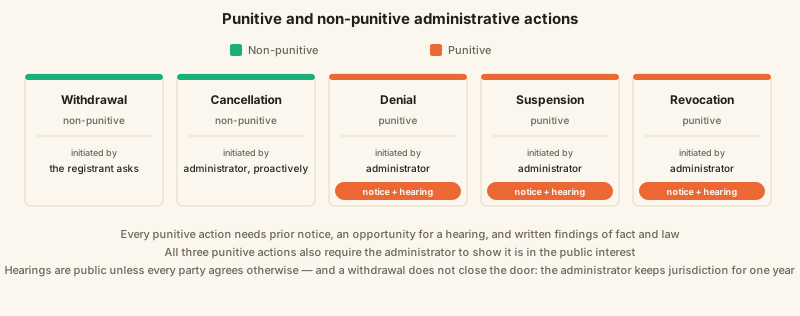
⚠️ Actions requiring notice/hearing vs. not
| Requirement | Applies to |
|---|---|
| Prior notice + opportunity for hearing + written facts and findings of law | ✅ Denial of a registration application; ✅ Suspension of registration; ✅ Revocation of registration |
| Public interest showing required | ✅ All punitive actions (denial, suspension, revocation) |
| Hearings are public | ⚠️ Unless everyone involved agrees otherwise (the applicant, the administrator, and any other related parties) |
🔑 Numbers & deadlines
| Number | What it applies to |
|---|---|
| Past 10 years | Lookback for: violation of a state or federal securities law; any felony conviction; securities-related misdemeanor conviction; enjoined by a court; subject to another state administrator’s regulatory action; dishonest or unethical practices; insolvency |
| Past 5 years | ⚠️ Lookback for violation of a FOREIGN securities law |
| Within 30 days of the application | Administrator typically provides the denial notice within this window |
| 30th day after filing | When effective registration generally occurs if all required documentation is submitted — so denial notice should come before this window ends |
| 60 days after the denial notice | Deadline for the applicant to request a hearing (same 60-day window applies to suspension/revocation appeals) |
| Within 15 days | 🔑 Once a hearing is requested, it must be scheduled within 15 days |
| No later than 30 days after the event | What “promptly” means for a registered person/issuer notifying the administrator of a disqualifying event |
| Annually | Registrations must be renewed |
| 2 | Punitive action types: denial; suspension or revocation |
| 3 | Obligations the administrator must meet: prior notice; opportunity for hearing; written facts and findings of law |
Key points
Punitive actions available to state administrator
- May deny applicants from registration
- May suspend or revoke current registrations
Cause for punitive action
- Must be in the public’s interest, plus any of the following:
- An incomplete, false, or misleading application was submitted
- Any of the following occurred within the past 10 years:
- Violation of a state or federal securities law
- Any felony conviction
- A securities-related misdemeanor conviction
- Enjoined by a court from engaging in the securities industry
- Is subject to a regulatory action by another state administrator
- Engaging in dishonest or unethical practices
- Insolvency
- Violated a foreign securities law within the past 5 years
- Is not qualified due to lack of experience, training, or knowledge
- Failure to supervise employees
- Failure to pay appropriate filing fees
Required to enforce punitive actions
- State administrator must provide:
- Appropriate prior notice to the applicant
- Opportunity for hearing is provided
- Disclosure of written facts and findings of law
Sources
Primary/official references for the material on this page. Every link was fetched and returned HTTP 200 on 2026-08-15.
| # | Source | Publisher |
|---|---|---|
| 1 | Uniform Securities Act 1956 with NASAA updates — the tested statute | NASAA |
| 2 | Adopted model rules archive | NASAA |
| 3 | Achievable Series 65 — chapter 4.4.2 | Achievable (course text) |