Market Makers, Spreads & the NYSE
Market makers
- Investors can buy and sell securities in the secondary market largely because of market makers.
“A market maker is a firm that makes a business out of trading securities with the public.”
- Like a car dealership that buys cars and resells them, a market maker buys securities from investors and sells those securities to other investors.
- This chapter explains how market makers use bid and ask spreads and how they operate in two major markets.
Bid & ask spreads
- Bid & ask (offer) spreads are maintained by market makers in the secondary market.
- 📌 Issuers sell new securities in the primary market; after that, investors trade them with each other in the secondary market.
- The bid and ask are the prices the market maker is willing to trade at.
- 🔑 The difference between them (the spread) is a key source of the market maker’s profit.
🔑 Definitions — bid, ask, spread (word-for-word)
| Term | Definition | Example |
|---|---|---|
| Bid | > “The bid is the price the firm is willing to buy a security at.” | GM stock: “$40 bid” — market maker is willing to buy up to 400 shares at $40 |
| Ask (offer) | > “The ask, sometimes called the offer, is the price the firm is willing to sell a security at.” | GM stock: “$41 ask” — market maker is willing to sell up to 700 shares at $41 |
| Spread | “The difference between them (the spread) is a key source of the market maker’s profit.” / “The difference between $40 and $41 is the spread.” | $41 − $40 = $1 spread |
| Round lot | > “100 shares of stock; common denomination for stock trading” | The “4” on the bid side means 4 round lots, or 400 shares |
| Efficient market | > “An efficient market is defined as one with active trading and small spreads.” | Popular stocks often have spreads measured in pennies |
| Market capitalization | > “The total market value of outstanding shares” | — |
| Market capitalization formula | > “Outstanding shares x market price” | — |
- ⚠️ Both terms are stated from the market maker’s perspective:
- “The term bid is from the market maker’s perspective: the firm is ‘bidding’ for someone to sell to them.”
- “The term ask is also from the market maker’s perspective: the firm is ‘asking’ a price in hopes that someone will buy.”
- Along with the bid price, the market maker also states how many shares they’re willing to buy at that price.
- Along with the ask price, the market maker states how many shares they’re willing to sell at that price.
Worked quote example
ABC stock
$62 bid / $63 ask
5x2
- Here a market maker is quoting ABC stock.
- The bid means the market maker will buy up to 500 shares at $62.
- The ask means the market maker will sell up to 200 shares at $63.
- Quote sizes are shown in round lots. The “5” on the bid side is 5 round lots, or 500 shares, and the “2” on the ask side is 200 shares.
- The spread is $1 ($63 − $62).
Where profit comes from
- The market maker’s profit comes from buying at the bid and selling at the ask.
- Even small spreads can add up because market makers may execute thousands of trades per day.
- A $1 spread is not common for actively traded stocks. Popular stocks often have spreads measured in pennies.
- In an efficient market, firms can still earn substantial profits because trading volume is high and spreads are small.
- As long as the market maker trades frequently with the public, small spreads can add up over the day.
⚠️ Which side does the customer buy at / sell at?
There are always two sides to a trade. The customer takes the opposite side of the market maker.
| Price | Market maker | Customer |
|---|---|---|
| Bid | Market maker buys | Customer sells |
| Ask (offer) | Market maker sells | Customer buys |
Customers sell at the bid and buy at the ask.
NYSE
- Functioning in some form since 1792, the New York Stock Exchange (NYSE) is the world’s largest stock exchange.
- 🔑 The NYSE operates as an auction market, where a designated market maker (DMM) (sometimes called a specialist) facilitates trading in a stock.
- Like other auctions, the DMM (acting like an auctioneer) matches buyers with sellers. The DMM may also trade with the public out of the DMM’s own inventory.
- In any given trade, the DMM can act in an agency or principal capacity.
- 📌 In an agency trade the firm matches a buyer with a seller. In a principal trade it buys from or sells to the client out of its own account. See agency vs. principal capacity.
How the DMM function actually works
-
In practice, the DMM function is both a person on the NYSE floor and a technology-driven trading system.
-
Modern markets move too quickly for a human to manually execute every trade, so market making relies heavily on computerized systems and algorithms that respond almost instantly to changing prices and order flow.
-
People still oversee these systems and may step in to trade manually when needed.
-
Private companies are hired by the NYSE to operate as DMMs, and they assign an employee to work at the DMM post.
-
There are several DMMs on the NYSE, but each listed stock is assigned to one DMM. For example, all trades of Coca-Cola stock (listed on the NYSE) are facilitated by one specific DMM.
-
🔑 The DMM’s primary goal is to maintain fair and orderly markets and reduce liquidity problems — the DMM helps ensure investors can trade at accurate market prices during normal trading hours.
Order routing — Super Display Book
- When firms submit customer orders to the NYSE, most orders go through this system and are routed to the DMM for execution.
- ⚠️ “In 2012, the Super Display Book was updated to the modern Universal Trading Platform, but FINRA still refers to the Super Display Book as the NYSE’s system.”
The DMM’s book
- Limit orders that are currently “away from the market” are placed on the NYSE’s order book, known as the DMM’s book.
- 📌 A limit order sets a price boundary. A buy limit at $62 can fill only at $62 or lower. While the stock trades above $62, the order is “away from the market” and waits until the price comes down to its limit.
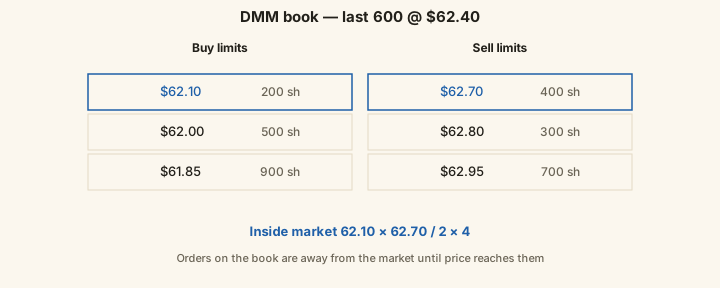
Described contents of that screen:
| Side of the book | What it holds |
|---|---|
| Left side | Buy limit orders entered by firms on behalf of customers |
| Right side | Sell limit orders |
| Both | These orders are “away from the market,” meaning they can’t be filled at the current market price |
Worked example (figures from the diagram above):
The last completed trade was 600 shares at $62.40, which sits between the highest bid and the lowest ask.
The best buy order is 200 shares at $62.10. The best sell order is 400 shares at $62.70.
- 🔑 This is the inside market: the best available prices currently on the DMM’s book.
62.10 x 62.70
2 x 4
Agency vs. principal — worked example
- Market orders are often matched against limit orders on the book. (A market order requests execution at the next available price.)
For example, if a market order to buy 400 shares enters the system, it could be matched against the $62.70 limit order to sell 400 shares. In that case, the DMM is acting in an agency capacity by matching:
the buyer (the market order to buy) with the seller (the $62.70 limit order to sell)
If the DMM believes the $0.60 spread (between the highest bid and lowest ask) is too wide, the DMM can step in and fill the market order at a better price than $62.70.
Assume the DMM sells 400 shares from inventory at $62.55. That gives the buyer a $0.15 per share price improvement compared with buying at $62.70. This is a common way DMMs act in a principal capacity: instead of matching orders from the book, they trade directly from their own inventory.
⚠️ When trading as principal, the DMM must avoid competing with public orders. In this example, that means the DMM cannot:
- sell from inventory at $62.70 or higher, or
- buy into inventory at $62.10 or lower
Doing so would mean trading in front of the public orders on the book.
| Market condition | DMM capacity | What the DMM does |
|---|---|---|
| Trading is active | Agency | Focus on matching buyers and sellers |
| Trading is thin or spreads are wide | Principal | Trade directly with the public to improve liquidity and pricing |
Stopping stock
- 🔑 DMMs are also authorized to stop stock, meaning they can freeze the price of a security for a short period of time.
- This is most often done for floor brokers, who work on the NYSE floor.
- Floor brokers represent financial firms that send trades to the NYSE.
For example, Charles Schwab could send a representative to the NYSE floor to help facilitate large customer trades (while small trades are routinely handled electronically). If Schwab receives a large order in an NYSE-listed stock, the order could be routed to a floor broker. The floor broker may then work with the DMM and other floor brokers to find the best available price.
- If the DMM chooses, the DMM can quote a price to the floor broker and “lock it in” (stop the stock) for a short time. During that time, the floor broker tries to find a better price from other brokers. If no better price is found before the time expires, the broker can return to the DMM and accept the quoted price.
- ⚠️ “DMMs can only stop stock for public orders. They cannot stop stock for themselves or for a firm’s trading account.”
Listing and other exchanges
- The NYSE trades only stocks that are listed on the exchange. To be listed, issuers must meet certain standards (such as market capitalization and minimum numbers of shareholders).
- 📌 “You don’t need to memorize the listing requirements, but it’s important to know that the NYSE generally lists large companies with actively traded stocks.”
| Exchange / concept | Description |
|---|---|
| American Stock Exchange (NYSE-MKT) | An exchange modeled after the NYSE structure |
| Philadelphia Stock Exchange | A regional exchange similar to the NYSE |
| Dual-listed stocks | A stock that trades on the NYSE and another exchange (often a regional exchange) |
Key points
Bid/ask spreads
- Maintained by market makers
- Provide best buy & sell prices
Bid
- Market makers buy at the bid
- Customers sell at the bid
Ask
- Market makers sell at the ask
- Customers buy at the ask
Round lot
- 100 shares of stock
Efficient market
- A large number of market participants
- Small spreads and active trading
New York Stock Exchange
- Auction market
- DMM acts as the NYSE auctioneer
- All trades occur in the first market
Designated market maker (DMM)
- Facilitates trading in NYSE stocks
- May act in an agency or principal capacity
DMM’s book
- Holds limit orders currently away from the market
- Market orders from other investors matched against the book
Floor brokers
- Employees of financial firms operating on the exchange floor
- Obtain the best execution for the firm’s large customer orders
Dual-listed stock
- Listed on a national and regional exchange
Sources
Primary/official references for the material on this page. Every link was fetched and returned HTTP 200 on 2026-08-15.
| # | Source | Publisher |
|---|---|---|
| 1 | Nasdaq — market structure and market makers | SEC |
| 2 | Trading basics — order handling and execution | SEC |
| 3 | Understanding order types — market, limit, IOC, FOK, AON | SEC / Investor.gov |
| 4 | Achievable Series 65 — chapter 2.9.1 | Achievable (course text) |