Regulation T & Margin Equity
📌 Exam relevance note
Margin is long and dense, and it’s usually tested lightly. Any of this material could appear on the exam, but it’s rare to see more than one or two margin-related questions, so don’t overinvest time memorizing every detail.
Cash vs margin accounts
| Account type | Payment requirement | Strategies allowed |
|---|---|---|
| Cash account | Investor must pay 100% for each securities transaction | Prohibits strategies with unlimited loss potential, such as short selling |
| Margin account | Investor may borrow money for investment purposes | Permits higher-risk strategies; required for short sales and any other strategy involving unlimited risk (like short calls) |
- At brokerage firms, there are two main types of accounts: cash and margin accounts.
- When an investor borrows money for investment purposes, they’re using leverage. Leverage magnifies both gains and losses.
- With a margin account, you can earn more when your investment is right, but you can also lose more when the market moves against you.
Casino analogy for leverage
- Imagine you have $5,000 of your own money and borrow another $5,000 from a friend. Then you take all $10,000 to the casino and bet it on one game.
- If you win, you double your money to $20,000 — more than you could’ve made with only your $5,000.
- If you lose, you lose your $5,000 and you still owe your friend $5,000.
- Borrowing money to invest works the same way: you can increase returns if you’re right, but you can also increase losses if you’re wrong.
Because margin adds risk, it is generally only appropriate for investors who can tolerate significant losses.
Opening margin accounts
Margin accounts require more than a basic new account form. Customers opening margin accounts must complete and sign the margin agreement, which has three parts.
Definitions — the three parts of the margin agreement
| Term | Definition | Example |
|---|---|---|
| Hypothecation agreement | Requires the customer to pledge their securities as collateral for margin loans. Must be signed by law. | Just as a home serves as collateral for a mortgage, securities held in a brokerage account serve as collateral for a margin loan. If a customer borrows money from their broker-dealer and can’t repay it, the broker-dealer can liquidate (sell) securities in the account to satisfy the loan. |
| Credit agreement | Contains the margin loan terms. Must be signed by law. | This is where you’ll find how the broker-dealer calculates margin interest, the repayment schedule, and other loan conditions. |
| Loan consent form | Authorizes the broker-dealer to lend the customer’s securities to other customers for short sales. Optional — the only optional part. | Short sales involve borrowing securities from a broker-dealer, selling them, and (ideally) buying them back after the price drops. The borrowed securities typically come from other margin customers. |
The loan consent form is the ONLY optional part of the margin agreement. By law, the hypothecation agreement and credit agreement must be signed to open a margin account.
Rehypothecation and Regulation U
- Broker-dealers are not banks and typically don’t have large amounts of cash available to lend. Instead, they rehypothecate (re-pledge) customers’ securities to banks in exchange for a loan.
- The relationship between the bank and the broker-dealer is governed by Regulation U.
Regulation U allows the broker-dealer to rehypothecate securities up to 140% of the customer’s loan (debit) amount.
Example: if a customer borrows $10,000 through a margin loan, the broker-dealer may rehypothecate $14,000 of the customer’s securities to the bank as collateral.
- The broker-dealer then lends the bank’s money to customers at a slightly higher interest rate.
- 🔑 The difference between the interest rate the broker-dealer pays the bank (the broker loan rate) and the interest rate charged to customers is how broker-dealers earn revenue from margin lending.
Commingling
| Account type | Commingling of securities |
|---|---|
| Margin account (with loan consent form on file) | Securities may be commingled with other customers’ securities — their stocks, bonds, and other investments may be held in other customer accounts. This happens behind the scenes; margin customers generally won’t know when their securities are being lent. |
| Cash account | Not permitted. Fully paid securities in cash accounts must be segregated and held in safekeeping for each investor. |
Deposit requirements
Deposit requirements are the amount of money required to execute an investment strategy in a margin account. When borrowing money from a broker-dealer, investors are subject to Regulation T and FINRA requirements.
| Rule | Requirement | Administered by |
|---|---|---|
| Regulation T | Generally requires a 50% deposit when borrowing money or securities for investment purposes. A rule under the Securities Exchange Act of 1934. | The Federal Reserve |
| FINRA minimum equity | Minimum margin equity (ownership) level of $2,000 to use margin | FINRA |
In practice, the required deposit is the GREATER of the Regulation T requirement and the FINRA requirement.
Sidenote — FINRA
- The Financial Industry Regulatory Authority (FINRA) is an industry-funded, non-governmental regulator.
- While organizations like the Securities and Exchange Commission (SEC) and the state administrator are government regulators, FINRA is a self-regulatory organization (SRO).
- SROs are granted regulatory authority within their industries. If the industry didn’t fund and enforce its own rules through an SRO, the government would typically impose more direct regulation.
- FINRA is sometimes compared to internal affairs within a police department: it investigates and disciplines member firms and representatives to help maintain investor confidence and market integrity.
- 📌 You don’t need deep detail on FINRA for the exam, since the SEC and state administrators are more commonly tested. Still, you’ll see FINRA referenced throughout securities regulation.
Worked example — long purchase deposit
An investor opens a new margin account and subsequently executes a purchase of 100 shares of ABC stock at $30. What is their deposit requirement?
Answer = $2,000
The investor is purchasing $3,000 of stock (100 shares x $30). They must deposit the greater of 50% or $2,000. A 50% deposit equals $1,500. Therefore, the investor must deposit $2,000 to execute this transaction.
Purchases below $2,000
- What if an investor purchases less than $2,000? For example, suppose an investor purchases $1,200 of a security.
- Requiring a $2,000 deposit wouldn’t make sense when the maximum loss is $1,200 (assuming the stock becomes worthless). In that case, the investor deposits 100% of the purchase amount.
- Practically, the account is treated like a cash account for that transaction.
🔑 Margin initial deposit rules — LONG accounts
| Purchase amount | Deposit amount |
|---|---|
| $2,000 or less | Entire amount |
| $2,000 – $4,000 | $2,000 |
| $4,000 or more | 50% (Regulation T) |
🔑 Margin initial deposit rules — SHORT accounts
- These rules differ for short accounts. When an investor sells short stock, losses can exceed the initial value of the position.
- Example of unlimited risk: assume an investor shorts 100 shares at $15. The initial short position is $1,500, but the investor could lose an unlimited amount if the stock rises. If the stock price rises to $50, the investor must spend $5,000 to buy it back ($50 x 100 shares), resulting in a $3,500 loss ($1,500 short sale − $5,000 repurchase).
- Because short positions have higher risk, margin rules require a minimum deposit equal to the greater of 50% or $2,000.
Most importantly, even a small short position below $2,000 still requires at least a $2,000 deposit. This is the key difference from long purchases.
Example: An investor opens a new margin account and subsequently executes a short sale of 10 shares of ABC stock at $40. What is their deposit requirement?
Even though the position is only worth $400 (10 shares x $40), the investor must deposit $2,000.
Unlike long purchases, short sales below $2,000 still require at least a $2,000 deposit. If this example were a long purchase of 10 shares at $40, the required deposit would be only $400.
| Position size | Long account deposit | Short account deposit |
|---|---|---|
| Below $2,000 (e.g., $400 position) | 100% of purchase ($400) | $2,000 |
| $2,000 – $4,000 | $2,000 | $2,000 |
| $4,000 or more | 50% (Reg T) | 50% (Reg T) |
Regulation T settlement / payment deadline
- Regulation T also sets a payment/delivery deadline for both margin and cash accounts.
- Although different securities have different settlement times, 🔑 Regulation T settlement is always two (2) business days after regular-way settlement.
- This is the last day cash for a purchase or securities for a sale can be delivered.
If the investor doesn’t deposit by Reg T settlement
The broker-dealer must take action. It can:
| Action | What happens |
|---|---|
| Request an extension from the appropriate SRO (usually FINRA) | The customer gets a few extra days to meet the obligation. Example: if a customer owes $10,000 for a recent purchase, they may receive a few additional days to deposit the $10,000. Extensions are relatively uncommon and may be denied. |
| Close out the position and freeze the account (more common) | The firm liquidates positions as needed and freezes the account. Example: if the customer owes $10,000 and doesn’t pay by Reg T settlement, the firm can liquidate $10,000 of securities in the account, apply the proceeds to the obligation, and then freeze the account. |
🔑 Frozen accounts
- A frozen account isn’t completely unusable. The customer can still trade, but only if the funds are already in the account.
- In other words, the customer must have the required cash on deposit before placing a purchase order.
- The freeze lasts 90 days.
Equity
A key margin concept is equity, which is the customer’s net ownership value in the account. When borrowed funds are involved, you have to account for the loan that must be repaid to determine what the customer truly owns.
Example: a $50,000 margin account with a $20,000 loan has $30,000 of equity.
There are two equity formulas: the long account equity formula and the short account equity formula.
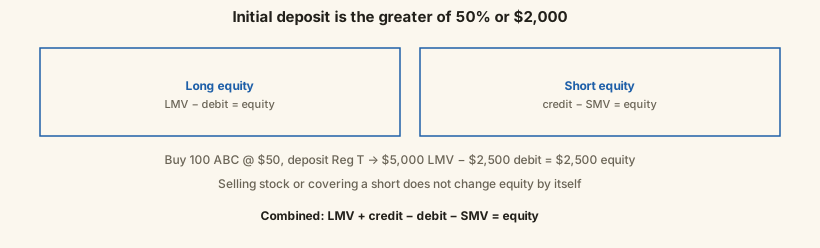
🔑 Long account equity formula
LMV − Debit = Equity
| Term | Definition |
|---|---|
| LMV (long market value) | The total market value of the long (owned) securities in the account |
| Debit | The outstanding margin loan balance (the amount borrowed from — and owed to — the broker-dealer) |
| Equity | What remains after subtracting the debit from the LMV |
Worked example 1 — long equity at opening
An investor purchases 100 shares of ABC stock at $50 in their newly-opened margin account and deposits their Regulation T requirement. Determine the equity.
$5,000 (LMV) − $2,500 (debit) = $2,500 (equity)
The investor purchases $5,000 of stock (100 shares x $50). The investor must deposit the greater of 50% of the purchase or $2,000. Here, 50% is greater, so the investor deposits $2,500. The remaining $2,500 is borrowed from the broker-dealer, which becomes the debit.
Worked example 2 — long equity after a price increase
An investor purchases 200 shares of ABC stock at $70 in their newly opened margin account and deposits their Regulation T requirement. The market then rises to $80. What is the equity?
Answer = $9,000
How the account starts:
$14,000 (LMV) − $7,000 (debit) = $7,000 (equity)
The investor purchases $14,000 of stock (200 shares x $70). The investor deposits 50% (which is greater than $2,000), so they deposit $7,000. The other $7,000 is borrowed, creating a $7,000 debit.
Next, incorporate the price increase to $80:
$16,000 (LMV) − $7,000 (debit) = $9,000 (equity)
The LMV rises because the stock is now worth $16,000 (200 x $80). The debit doesn’t change because the investor didn’t borrow more or repay the loan.
Worked example 3 — long equity when shares are sold
Key rule: unless stated otherwise, sale proceeds in a long margin account are used to repay the margin loan, which reduces the debit balance.
A client goes long 400 shares of ZZZ stock at $20 per share. The stock rises to $30, and the investor sells 100 shares. What is the resulting equity formula?
How the account starts:
$8,000 (LMV) − $4,000 (debit) = $4,000 (equity)
The investor buys $8,000 of stock (400 x $20). They deposit 50% (greater than $2,000), so they deposit $4,000 and borrow $4,000.
Next, incorporate the price increase to $30:
$12,000 (LMV) − $4,000 (debit) = $8,000 (equity)
The LMV increases to $12,000 (400 x $30). The debit stays at $4,000.
Finally, the investor sells 100 shares at $30. The updated formula is:
$9,000 (LMV) − $1,000 (debit) = $8,000 (equity)
Two values change when shares are sold in a long margin account:
- LMV decreases because the account holds $3,000 less stock (100 x $30).
- Debit decreases because the $3,000 sale proceeds are used to repay the loan.
Notice that equity doesn’t change from the sale itself ($8,000 before and after). Selling converts $3,000 of stock into $3,000 of cash, so the account’s net value is unchanged.
🔑 Short account equity formula
Equity works the same way in a short account, but the formula is different:
Credit − SMV = Equity
| Term | Definition |
|---|---|
| Credit | The cash balance in the margin account related to the short position. It comes from (1) the short sale proceeds and (2) the investor’s required deposit. |
| SMV (short market value) | The current market value of the securities sold short |
| Equity | The account’s net worth (credit minus SMV) |
Worked example 1 — short equity at opening
An investor sells short 100 shares of XYZ stock at $80 and deposits the required margin.
First, find the credit:
- Short sale proceeds: 100 x $80 = $8,000
- Required deposit: the greater of 50% or $2,000
- 50% of $8,000 is $4,000, so the deposit is $4,000
So the credit balance is $8,000 + $4,000 = $12,000.
*The credit balance represents cash “on the sideline.” Since the investor must eventually repurchase the stock, the broker-dealer requires cash in the account to support that future buy-in. In this example, $12,000 is available to repurchase the 100 shares.
Next, find the SMV:
- SMV = 100 x $80 = $8,000
Now apply the formula:
$12,000 (credit) − $8,000 (SMV) = $4,000 (equity)
Worked example 2 — short equity after a price decrease
An investor sells short 300 shares of BCD stock at $60 and deposits the required margin. The stock then falls to $50. What is the equity?
Answer = $12,000
How the account starts:
$27,000 (credit) − $18,000 (SMV) = $9,000 (equity)
The credit equals the short sale proceeds plus the deposit:
- Short sale proceeds: 300 x $60 = $18,000
- Deposit: 50% of $18,000 = $9,000 (greater than $2,000)
- So credit = $18,000 + $9,000 = $27,000
Next, incorporate the price decrease to $50:
$27,000 (credit) − $15,000 (SMV) = $12,000 (equity)
The SMV falls to $15,000 (300 x $50). The credit doesn’t change because the investor hasn’t shorted more shares or repurchased any shares.
Worked example 3 — short equity when part of the position is closed
Key rule: unless stated otherwise, repurchases to close a short position are funded from the credit balance (the cash set aside to buy back shares).
A client goes short 100 shares of CDE stock at $200 per share. The stock falls to $150, and the investor buys back 50 shares to close part of the position. What is the resulting equity formula?
The credit equals the short sale proceeds plus the deposit:
- Short sale proceeds: 100 x $200 = $20,000
- Deposit: 50% of $20,000 = $10,000 (greater than $2,000)
- So credit = $30,000
Next, incorporate the price decrease to $150:
$30,000 (credit) − $15,000 (SMV) = $15,000 (equity)
The SMV falls to $15,000 (100 x $150). The credit doesn’t change.
Finally, the investor buys back 50 shares at $150. The updated formula is:
$22,500 (credit) − $7,500 (SMV) = $15,000 (equity)
Two values decline when part of a short position is closed:
- Credit decreases because $7,500 of cash is used to repurchase shares (50 x $150).
- SMV decreases because half the short position is closed, reducing SMV by $7,500.
Notice that equity doesn’t change from the act of buying back shares ($15,000 before and after). The account is simply using $7,500 of cash to eliminate $7,500 of short exposure.
Key points
Margin accounts
- Borrow money for investment (leverage)
- Only suitable for risk-tolerant investors
Margin agreement components
- Hypothecation agreement
- Credit agreement
- Loan consent form
Hypothecation agreement
- Investor pledges securities as collateral
- Must be signed by the customer
- Firms rehypothecate securities to the bank
Regulation U
- Governs B/D to bank relationship
- B/Ds can rehypothecate 140% of debit
Credit agreement
- Margin loan details and specifics
- Must be signed by the customer
Loan consent form
- Allows B/D to lend out securities
- Does not have to be signed
Commingling securities
- Allowed for margin account securities
- Prohibited for cash account securities
Regulation T
- Requires 50% deposit for margin trade
Regulation T settlement
- 2 business days after regular-way settlement
FINRA margin requirement
- Minimum equity of $2,000
Frozen accounts
- Implemented if the customer misses Reg T settlement
- Purchases only occur if cash is in the account
- Lasts for 90 days
Long equity formula
- LMV − debit = equity
- LMV is the long market value
- Debit is the amount borrowed
- Equity is the account’s net worth
Short equity formula
- Credit − SMV = equity
- Credit is the amount sold short plus the amount deposited
- SMV is the short market value
- Equity is the account’s net worth
Combined equity formula
- 🔑 LMV + credit − debit − SMV = equity
- Can be rewritten in multiple ways
Sources
Primary/official references for the material on this page. Every link was fetched and returned HTTP 200 on 2026-08-15.
| # | Source | Publisher |
|---|---|---|
| 1 | Regulation T — credit by brokers and dealers | eCFR (12 CFR Part 220) |
| 2 | Margin — borrowing to buy stock, maintenance calls | SEC |
| 3 | Rule 4210 — margin, minimum maintenance requirements | FINRA |
| 4 | Approval order replacing Rule 4210 day-trading margin (and the $25,000 pattern-day-trader minimum) with intraday margin standards | SEC (Federal Register, 17 Apr 2026) |
| 5 | Achievable Series 65 — chapter 2.9.5 | Achievable (course text) |