State Registration by Filing
⚠️ The three state registration methods — where this page fits
There are three ways to register a security at the state level:
| Method | This page? |
|---|---|
| Registration by filing (notice filing) | ✅ This page |
| Registration by coordination | Separate page |
| Registration by qualification | Separate page |
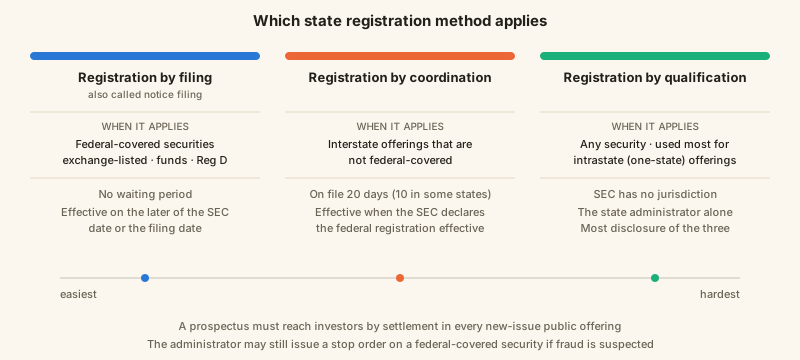
🔑 Registration by filing at a glance
| Question | Answer |
|---|---|
| Which issuers may use it? | Issuers of federal-covered securities — exchange-traded securities (and senior/equal-seniority securities of the same issuer), investment company securities, Regulation D securities, and certain federally exempt securities (US Government securities; municipal securities offered outside their state of issuance) |
| What must be filed? | A copy of the SEC registration form and any amendments; consent to service of process; report detailing the dollar amount of securities to be sold in the state; filing fee |
| How long is the waiting period? | No stated waiting period — the security may be sold once the required documents and filing fee are submitted |
| When does registration become effective? | On the day SEC registration becomes effective or on the day the notice filing is submitted — whichever occurs later |
A federal-covered security can be sold in a state once the required documents and filing fee are submitted. Sales may occur on the day SEC registration becomes effective or on the day the notice filing is submitted - whichever occurs later.
🔑 Numbers & deadlines
| Item | Requirement |
|---|---|
| Effective/sale timing | Later of: day SEC registration becomes effective OR day the notice filing is submitted |
| Notice filing location | Each state where the security will be offered |
| Prospectus delivery (all new issue public offerings, including coordination and qualification) | Must be delivered to investors by settlement (when the sale is finalized) |
| US Government / municipalities offering outside their state | Typically not subject to any filing requirements |
| Required notice filing items | 4 items (SEC registration form + amendments; consent to service of process; dollar-amount report; filing fee) |
| Administrator’s power over federal-covered securities | May issue stop orders to prevent sales if fraud is suspected |
Governing acts referenced: Uniform Securities Act (USA), National Securities Market Improvement Act (NSMIA).
Who may file a registration statement
According to the Uniform Securities Act (USA), a registration statement may be filed by any of these entities:
| Filer | Explanation |
|---|---|
| Issuers | In most cases, the issuer files the registration paperwork when it wants to sell its securities |
| A person on whose behalf the offering is to be made | Usually means a large shareholder who wants to sell previously unregistered securities to the public |
| Broker-dealers | The issuer often works with an underwriter (the USA loosely treats the underwriter as a broker-dealer), so a broker-dealer may file registration paperwork on the issuer’s behalf |
Example: a large institution buys securities through a private placement (e.g., Regulation D), and the issuer never plans to register those shares. If the institution later wants to sell those securities to the general public, it must register them. Otherwise, it would need to sell them through another type of exempt transaction.
Federal-covered securities
- The National Securities Market Improvement Act (NSMIA) created a category called federal-covered securities.
- The idea is similar to federal-covered advisers: 🔑 these securities register only with the SEC, and then provide a notice filing to the state administrator.
NSMIA defines the following as federal-covered securities:
| Federal-covered security category | Conditions / notes |
|---|---|
| Exchange-traded securities | Listed (or authorized for listing) on NYSE, American Stock Exchange, or Nasdaq National Market System; also includes securities of the same issuer equal in seniority or senior to such a security |
| Investment company securities | Open-end management companies (mutual funds); closed-end management companies (closed-end funds); unit investment trusts; face amount certificates |
| Regulation D securities | Private placement securities exempt from SEC registration |
| Certain federally exempt securities | US Government securities (all); municipal securities — only when sold outside their state of issuance |
Exchange-traded securities
NSMIA states:
A security is a covered security if such security is:
Listed, or authorized for listing, on the New York Stock Exchange or the American Stock Exchange, or listed on the National Market System of the Nasdaq Stock Market (or any successor to such entities);
Is a security of the same issuer that is equal in seniority or that is a senior security to a security described in [previous bullet point]
- In plain English, a security is federal-covered if it’s listed on a national exchange such as the New York Stock Exchange (NYSE), the American Stock Exchange (now NYSE American), or NASDAQ.
- Only larger, well-established companies typically qualify for these listings. Examples: Visa (NYSE), Tesla (NASDAQ), Apple (NASDAQ). Smaller companies may trade on NYSE American.
- NSMIA also treats certain other securities from the same issuer as federal-covered, even if those securities aren’t exchange-traded.
- Stocks are the most common securities listed on exchanges. Many debt securities (such as bonds) are not exchange-traded; instead, they trade in the over-the-counter (OTC) markets.
| Term | Definition |
|---|---|
| OTC security | A security that does not trade on an exchange |
Example: Ford Motor Company common stock trades on the NYSE. If Ford issued a bond, that bond would likely trade OTC. Even though the bond wouldn’t be listed on a national exchange, it would still be federal-covered because bonds are senior securities to common stock.
*While not an important topic for the exam, a security’s seniority relates to a company’s liquidation priority.
Liquidation priority order (general):
| Order | Claimant |
|---|---|
| 1 | Secured creditors (secured bondholders) |
| 2 | Unsecured creditors (debenture holders) |
| 3 | Preferred stockholders |
| 4 | Common stockholders |
- Because common stockholders are last in line, most other securities an issuer sells have senior priority.
- 📌 Bottom line: it’s generally safe to assume that any security sold by an issuer with common stock listed on a national exchange is federal-covered.
Investment company securities
- Investment companies pool investors’ money, invest according to a stated objective, and seek the best return possible within that structure. Example: the Vanguard Growth and Income Fund, a mutual fund that invests in stocks with growth and income potential.
| Four types of investment companies |
|---|
| Open-end management companies (mutual funds) |
| Closed-end management companies (closed-end funds) |
| Unit investment trusts |
| Face amount certificates |
Regulation D securities
- Securities sold through Regulation D private placements are exempt from SEC registration. NSMIA also classifies these securities as federal-covered.
Certain federally exempt securities
Two exempt categories are also treated as federal-covered:
| Security | Condition |
|---|---|
| US Government securities | All |
| Municipal securities | ⚠️ Federal-covered only when they’re sold outside their state of issuance |
- Example: a municipal bond issued in Wisconsin is federal-covered in every state except Wisconsin. Within Wisconsin, that bond is not federal-covered, which gives the Wisconsin state administrator some regulatory authority over the offering.
- 📌 For exam purposes, the key point is that municipal bonds are federal-covered outside the state where they’re issued.
Registration by filing (notice filing)
- Federal-covered securities are exempt from state registration, but they may still have certain obligations to the state administrator.
- Similar to federal-covered advisers, issuers of federal-covered securities must submit a notice filing in each state where the security will be offered.
- Under the USA, this is called registration by filing (also known as notice filing), even though the security is not actually registering with the state.
*Unlike other federal-covered securities, the US Government and municipalities offering securities outside their state are typically not subject to any filing requirements.
- Federal-covered securities don’t register with the state, but most are registered with the SEC (federal registration). ⚠️ The main exceptions are Regulation D securities and government securities, which are also exempt at the federal level.
🔑 What must be filed
The USA requires issuers of federal-covered securities to provide the following with the notice filing:
| Required item |
|---|
| A copy of the SEC registration form and any amendments |
| Consent to service of process |
| Report detailing the dollar amount of securities to be sold in the state |
| Filing fee |
Administrator’s role
- ⚠️ The state administrator generally does not review or “approve” these filings in the way they would for a state-registered offering. The SEC regulates federal-covered securities, not the state.
- Although the state administrator has limited authority over federal-covered securities, they may issue stop orders to prevent sales if fraud is suspected.
🔑 When sales may occur (effective-date rule)
A federal-covered security can be sold in a state once the required documents and filing fee are submitted. Sales may occur on the day SEC registration becomes effective or on the day the notice filing is submitted - whichever occurs later.
Prospectus delivery
- Once a federal-covered security’s registration is effective, the issuer must meet prospectus delivery requirements.
| Term | Definition |
|---|---|
| Prospectus | The disclosure document given to investors that contains the material information they need |
- Example referenced: AirBnB’s prospectus from its December 2020 IPO.
- 🔑 In any new issue public offering (including registration by coordination and qualification), the prospectus must be delivered to investors by settlement (when the sale is finalized).
Key points
Registration statements may be filed by
- Issuers
- A person on whose behalf the offering is to be made
- Broker-dealers
Federal-covered securities
- Exchange-traded securities
- Includes senior securities of the same issuer
- Investment company securities
- Regulation D securities
- Some government securities
- All US Government securities
- Municipal securities offered outside their state of issuance
Registration by filing
- SEC (federal) registration only
- Must provide notice filing to the state
- Required items in notice filing:
- A copy of the SEC registration form and any amendments
- Consent to service of process
- Report detailing the dollar amount of securities to be sold in the state
- Filing fee
Sources
Primary/official references for the material on this page. Every link was fetched and returned HTTP 200 on 2026-08-15.
| # | Source | Publisher |
|---|---|---|
| 1 | Uniform Securities Act 1956 with NASAA updates — the tested statute | NASAA |
| 2 | Uniform Securities Acts (1956 / 1985 / 2002) index | NASAA |
| 3 | Achievable Series 65 — chapter 4.3.5.3 | Achievable (course text) |