New Accounts & Advisory Contracts
Overview
It’s important to understand the basics of opening brokerage and advisory accounts for customers and clients. If you’ve prepared for another finance exam like the SIE, Series 6, or Series 7, you’ve likely seen much of the process and paperwork before. This chapter adds several concepts that are especially important for this material.
Customer agreements related to opening accounts covered here:
- New accounts
- Margin accounts
- Options accounts
New accounts
Clients and customers must provide specific information to open new accounts with broker-dealers and investment advisers. This requirement comes from the Patriot Act, which was signed into law after the 9/11 attacks in 2001 to help prevent terrorism and money laundering. The law requires financial firms to verify customer identities, helping prevent accounts from being opened under false identities.
🔑 Customer Identification Program (CIP) — four pieces of critical information
| # | Required information |
|---|---|
| 1 | Name |
| 2 | Date of birth |
| 3 | Address |
| 4 | SSN or TIN |
- If a customer is a non-resident alien, they must provide their foreign passport and their US tax identification number (TIN).
- Citizenship is confirmed through this process, which is another account opening disclosure required.
Verification methods
| Method | Detail / Example |
|---|---|
| Government-issued ID | Driver’s license, passport, and/or military ID |
| Credit database | TransUnion, Experian, and/or Equifax |
Suitability information
- Firms also request information about the client’s financial situation. This is called suitability information, and it’s especially important for investment advisers.
- To make suitable recommendations, a financial professional needs to understand the client’s financial status, risk tolerance, and goals.
- ⚠️ Technically, investors are not legally required to provide suitability information. However, if the firm doesn’t have enough suitability information, it can’t make recommendations. In that case, any trades must be unsolicited (meaning the client initiates the trade without a recommendation).
- Unsolicited trading is common at broker-dealers, especially for self-directed customers.
NASAA advisory contract rule (2013 update)
The North American Securities Administrators Association (NASAA) issued an updated rule in 2013 regarding advisory contracts. To comply, contracts that clients sign with investment advisers must be in writing and must disclose:
🔑 Required advisory contract provisions (word-for-word)
| # | Required disclosure |
|---|---|
| 1 | The services to be provided |
| 2 | Term of the contract (length of time it covers) |
| 3 | Advisory fees to be paid |
| 4 | Formula for computing the advisory fee |
| 5 | Amount of fees returned if contract terminated prematurely |
| 6 | If discretionary authority is provided to the adviser and/or IARs |
| 7 | No assignment may be made without the client’s authorization |
| 8 | The adviser will not keep capital gains made (unless the client is qualified) |
| 9 | Advisers structured as partnerships will notify clients if the partnership structure changes |
Sidenote: Assignment of contracts
When the investment adviser controlling a client’s account materially changes, assignment has occurred.
🔑 NASAA defines it as:
Any transaction or event that results in any change to the individuals or entities with the power, directly or indirectly, to direct the management or policies of, or to vote more than 50 percent of any class of voting securities of, the investment adviser or federal-covered investment adviser as compared to the individuals or entities who had such power as of the date when the contract was first entered into, extended or renewed.
In simple terms, assignment occurs when control of the advisory firm changes in a way that effectively transfers the client’s contract to a different controlling party.
- In its most basic form, assignment would occur if an adviser transferred a client’s contract to a completely different firm. For example, assume a client has ABC Advisers managing their assets. If the business is sold to XYZ Advisers, assignment occurs once XYZ begins managing ABC’s former clients.
- ⚠️ Assignment isn’t inherently unethical or illegal, but it must be voluntary. If the client approves the assignment in writing, it complies with securities rules and regulations. Any involuntary assignment is unlawful.
📌 Partnerships — common test focus
Investment advisers structured as partnerships are a common test focus for assignment. Many advisory firms are partnerships, meaning two or more persons own, manage, and control the business. Assignment occurs if a majority (more than 50%) of the partnership changes.
| Scenario | Change | Is it assignment? | Client requirement |
|---|---|---|---|
| Acme Advisory Partners has 3 partners (Parsa, Denzel, Jada). Parsa and Denzel sell interests to Sally | 2 of 3 partners (66%) — majority change | ✅ Yes, assignment | Must obtain written approval from all clients to continue managing their accounts (even if the firm keeps the same name) |
| Only Parsa sells his interest to Sally | 1 of 3 partners (33%) — minority change | ❌ No, not assignment | Still requires written notification to clients within a reasonable amount of time |
- 🔑 Corporations can be subject to similar assignment rules if more than 50% of the voting shares change hands.
Hedge clauses
NASAA rules also prohibit the use of hedge clauses in advisory contracts. 🔑 Rule language:
It is unlawful for any investment adviser, investment adviser representative, or federal-covered investment adviser to include in an advisory contract, any condition, stipulation, or provisions binding any person to waive compliance with any provision of [the Uniform Securities Act].
- In plain terms, a hedge clause is language where a client “agrees” to let the adviser or IAR avoid legal responsibilities or waive compliance with securities law.
- You might wonder why a client would ever agree to that. One reason the idea might come up is if a client who doesn’t meet qualified status wants the adviser to ignore NASAA rules so the adviser can charge performance fees. That would be both unethical and illegal.
Performance fees involve the adviser keeping a portion of the capital gains it makes for its clients. A common performance fee structure is 2 & 20, meaning the adviser charges 2% of assets under management (AUM) and keeps 20% of the gains made.
⚠️ Permitted hedge-clause language (“uncontrollable events”)
Although hedge clauses are generally unlawful, regulators often allow hedge-clause language that addresses truly “uncontrollable events.” These are typically large-scale disruptions such as:
| Permitted category | Example |
|---|---|
| Weather-related disasters | Hurricanes, earthquakes |
| Communication disruptions | Telephone lines going down |
| War | — |
| Government shutdowns | — |
| Other large-scale catastrophes | Global pandemics |
For example, an adviser might include language stating they may not be able to fulfill fiduciary obligations during a natural disaster.
Sidenote: Disclosure of non-public client data
- In general, registered persons may not disclose non-public client data (e.g., account activity, contract details) without explicit client approval.
- This rule generally applies unless trading authority or legal jurisdiction applies.
- If a client’s partner, spouse, or another third party has power of attorney, they may be provided non-public account information upon request.
Legal jurisdiction typically refers to a governmental entity with authority to request this information.
🔑 Entities that may receive non-public client data WITHOUT client approval
| Entity | Mechanism / note |
|---|---|
| Judges | Requesting information via court orders |
| Police investigators | Via subpoena |
| Federal Bureau of Investigation (FBI) | — |
| Internal Revenue Service (IRS) | — |
| State administrator | — |
| Securities and Exchange Commission (SEC) | — |
| Financial Industry Regulatory Authority (FINRA) | — |
Margin accounts
- Margin accounts allow investors to borrow money for investment purposes. This creates leverage, which can amplify both gains and losses.
- In addition to a new account form, investors opening margin accounts must also complete and sign the margin agreement.
🔑 Margin agreement — three subsections
| Component | Definition | Example / note |
|---|---|---|
| Hypothecation agreement | Where the customer pledges securities as collateral for the margin loan | Just as a home serves as collateral for a mortgage, securities in a brokerage account serve as collateral for margin borrowing. If the customer can’t repay the loan, the broker-dealer can liquidate (sell) securities in the account to pay off the debt. |
| Credit agreement | Describes the margin loan terms, including how margin interest is calculated, the repayment schedule, and other loan terms | Also discloses whether the investor’s credit may be checked. |
| Loan consent form | The only optional part of the margin agreement. If signed, it allows the broker-dealer to lend the customer’s securities to other investors for short sales | Although there’s no legal requirement to sign it, most broker-dealers won’t open margin accounts without it. |
- ⚠️ The margin agreement must be signed and submitted (except for the loan consent form) promptly after the first executed margin trade. This is slightly different from FINRA rules you may have learned while preparing for the SIE, Series 6, or Series 7.
- Margin accounts are risky because the investor can lose more than the cash they deposited. If the investment declines sharply, the investor still owes the borrowed funds back to the broker-dealer.
Additional margin disclosures
Because of these added risks, investors opening margin accounts receive additional disclosures. These disclosures emphasize that:
- The investor can lose more than the account’s value, and
- Securities in the account serve as collateral for the loan
Options account
An option is a contract between two parties (investors) to perform a transaction at a fixed price.
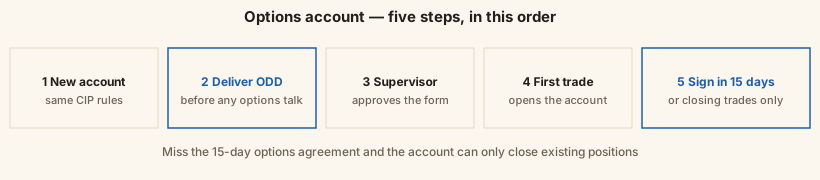
🔑 Options account opening process (in order)
| Step | Action | Detail |
|---|---|---|
| 1 | Investor fills out a new account form | The same structure and rules discussed above (including CIP procedures) apply. |
| 2 | Investor is provided the ODD | The Options Disclosure Document (ODD) explains the characteristics, risks, and benefits of options. Produced by the Options Clearing Corporation, the primary options regulator. ⚠️ Must be delivered before opening an options account or having any options-related discussion — e.g., if a firm mails options marketing materials to an investor who hasn’t received the ODD, the firm must include the ODD. |
| 3 | Account is approved by the firm supervisor | The new account form is sent to a firm supervisor for approval. The supervisor confirms that required documentation is complete and that proper account-opening procedures were followed. |
| 4 | First trade “opens” the account | Once approved, the investor may place options trades. The first executed trade technically opens the account. |
| 5 | Investor returns signed options agreement within 15 days | By signing it, the investor confirms they have read the ODD, understand the characteristics of options, and that their suitability information is accurate as of the signing date. ⚠️ If it isn’t returned on time, the account is restricted to transactions that close out existing options positions. |
Key points
Customer identification procedure
- Firms must verify the identities of their clients
- The following information must be collected:
- Name
- Date of birth
- Address
- SSN or TIN
- Client information must be verified by comparing it against:
- Government-issued ID, or
- Comparison against a credit database
Disclosure of non-public client data
- Strictly prohibited without client approval
- Does not apply to:
- Third parties with trading authority
- Legal authorities
Assignment of contract
- Occurs when an adviser transfers the contract to another adviser
- May only be done with written client approval
- Considered assignment:
- Majority change to adviser set up as a partnership
- Minority changes to adviser set up as a partnership is not assignment
- Still requires written notice to clients
Hedge clauses
- An attempt to gain client approval to avoid compliance with the law
- Generally prohibited
- Hedge clauses relating to “acts of god” or other uncontrollable events ARE allowed
Margin accounts
- Allow investors to pledge securities in return for borrowing money
- Generally used by investors for leverage
- Amplified gains and losses
- Margin agreement components
- Hypothecation agreement
- Credit agreement
- Loan consent form
Options accounts
- Process for opening:
- Investor fills out a new account form
- Investor is provided the ODD
- Account is approved by the firm supervisor
- First trade “opens” the account
- Investor returns signed options agreement within 15 days
Sources
Primary/official references for the material on this page. Every link was fetched and returned HTTP 200 on 2026-08-15.
| # | Source | Publisher |
|---|---|---|
| 1 | Model Rule 102(a)(4)-1 — unethical practices of IAs and IARs | NASAA |
| 2 | Investment Advisers Act rules (206(4)-x, custody, brochure) | eCFR (17 CFR Part 275) |
| 3 | Rule 4512 — customer account information, trusted contact | FINRA |
| 4 | Achievable Series 65 — chapter 4.5.4 | Achievable (course text) |