Open Market Operations & Reserve Requirements
⚠️ MONETARY vs FISCAL POLICY — who controls what
This is the top trap in Unit 3. Every tool on this page belongs to the Federal Reserve, not to Congress or the President.
| Policy | Who controls it | Tools |
|---|---|---|
| Monetary policy | The Federal Reserve Board (the Fed) — open market operations specifically conducted by the FOMC (Federal Open Market Committee) | 🔑 DORM: Discount rate, Open market operations, Reserve requirements, Margin requirements (Reg T) |
| Fiscal policy | Congress and the President (covered in the Fiscal policy chapter) | Taxation and government spending — none of the DORM tools |
If a question names the discount rate, open market operations, reserve requirements, or Regulation T margin requirements, the answer is the Fed, never Congress.
🔑 THE MASTER TABLE — every Federal Reserve tool
“The Federal Reserve has four tools it can use to enforce monetary policy.”
| Tool | What it is | Who sets it | TIGHTENING action → effect on money supply & interest rates | EASING (loosening) action → effect on money supply & interest rates |
|---|---|---|---|---|
| D — Discount rate | “the interest rate the Fed charges when a bank borrows directly from the Federal Reserve” — 🔑 the only rate the Fed controls directly | The Federal Reserve | Raise the discount rate → borrowing from the Fed becomes more expensive → reduces lending → tightens money supply → interest rates up | Lower the discount rate → banks borrow more cheaply → increases lending → loosens money supply → interest rates down for customers |
| O — Open market operations | “the Fed’s purchases and sales of securities with banks” — the tool the Fed uses most actively | The FOMC (Federal Open Market Committee), a part of the Federal Reserve | Sell securities to banks = reverse repurchase agreements → Fed takes cash out of the system in exchange for securities → less cash available to lend → tightens money supply → interest rates up | Buy securities from banks = repurchase agreements → Fed puts more cash into banks in exchange for securities they own → more cash available to lend → loosens money supply → interest rates down |
| R — Reserve requirements | “the portion of deposits they must hold in reserve” — banks must continually meet them | The Federal Reserve | Raise reserve requirements → banks must hold more deposits in reserve and can lend out less → decreases money in the financial system (tightening) → interest rates up, borrowing more expensive | Lower reserve requirements → banks can lend out more of their deposits → increases money in the financial system (loosening) → interest rates down, borrowing cheaper |
| M — Margin requirements (Regulation T) | Reg T “requires investors to deposit 50% of the purchase price for initial margin transactions” | The Federal Reserve | Raise Reg T above 50% → reduces borrowing for investment purposes → decreases the amount of money in the system (tightening) → interest rates up | Lower Reg T below 50% → allows investors to borrow more for investment purposes → expands the money supply (loosening) → interest rates down |
Mnemonic: Many test takers remember these four tools by the acronym ‘DORM.’
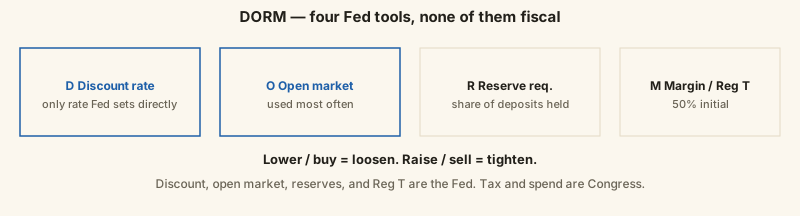
“Of the four tools, open market operations are the tool the Fed uses most actively.”
The discount rate
“The discount rate is the interest rate the Fed charges when a bank borrows directly from the Federal Reserve.”
“Although the Fed tries to influence interest rates throughout the economy, the discount rate is the only rate it controls directly.”
| Fed action | Cost to banks | Lending | Money supply | Interest rates |
|---|---|---|---|---|
| Lowers the discount rate | Banks can borrow more cheaply | Tends to increase lending | Loosens | Pushes rates down for customers |
| Raises the discount rate | Borrowing from the Fed becomes more expensive | Tends to reduce lending | Tightens | Pushes rates up |
Open market operations
“Open market operations are the Fed’s purchases and sales of securities with banks.”
🔑 Repos vs reverse repos
| Repurchase agreement (repo) | Reverse repurchase agreement (reverse repo) | |
|---|---|---|
| Fed’s action | Fed BUYS securities from banks | Fed SELLS securities to banks |
| Why the name | “the bank will buy back the securities at some point in the future” | “This is the opposite of a repurchase agreement” — later, the Fed will buy back the securities |
| Short-term cash flow | Fed is putting more cash into banks in exchange for securities the banks own (e.g., Treasury bonds) | Fed is taking cash out of the system by exchanging securities for cash |
| Cash available to lend | More | Less |
| Money supply | Loosened | Tightened |
| Interest rates | Decreasing (tend to fall) | Increasing (tend to rise) |
Trap: “Fed buys = money supply grows” and “Fed sells = money supply shrinks.” The direction feels backwards to many test takers — the Fed hands out cash when it buys.
The FOMC
| Attribute | Detail |
|---|---|
| What it is | The Federal Open Market Committee (FOMC), a part of the Federal Reserve |
| Role | Oversees open market operations |
| Typical securities traded | Treasury / government securities and prime banker’s acceptances (short-term bank securities) |
| Recent expansion | “In the past decade (especially during the COVID-19 crisis), the securities traded by the FOMC have expanded.” |
Exam note: “For exam purposes, focus on what the FOMC typically trades, not the unique securities traded during an economic catastrophe.”
Reserve requirements
As discussed in the Rates chapter, banks must continually meet reserve requirements (the portion of deposits they must hold in reserve). The Fed can raise or lower these requirements to pursue monetary policy.
Real-world footnote: the Fed set reserve requirement ratios to 0% effective March 26, 2020, and they have stayed there — so this is currently a dormant tool in practice (Federal Reserve ). The exam still tests the raise/lower logic below; answer it as written.
| Fed action | Bank lending capacity | Money in the financial system | Interest rates | Borrowing cost |
|---|---|---|---|---|
| Lowers reserve requirements | Banks can lend out more of their deposits | Increases (loosening) | Tend to fall | Borrowing becomes cheaper |
| Raises reserve requirements | Banks must hold more in reserve, can lend out less | Decreases (tightening) | Tend to rise | Borrowing becomes more expensive |
Margin requirements (Regulation T)
Leverage
“When investors use margin, they borrow money to invest. This is called leveraging, and it amplifies both gains and losses.”
| Outcome | Result of leveraging |
|---|---|
| Investment performs well | “the investor can earn more than they would using only their own capital” |
| Investment performs poorly | “the investor can lose more than they would using only their own money” |
🔑 Regulation T
“Regulation T was created to prevent investors from borrowing too much money. It requires investors to deposit 50% of the purchase price for initial margin transactions.”
Memorize: Reg T initial margin = 50%.
Worked example: “if you purchase $10,000 of stock in a margin account, Regulation T requires a deposit of at least $5,000.”
| Fed action on Reg T | Investor borrowing | Money supply |
|---|---|---|
| Lower Reg T below 50% | Investors can borrow more for investment purposes | Loosens (expands) the money supply |
| Raise Reg T requirements | Reduces borrowing for investment purposes | Tightens (contracts) — decreases the amount of money in the system |
🔑 Final summary — loosening vs tightening actions
“Let’s summarize the actions that correspond with loosening and tightening the money supply”
| Tool | Loosening (growing) the money supply | Tightening (shrinking) the money supply |
|---|---|---|
| Discount rate | Lower the discount rate | Raise the discount rate |
| Open market operations | Pursue repurchase agreements (Fed buys) | Pursue reverse repurchase agreements (Fed sells) |
| Reserve requirements | Lower reserve requirements | Raise reserve requirements |
| Margin requirements | Lower margin requirements | Raise margin requirements |
Pattern to memorize: LOWER everything = loosen (rates down). RAISE everything = tighten (rates up). The single exception in wording is open market operations, where “buy” is the loosening action and “sell” is the tightening action.
Key points
Tools of the Federal Reserve
- D - discount rate
- O - open market operations
- R - reserve requirements
- M - margin requirements (Reg T)
Discount rate
- Rate for Fed loans to banks
- Result of lowering:
- Loosens money supply
- Decreases interest rates
- Result of raising:
- Tightens money supply
- Increases interest rates
Open market operations
- Fed buys and sells securities
- Conducted by the FOMC
- Typical securities traded:
- Government securities
- Prime banker’s acceptances
Repurchase agreements
- Fed buys securities from banks
- Result:
- Loosened money supply
- Decreasing interest rates
Reverse repurchase agreements
- Fed sells securities to banks
- Result:
- Tightened money supply
- Increasing interest rates
Reserve requirements
- Banks must hold a portion of deposits in reserves
- Result of lowering:
- Loosens money supply
- Decreases interest rates
- Result of raising:
- Tightens money supply
- Increases interest rates
Margin requirements (Reg T)
- 50% deposit for margin transactions
- Result of lowering:
- Loosens money supply
- Decreases interest rates
- Result of raising:
- Tightens money supply
- Increases interest rates
Sources
Primary/official references for the material on this page. Every link was fetched and returned HTTP 200 on 2026-08-15.
| # | Source | Publisher |
|---|---|---|
| 1 | Open market operations and the federal funds target | Federal Reserve |
| 2 | Reserve requirements (set to 0% since March 2020) | Federal Reserve |
| 3 | Discount window and the discount rate | Federal Reserve |
| 4 | FOMC — composition and meeting schedule | Federal Reserve |
| 5 | Achievable Series 65 — chapter 3.1.3 | Achievable (course text) |