Fund Objectives & Categories
Framing
- We’ve already learned about the characteristics of mutual funds, closed-end funds, and exchange-traded funds (ETFs). This chapter focuses on common fund types.
- 🔑 A fund’s type is usually based on its investment objective and the kinds of securities it holds.
- ⚠️ Some types are easy to tell apart, while others can look similar, so it helps to compare them side by side.
- 📌 These are the most common fund types you’ll see in practice and on this material, especially in suitability questions. You’ll see these fund types again in later sections.
🔑 MASTER TABLE — fund types and categories
| Fund type | Objective | Typical holdings | Risk/suitability notes |
|---|---|---|---|
| Growth fund | Capital appreciation — increase the value of holdings over time (buy low, sell higher) | Most often common stock (greatest potential for capital gains); may also include convertible preferred stock and convertible bonds (conversion into common stock creates capital appreciation potential) | Riskier than income funds due to stock price volatility |
| Small-cap growth fund | Growth, via smaller companies | Invests exclusively in smaller companies | Smaller companies = more risk and more growth potential; more vulnerable in downturns, more likely to fail when conditions worsen |
| Large-cap growth fund | Growth, via large established companies | Mostly large, established companies | Can still be moderately risky, but typically less aggressive and less volatile than small-cap growth funds |
| Aggressive growth fund | Higher returns by taking on more risk | Common stock with higher return potential, including small-cap company stock and companies in volatile or emerging industries | Highest-risk growth category |
| Growth & income fund (a.k.a. blend fund) | Capital appreciation plus income | Income-producing stocks: preferred stock and dividend-paying common stock — stock only | Typically more conservative than pure growth funds; dividend-paying stocks generally less risky than growth-focused common stocks |
| Balanced fund | A fairly even mix of growth and income | Growth-oriented common stock AND income-producing securities, including bonds | ⚠️ Balanced funds invest in both bonds and stock; growth & income funds invest in stock only. Don’t mix these up |
| Income fund | Consistent interest and dividend income; capital appreciation is not the primary goal | Only income-producing securities: bonds, preferred stock, dividend-paying common stock | Generally more conservative and less risky than growth funds |
| Corporate bond fund | Income | Corporate issuers’ bonds | A type of income fund |
| Municipal bond fund | Income | Municipal issuers’ bonds | A type of income fund |
| US Government bond fund | Income | US Government issuers’ bonds | A type of income fund |
| High yield bond fund | Higher income | Riskier “junk” bonds with high yields | Higher risk |
| Conservative bond fund | Income with lower risk | Investment-grade bonds | Lower levels of risk and yield |
| International bond fund | Income | Bonds from foreign companies and governments | A type of income fund |
| Ginnie Mae fund | Income | Mortgage-backed securities of Ginnie Mae — Ginnie Mae doesn’t purchase mortgages; it guarantees qualifying MBS issued by approved private lenders | Subject to prepayment and extension risk, but suitable for risk-averse investors seeking conservative investments due to government backing of agency securities |
| Fannie Mae fund | Income | MBS of Fannie Mae — Fannie Mae purchases mortgages from financial institutions | Same: prepayment/extension risk, but conservative/suitable for risk-averse investors due to government backing |
| Freddie Mac fund | Income | MBS of Freddie Mac — Freddie Mac purchases mortgages from financial institutions | Same: prepayment/extension risk, but conservative/suitable for risk-averse investors due to government backing |
| Asset allocation fund | Invest across asset classes based on a chosen allocation | Mix of asset classes, e.g., a 60% stock / 40% bond mix | Some keep a constant mix; others change the mix based on expected market performance or fund requirements |
| Life cycle fund (a.k.a. target date fund) | Adjust over an investor’s lifetime | Start more aggressive (heavier allocation to growth stocks), become more conservative over time by shifting into fixed-income securities | Reflects the suitability principle: as an investor gets older, they generally should take less risk |
| Money market fund | Small amounts of income; cash-like holding | Money market securities = fixed income securities with one year or less to maturity | Low risk, low yield, very liquid (easy to sell); suitable for investors with short-term time horizons |
| Specialized fund | Not defined by growth or income; concentrate on a specific industry or region | Securities from a specific industry or region (e.g., Japan funds, biotechnology funds, Latin American funds) | Risk and return can vary widely depending on the region or industry |
| Sector fund | Concentrate on a specific industry | Industry-specific securities | The name used for specialized funds that focus on a specific industry |
| Index fund | Match the return of a specific index | Securities on the index’s list (e.g., S&P 500) | Passive investing — isn’t trying to pick the “best” securities, just match the index’s performance |
Growth funds
- A growth fund seeks capital appreciation — it aims to increase the value of its holdings over time (buying securities at lower prices and selling at higher prices).
- Growth funds most often invest in common stock because common stock has the greatest potential for capital gains.
- They may also include convertible preferred stock and convertible bonds, since the ability to convert into common stock can create capital appreciation potential.
Sidenote — Capitalization
- Sometimes funds are classified by the size of the companies they invest in. Market capitalization is a common way to measure company size.
🔑 Market capitalization = a company’s outstanding shares × its market value
- Growth funds often describe their strategy using market cap. For example, a small-cap growth fund invests exclusively in smaller companies.
- 📌 Knowing each market capitalization category isn’t heavily tested on this material, but here are the four categories:
| Category | Market capitalization |
|---|---|
| Large cap | More than $10 billion |
| Mid-cap | $2 billion – $10 billion |
| Small-cap | $300 million – $2 billion |
| Micro-cap | Less than $300 million |
- In general, smaller companies tend to have more risk and more growth potential. When a small company performs well in a strong economy, its stock price can rise quickly. But smaller companies are also more vulnerable in downturns and may be more likely to fail when conditions worsen.
- ⚠️ Keep this relationship in mind for test questions: large-cap funds hold mostly large, established companies. Large-cap growth funds can still be moderately risky, but they’re typically less aggressive and less volatile than small-cap growth funds.
Aggressive growth funds
- Aggressive growth funds are growth funds that take on more risk in pursuit of higher returns.
- They typically invest in common stock with higher return potential, including stock of small-cap companies and companies in volatile or emerging industries.
Growth & income funds
- Growth and income funds, sometimes called blend funds, seek capital appreciation but also invest in income-producing stocks.
- These holdings can include preferred stock and dividend-paying common stock.
| Holding | Fact stated |
|---|---|
| Preferred stock | Virtually all preferred stock pays a fixed dividend |
| Dividend-paying common stock | More typical of larger, well-established companies (for example, Walmart) |
- Stocks that provide dividend income are generally less risky than growth-focused common stocks. To pay consistent dividends, a company usually needs consistent profits.
- As a result, growth and income funds are typically more conservative than pure growth funds.
Definitions
| Term | Definition | Example |
|---|---|---|
| Conservative | Low risk | Growth & income funds are more conservative than pure growth funds |
| Aggressive | High risk | Aggressive growth funds take on more risk in pursuit of higher returns |
Balanced funds
- Balanced funds are similar to growth and income funds, but they aim for a fairly even mix between:
- growth-oriented common stock, and
- income-producing securities, including bonds.
Do not mix these up:
| Balanced fund | Growth & income fund | |
|---|---|---|
| Holdings | Bonds AND stock | Stock only |
Income funds
- Income funds invest only in income-producing securities, such as bonds, preferred stock, and dividend-paying common stock.
- Capital appreciation (growth) is not the primary goal. Instead, these funds aim to provide consistent interest and dividend income.
- Income funds are generally more conservative and less risky than growth funds.
Why growth funds are usually riskier than income funds
- The main reason is price volatility in the stock market. Stock prices can move sharply based on business performance and overall economic conditions. If a company has a poor year or the economy enters a recession, common stockholders can experience significant losses.
| Income investment | Why it’s steadier |
|---|---|
| Bonds | Issuers are legally required to pay interest. Bond values typically don’t fluctuate dramatically unless interest rates change significantly |
| Preferred stock | Dividends aren’t a legal obligation, but issuers rarely miss payments unless they’re under serious financial stress |
| Dividend-paying common stock | Larger, established companies with long profit histories often pay cash dividends. Even in difficult markets, these stocks may hold value better than non-dividend growth stocks |
- In general, income-producing investments can help investors reduce volatility and limit large losses.
Types of income funds
| Income fund type | Invests in |
|---|---|
| Corporate bond funds | Corporate issuers |
| Municipal bond funds | Municipal issuers |
| US Government bond funds | US Government issuers |
| High yield bond funds | Riskier “junk” bonds with high yields |
| Conservative bond funds | Investment-grade bonds with lower levels of risk and yield |
| International bond funds | Bonds from foreign companies and governments |
Agency mortgage funds
| Agency | What it does | Investor experience |
|---|---|---|
| Ginnie Mae | Does NOT purchase mortgages — instead, it guarantees qualifying mortgage-backed securities issued by approved private lenders | Investors receive income originating from interest and principal payments on the underlying mortgages |
| Fannie Mae | Purchases mortgages from financial institutions | Same |
| Freddie Mac | Purchases mortgages from financial institutions | Same |
- ⚠️ Trap: Ginnie Mae guarantees; Fannie Mae and Freddie Mac purchase.
- Although subject to prepayment and extension risk, Ginnie Mae, Fannie Mae, and Freddie Mac funds are suitable for risk-averse investors seeking conservative investments due to the government backing of agency securities.
Asset allocation funds
- Asset allocation funds invest across asset classes based on a chosen allocation. For example, an asset allocation fund might hold a 60% stock / 40% bond mix.
| Approach | Description | Example given |
|---|---|---|
| Constant mix | Keeps the same allocation | Fidelity’s Asset Manager 70% Fund — invests 70% of portfolio assets in stocks, with the remaining 30% invested in long and short term debt securities |
| Changing mix | Changes the mix based on expected market performance or fund requirements | Life cycle / target date funds |
Life cycle funds (target date funds)
- Life cycle funds, also known as target date funds, are designed to adjust over an investor’s lifetime.
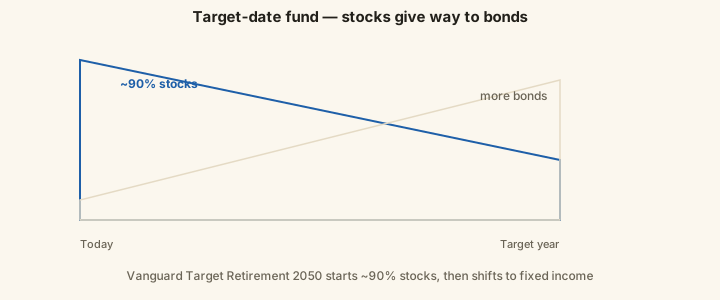
- They typically start out more aggressive (with a heavier allocation to growth stocks) and become more conservative over time by shifting assets into fixed-income securities.
- 🔑 This reflects a common suitability principle: as an investor gets older, they generally should take less risk.
A common example is the Vanguard Target Retirement 2050 Fund, created for investors targeting retirement around the year 2050. The fund is aggressive right now with roughly 90% of the assets invested in stocks, but the allocation will shift more to bonds and other fixed income securities as time passes.
Money market funds
- Money market funds are a type of income fund, but they generally pay small amounts of income.
- 🔑 Money market securities are fixed income securities with one year or less to maturity, so money market funds are typically low risk and low yield.
| Feature | Detail |
|---|---|
| Common use | Many investors use money market funds similarly to bank savings accounts; when an investor holds cash in an investment account, it’s often placed in a money market fund |
| Share price | Priced at a consistent $1.00 per share |
| Distributions | Typically make monthly dividend payments |
| Investor choice | Reinvest the proceeds to buy more $1.00 shares, or take the payment as cash |
| Liquidity | Very liquid (easy to sell) |
| Income | Provides a small amount of income |
| Suitability | Investors with short-term time horizons |
Specialized funds
- Specialized funds aren’t defined by growth or income objectives. Instead, they concentrate on securities from a specific industry or region.
- Examples: Japan funds, biotechnology funds, Latin American funds.
- Risk and return can vary widely depending on the region or industry.
- 📌 Funds that focus on a specific industry are sometimes called sector funds.
Index funds
- Index funds aim to match the return of a specific index.
- An index is a list of securities designed to track and average the values of the securities on that list.
- A well-known example is the S&P 500, often used as a proxy for “the market.” The S&P 500 is a list of 500 large companies that are traded in the United States.
- Investors use indexes to gauge broad market trends. When the S&P 500 is up, it’s commonly interpreted as the overall market moving upward.
Forms indexes come in
| Index form | Tracks |
|---|---|
| Broad stock market indexes | The overall market (like the S&P 500) |
| Small-cap and large-cap indexes | Smaller and larger companies |
| Bond indexes | Bond values across different issuers |
| Specialized indexes | Specific industries or regions |
- When investors buy an index fund, they’re choosing a fund that isn’t trying to pick the “best” securities. Instead, it’s trying to match the index’s performance.
- This approach is called passive investing, and it has become very popular — now accounting for over 50% of U.S. domestic equity mutual fund and ETF assets under management as of 2024.
Key points
Growth funds
- Objective: capital appreciation
- Invest mainly in common stock; may include convertible preferred stock/bonds
- Market capitalization categories (size = shares outstanding × market value):
- Large cap: >$10 billion
- Mid-cap: $2B–$10B
- Small-cap: $300M–$2B
- Micro-cap: <$300 million
- Smaller companies = more risk + more growth potential; large-cap growth funds less volatile than small-cap
Aggressive growth funds
- Growth funds with higher risk/return targets
- Focus on small-cap stocks and volatile/emerging industries
Growth & income funds (blend funds)
- Combine capital appreciation with income-producing stocks (preferred + dividend-paying common stock)
- More conservative than pure growth funds
- Key terms: Conservative = low risk; Aggressive = high risk
Balanced funds
- Mix of growth stock AND income securities (including bonds)
- Key distinction: balanced funds hold stocks + bonds; growth & income funds hold stock only
Income funds
- Invest only in income-producing securities: bonds, preferred stock, dividend-paying common stock
- Goal: consistent income, not growth
- Generally more conservative than growth funds due to lower price volatility
- Types: corporate, municipal, US Government, high yield (“junk”), conservative (investment-grade), international bond funds
- Ginnie Mae/Fannie Mae/Freddie Mac funds:
- Invest in mortgage-backed securities
- Ginnie Mae guarantees MBS (doesn’t purchase mortgages); Fannie/Freddie purchase mortgages
- Conservative due to government backing; subject to prepayment/extension risk
Asset allocation funds
- Invest across asset classes per a set allocation (e.g., 60% stock/40% bond)
- Can be static or dynamic mix
- Life cycle/target date funds: shift from aggressive (growth stocks) to conservative (fixed income) over time as investor ages
Money market funds
- Type of income fund; invest in short-term (≤1 year) fixed income securities
- Low risk, low yield, highly liquid
- Priced at constant $1.00/share; pay monthly dividends
- Suitable for short-term time horizons, cash-like holdings
Specialized funds
- Focus on specific industry or region (not growth/income based)
- Also called sector funds
- Risk/return varies widely by focus area
Index funds
- Aim to match performance of a specific index (e.g., S&P 500)
- Represents passive investing (vs. active security selection)
- Indexes exist for broad market, cap size, bonds, and specialized sectors
- Passive investing now >50% of US domestic equity fund/ETF assets (2024)
Practice questions
Q1. What is the primary objective of a growth fund?
Show answer
Capital appreciation — increasing holdings’ value over time, mainly through common stock (and possibly convertible preferred stock or convertible bonds).
Q2. How does a balanced fund differ from a growth & income (blend) fund?
Show answer
Balanced funds hold growth stock AND income securities including bonds. Growth & income funds hold stock only (preferred and dividend-paying common stock).
Q3. What securities do income funds invest in, and what is NOT their primary goal?
Show answer
Only income-producing securities: bonds, preferred stock, and dividend-paying common stock. Capital appreciation is not the primary goal.
Q4. What does Ginnie Mae do vs. Fannie Mae and Freddie Mac regarding mortgages?
Show answer
Ginnie Mae guarantees qualifying MBS issued by approved private lenders — it does not purchase mortgages. Fannie Mae and Freddie Mac purchase mortgages from financial institutions.
Q5. What is a life cycle (target date) fund designed to do over time?
Show answer
Start aggressive (heavier growth stock allocation) and become more conservative by shifting into fixed-income as the investor ages — reflecting lower risk tolerance with age.
Q6. What defines money market securities, and what is the typical share price?
Show answer
Fixed income securities with one year or less to maturity. Money market funds are low risk, low yield, highly liquid, and priced at a consistent $1.00 per share.
Q7. Which growth fund category is highest risk?
Show answer
Aggressive growth funds — invest in small-cap and volatile/emerging industry stocks for higher return potential.
Q8. How does market capitalization relate to risk in growth funds?
Show answer
Smaller companies have more risk and growth potential. Large-cap growth funds are typically less aggressive and less volatile than small-cap growth funds.
Q9. What is an index fund’s objective?
Show answer
Match the return of a specific index through passive investing — not trying to pick the “best” securities.
Q10. What is an asset allocation fund?
Show answer
A fund that invests across asset classes per a chosen allocation (e.g., 60% stock / 40% bond), either keeping a constant mix or changing it based on market expectations or fund requirements.
Sources
Primary/official references for the material on this page. Every link was fetched and returned HTTP 200 on 2026-08-15.
| # | Source | Publisher |
|---|---|---|
| 1 | Mutual funds and ETFs — NAV, fees, share classes | SEC / Investor.gov |
| 2 | Investment product categories | SEC / Investor.gov |
| 3 | Open-end vs closed-end vs UIT classification | Cornell LII (15 U.S.C. 80a-5) |
| 4 | Achievable Series 65 — chapter 1.3.6 | Achievable (course text) |