Contract Anatomy & Moneyness
Anatomy of an options contract
Let’s look at what an options contract typically looks like:
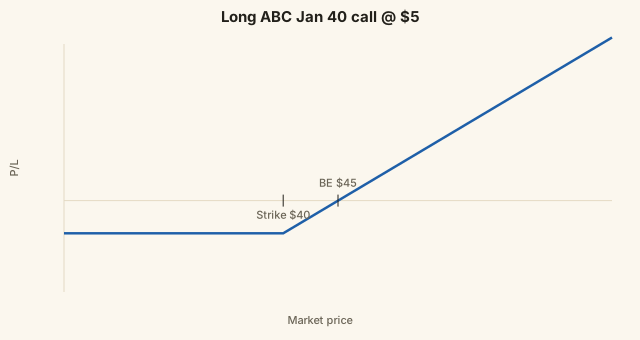
Long 1 ABC Jan 40 call @ $5
To understand what this means, break the contract into its parts.
| Component | In the example | Meaning |
|---|---|---|
| Long / short | Long | Long means the investor buys the contract. Buying an option gives the investor a right. Short means the investor sells (writes) the contract. Selling an option creates an obligation. |
| Number of contracts | 1 | The number of contracts being bought or sold. 🔑 Equity options contracts typically cover 100 shares of stock per contract. |
| Underlying stock | ABC | The (fictitious) underlying stock the option is based on. In the real world, ABC could be replaced by Bank of America Corp. (ticker: BAC), Meta Platforms Inc. (ticker: META), Home Depot Inc. (ticker: HD), or any other publicly traded stock. |
| Expiration month | Jan | Options expire on the third Friday of the month at 11:59pm ET. This contract expires on the third Friday in January at 11:59pm ET (10:59pm CT). |
| Strike price | 40 | The strike price is the option’s exercise price. If the customer exercises this option, the transaction occurs at $40 per share. |
| Call or put | call | A call gives the right to buy stock. A put gives the right to sell stock. |
| Premium | @ $5 | The option’s premium. ⚠️ The contract is actually trading for $500, not $5, because equity options cover 100 shares. |
🔑 Premium math:
- Premiums are quoted per share.
- To find the contract’s total cost, multiply the premium by 100.
To summarize, here’s the contract again:
Long 1 ABC Jan 40 call @ $5
This investor is long one contract that gives them the right to buy 100 shares of ABC stock at $40 per share. The cost of the contract was $500.
Calls and puts are the two types of options contracts available to investors. They provide different rights and obligations, but otherwise work in similar ways. You’ll want to know how each option operates and how investors use them.
Calls
Calls are contracts that provide the right to buy an asset at a fixed price (the strike price). If you buy an equity call, you gain the right to buy stock at the strike price.
A call is typically exercised only if the stock’s market price rises above the strike price. For example, a 40 call (right to buy at $40) would be exercised if the stock’s market price were above $40.
To satisfy the holder’s right, call writers are obligated to sell stock at the strike price.
Let’s walk through a few examples:
1 ABC Jan 40 call @ $5 while the market price is $39
In this scenario:
- The option holder (buyer) pays $500 to gain the right to buy 100 shares of ABC stock at $40.
- The option writer (seller) receives the $500 premium.
- If the holder exercises, the writer must sell 100 shares at $40.
The contract expires on the third Friday in January at 11:59pm ET. The market price of $39 is just context for ABC’s current price and doesn’t change the contract terms.
Call, market rises
1 ABC Jan 40 call @ $5 while the market price is $39. The market price subsequently rises to $60.
The contract now has $20 of intrinsic value and will be exercised. How much does the holder gain or lose?
Answer = $1,500 gain
Action Result Buy call -$500 Exercise - buy shares -$4,000 Sell shares +$6,000 Total +$1,500 Calls go “in the money” (gain intrinsic value) when the market rises. If the holder exercises and buys 100 shares at $40, they can sell those shares in the market at $60. That’s a $20 per share gain, or $2,000 total. After subtracting the $500 premium paid, the net gain is $1,500.
How about the writer?
Answer = $1,500 loss
Action Result Sell call +$500 Buy shares -$6,000 Assigned - sell shares +$4,000 Total -$1,500 When the market price increases to $60, the call becomes in the money and is exercised. The writer is assigned and must deliver 100 shares at $40 per share. If the writer doesn’t already own the stock, they must buy 100 shares in the market at $60 and then sell them at $40 through assignment. That’s a $20 per share loss ($2,000 total), partially offset by the $500 premium received, for a net loss of $1,500.
Options often produce opposite outcomes for the holder and writer, as in the example above. However, the details can change depending on the writer’s situation. For example, if the writer already owned the stock, they wouldn’t need to buy shares in the market to deliver them.
Call, market falls
Now let’s see what happens if the market moves the other way.
1 ABC Jan 40 call @ $5 while the market price is $39. The market price subsequently falls to $35.
The contract has no intrinsic value and will expire. How much does the holder gain or lose?
Answer = $500 loss
Action Result Buy call -$500 Total -$500 When the market falls to $35, the call is out of the money and has no intrinsic value. The holder wouldn’t exercise the right to buy at $40 when the market is offering the stock at $35. The option expires unused, so the premium paid ($500) is the holder’s total loss.
How about the writer?
Answer = $500 gain
Action Result Sell call +$500 Total +$500 The holder’s loss is the writer’s gain. When a call expires out of the money, the writer keeps the premium and doesn’t have to take any further action.
Here’s a video summarizing many of the key points related to call options.
Puts
Puts are contracts that provide the right to sell at a fixed price (the strike price). Investors who buy equity puts gain the right to sell stock at the strike price.
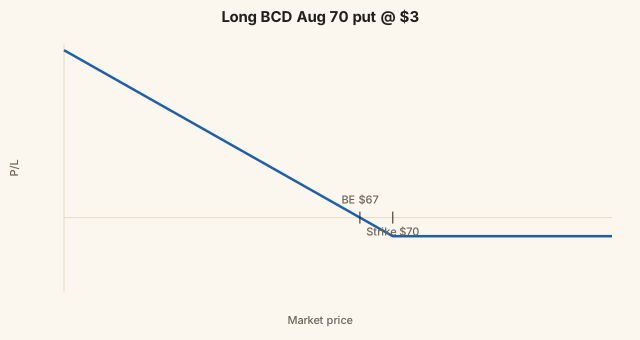
A put is typically exercised if the stock’s market price falls below the strike price. For example, a 70 put (right to sell at $70) would be exercised if the stock’s market price were below $70.
To satisfy the holder’s right, put writers are obligated to buy stock at the strike price.
Let’s walk through a few examples:
1 BCD Aug 70 put @ $3 while the market price is $71
In this scenario:
- The holder pays $300 to gain the right to sell 100 shares of BCD stock at $70.
- The writer receives $300.
- If the holder exercises, the writer must buy 100 shares at $70.
The contract expires on the third Friday in August at 11:59pm ET. The market price of $71 is just context for BCD’s current price and doesn’t change the contract terms.
Put, market falls
1 BCD 70 put @ $3 while the market price is $71. The market subsequently falls to $55.
What is the gain or loss for the holder?
Answer = $1,200 gain
Action Result Buy put -$300 Buy shares -$5,500 Exercise - sell shares +$7,000 Total +$1,200 Puts go “in the money” (gain intrinsic value) when the market falls. Here, the holder can buy 100 shares in the market at $55, then exercise the put and sell those shares at $70. That’s a $15 per share gain ($1,500 total). After subtracting the $300 premium paid, the net gain is $1,200.
How about the writer?
Answer = $1,200 loss
Action Result Sell put +$300 Exercise - buy shares -$7,000 Sell shares +$5,500 Total -$1,200 With the contract $15 in the money, it is assigned. The writer must buy 100 shares at $70. Many put writers don’t want to keep the stock, so they may sell it in the market at $55. That creates a $15 per share loss ($1,500 total), partially offset by the $300 premium received, for a net loss of $1,200.
Put, market rises
Now let’s see what happens if the market moves in the opposite direction.
1 BCD Aug 70 put @ $3 while the market price is $71. The market price subsequently rises to $80.
How much does the holder gain or lose?
Answer = $300 loss
Action Result Buy put -$300 Total -$300 When the market rises to $80, the put is out of the money and has no intrinsic value. The holder wouldn’t exercise the right to sell at $70 when the market is offering $80. The option expires unused, so the premium paid ($300) is the holder’s total loss.
How about the writer?
Answer = $300 gain
Action Result Sell put +$300 Total +$300 The holder’s loss is the writer’s gain. When a put expires out of the money, the writer keeps the premium and doesn’t have to take any further action.
Here’s a video summarizing many of the key points related to put options.
⚠️ Four-position master table (built from this page’s statements)
| Position | Right or obligation | Direction wanted (per this page’s ITM rules) | Maximum gain | Maximum loss | Breakeven |
|---|---|---|---|---|---|
| Long call (holder) | Right to buy stock at the strike price | Wants market to rise above the strike (call goes ITM when market rises) | Not stated on this page — worked example: +$1,500 when a 40 call bought at $5 is exercised with the stock at $60 | Premium paid (worked example: $500) — “the option expires unused, so the premium paid ($500) is the holder’s total loss” | Not stated on this page |
| Short call (writer) | Obligation to sell stock at the strike price | Wants market to stay at or below the strike (writer seeks OTM) | Premium received (worked example: +$500 when the call expires OTM) | Not stated on this page — worked example: -$1,500 when assigned with the stock at $60 | Not stated on this page |
| Long put (holder) | Right to sell stock at the strike price | Wants market to fall below the strike (put goes ITM when market falls) | Not stated on this page — worked example: +$1,200 when a 70 put bought at $3 is exercised with the stock at $55 | Premium paid (worked example: $300) — “the option expires unused, so the premium paid ($300) is the holder’s total loss” | Not stated on this page |
| Short put (writer) | Obligation to buy stock at the strike price | Wants market to stay at or above the strike (writer seeks OTM) | Premium received (worked example: +$300 when the put expires OTM) | Not stated on this page — worked example: -$1,200 when assigned with the stock at $55 | Not stated on this page |
Max gain/max loss formulas and breakeven points are not given on this page; they are developed in the later premium/exercise and strategy chapters.
⚠️ ITM / ATM / OTM — calls vs. puts (mirror images)
| Money-ness | Call | Put |
|---|---|---|
| In the money (ITM) | Market price is above the strike price | Market price is below the strike price |
| At the money (ATM) | Market price equals the strike price — not defined on this page | Market price equals the strike price — not defined on this page |
| Out of the money (OTM) | Market price falls below the strike price | Market price rises above the strike price |
| Who wants it | Holders seek ITM options; writers seek OTM options | Holders seek ITM options; writers seek OTM options |
| Exercise trigger stated | A 40 call (right to buy at $40) would be exercised if the stock’s market price were above $40 | A 70 put (right to sell at $70) would be exercised if the stock’s market price were below $70 |
Calls and puts are exact mirror images here — rising markets put calls in the money, falling markets put puts in the money. This is the pairing most often swapped on the exam.
Swaps
Swaps are derivative contracts typically traded over the counter (OTC). Institutions use swaps to hedge or speculate on changes in financial variables like interest rates, currencies, or credit risk. Swaps are not traded on an exchange; instead, they are negotiated privately between parties. This allows customization, but it also introduces counterparty risk. Common swap types are interest rate or currency swaps, where principal and interest payments in different currencies are exchanged. ⚠️ Swaps are unsuitable for retail investors; they are used mainly by institutional investors.
| Feature | Swaps |
|---|---|
| Trading venue | Typically over the counter (OTC); not traded on an exchange |
| How formed | Negotiated privately between parties |
| Purpose | Hedge or speculate on changes in financial variables like interest rates, currencies, or credit risk |
| Benefit | Allows customization |
| Risk | Introduces counterparty risk |
| Common types | Interest rate or currency swaps, where principal and interest payments in different currencies are exchanged |
| Suitability | Unsuitable for retail investors; used mainly by institutional investors |
Key points
Option contracts
- Cover 100 shares of stock
- Strike price is the fixed exercise price
- Premium is in multiples of 100
Call options
- Holders have the right to buy
- Writers have the obligation to sell
- In the money (ITM) when the market rises above the strike price
- Out of the money (OTM) when the market falls below the strike price
- Holders seek ITM options
- Writers seek OTM options
Put options
- Holders have the right to sell
- Writers have the obligation to buy
- In the money (ITM) when the market falls below the strike price
- Out the money (OTM) when the market rises above the strike price
- Holders seek ITM options
- Writers seek OTM options
Swaps
- Derivative contracts typically traded over the counter (OTC)
- used to hedge or speculate on changes in financial variables
Sources
Primary/official references for the material on this page. Every link was fetched and returned HTTP 200 on 2026-08-15.
| # | Source | Publisher |
|---|---|---|
| 1 | Options fundamentals, strategies and the ODD | OCC / Options Industry Council |
| 2 | Listed options contract specs and index options | Cboe |
| 3 | Premium = intrinsic + time value; pricing inputs | OCC / Options Industry Council |
| 4 | Achievable Series 65 — chapter 1.4.1.4 | Achievable (course text) |