Duration & Price Volatility
Price volatility
When interest rates change, bond prices in the secondary market change too. Bonds with longer maturities and lower coupons tend to have the most price volatility.
🔑 Master table — what drives volatility and duration
| Bond feature | Price volatility | Duration | Why |
|---|---|---|---|
| Long maturity | Highest | Longest | Investor is locked into the bond’s cash flows for a longer period of time |
| Short maturity | Lowest | Shortest | Par value is received back soon; principal can be reinvested at prevailing rates |
| Low coupon | Highest | Longest | Less coupon income to reinvest; more of the return is realized at maturity |
| High coupon | Lowest | Shortest | More interest income each year to reinvest at prevailing rates |
The text states: “the debt security with the longest maturity and the lowest coupon will have the highest duration.”
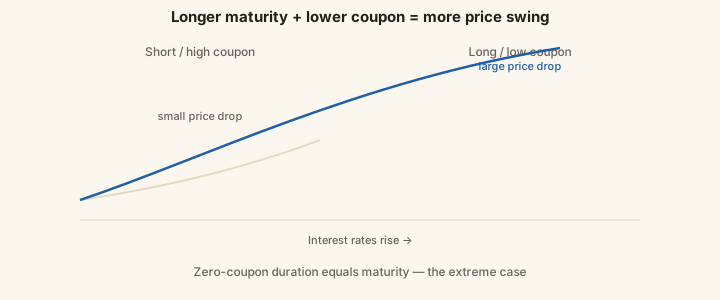
Long maturities
A bond with a long maturity is usually more sensitive to interest rate changes because you’re locked into its cash flows for a longer period of time.
Setup: Assume you own a 1-year bond and a 20-year bond.
When interest rates RISE
- The market value of both bonds will fall — but the 20-year bond’s price will typically fall more.
- Newly issued bonds come to market with higher yields. That makes existing bonds (with lower coupons) less attractive, so their prices drop to offer a competitive yield.
The 1-year bond usually declines less because:
- It matures soon.
- Within one year, the investor receives par value back.
- At maturity, the investor can reinvest the principal into a new bond at the higher prevailing rate.
The 20-year bond doesn’t have that flexibility. The investor must wait much longer to get par value back, and the bond is effectively “stuck” paying the lower coupon unless it’s sold. That longer wait is why long-maturity bonds tend to fall further when rates rise.
When interest rates FALL
Same logic in reverse. Long-term bonds usually rise more in price because their higher coupon payments (relative to new, lower-rate bonds) are locked in for many years.
| Bond | Rates rise | Rates fall | Reason |
|---|---|---|---|
| 1-year bond | Falls, but less | Rises, but not by much | Matures soon; investor will have to reinvest at lower rates |
| 20-year bond | Falls more | Rises more | Higher coupon is locked in for a long time |
Low coupons
Bonds with lower coupons tend to have more price volatility than bonds with higher coupons.
Setup: Assume you own two 10-year bonds:
- One has a 2% coupon.
- The other has a 10% coupon.
| Scenario | 2% coupon bond | 10% coupon bond | Reason given |
|---|---|---|---|
| Rates rise | Falls further | Falls less | The 2% bond pays less interest along the way, so the investor has less cash to reinvest at the new, higher rates. The 10% bond pays more interest each year, giving the bondholder more money to reinvest at higher prevailing rates, which reduces sensitivity to rising rates. |
| Rates fall | Rises further | Rises less | Lower-coupon bonds are more likely to be priced at a discount; if a larger portion of value is realized at maturity (when par is paid), the investor isn’t receiving large coupon payments that must be reinvested at the new, lower rates. The 10% bond’s coupons must be reinvested at lower rates, making it relatively less valuable, so its price rises less. |
Another way to think about it: the lower the coupon, the more likely the bond was sold at a discount. If much of the investor’s return comes from the bond moving from a discount price up to par at maturity, the investor has to wait longer to realize that return.
The text notes a video breakdown of a practice question regarding price volatility is provided on the page.
Duration
The concept of duration is closely related to price volatility. In general, the debt security with the longest maturity and the lowest coupon will have the highest duration.
🔑 Duration is commonly used to describe:
- How sensitive a bond’s price is to interest rate changes, and
- How long it takes (in time terms) for an investor to recoup the bond’s original cost through its cash flows
Worked example 1 — coupon-paying debenture
20 year, $1,000 par, 10% debenture trading for 120
This bond pays $100 in annual interest (10% of $1,000) over a 20-year period. It currently costs $1,200 (trading at 120% of $1,000).
If this bond pays $100 in annual interest and currently costs $1,200, how long will it take an investor to recoup their original investment? Assuming the interest is not reinvested, it will take 12 years (12 years x $100 annual interest).
Therefore, the duration of this debenture is roughly 12 years.
The text flags that duration calculations often assume future cash flows are discounted to present value and reinvested. The details are not important for test purposes, but the duration calculation above is very oversimplified. Test questions tend to focus on the fundamental concepts of duration — know the basics and you’ll be fine.
Bond quote reminder: a quote of “120” means 120% of $1,000 = $1,200; a quote of “45” means 45% of $1,000 = $450. (The text links back to the bond-quoting chapter for review.)
Worked example 2 — zero coupon bond
20-year, $1,000 par, zero coupon bond trading for 45
This bond does not pay interest until maturity (same with all zero coupon bonds), which is in 20 years. It currently costs $450 (trading at 45% of $1,000).
Because a zero coupon bond pays no interest until the end, the investor doesn’t receive cash flows along the way. That means it takes the full life of the bond to recoup the investment.
🔑 A zero coupon bond’s duration is equal to its maturity. Therefore, this bond’s duration is 20 years.
Comparison of the two bonds
| Bond | Price | Annual cash flow | Duration |
|---|---|---|---|
| 20 year, $1,000 par, 10% debenture trading for 120 | $1,200 | $100 | 12 years |
| 20-year, $1,000 par, zero coupon bond trading for 45 | $450 | $0 until maturity | 20 years |
Duration and price volatility point in the same direction: longer maturities and lower coupons generally mean greater sensitivity to interest rate changes. These two bonds fit that pattern. Both have 20-year maturities, but the zero coupon bond typically has more price volatility and a longer duration.
Exam trap: two bonds with the same maturity can have very different durations — the coupon is the differentiator. The zero coupon bond is the extreme case (duration = maturity).
Key points
Price volatility
- Measures how fast bond prices move when interest rates change
- Bonds with the most price volatility:
- Long maturities
- Low coupons
- Bonds with low price volatility:
- Short maturities
- High coupons
Duration
- Measures the amount of time necessary to recoup the original cost
- Bonds with longer duration:
- Long maturities
- Low coupons
- Bonds with shorter duration:
- Short maturities
- High coupons
Practice questions
Q1. Which two bond features produce the highest price volatility and longest duration?
Show answer
Long maturities and low coupons. The debt security with the longest maturity and lowest coupon has the highest duration.
Q2. You own a 1-year bond and a 20-year bond. Interest rates rise. Which falls more in price, and why?
Show answer
The 20-year bond falls more. The 1-year bond matures soon, returning par for reinvestment at higher rates. The 20-year bond is locked into a lower coupon for much longer.
Q3. Compare two 10-year bonds — 2% coupon versus 10% coupon — when rates rise.
Show answer
The 2% bond falls further. The 10% bond pays more interest along the way, giving the holder more cash to reinvest at higher prevailing rates, reducing sensitivity.
Q4. What are the two common uses of duration?
Show answer
(1) Measuring how sensitive a bond’s price is to interest rate changes, and (2) estimating how long (in time terms) it takes to recoup the bond’s original cost through cash flows.
Q5. A 20-year $1,000 par, 10% debenture trades at 120 ($1,200). Assuming no reinvestment, what is its approximate duration?
Show answer
12 years. Annual interest = $100; $1,200 ÷ $100 = 12 years to recoup the purchase price. (The text notes this is an oversimplified calculation.)
Q6. A 20-year $1,000 par zero coupon bond trades at 45 ($450). What is its duration?
Show answer
20 years — equal to maturity. Zero coupon bonds pay no interim cash flows, so the full investment is recouped only at maturity.
Q7. ⚠️ Two bonds both have 20-year maturities but different coupons. Which has higher duration and volatility?
Show answer
The zero coupon bond (0% coupon). Same maturity does not mean same duration — coupon is the differentiator. Zero coupon duration always equals maturity.
Q8. A bond quote of “120” means what dollar price on a $1,000 par bond? What about “45”?
Show answer
120 = 120% of par = $1,200. 45 = 45% of par = $450.
Q9. When interest rates fall, which bond rises more — a long-maturity or short-maturity bond?
Show answer
Long-maturity bonds rise more because their higher coupon payments are locked in for many years, making them more valuable relative to new lower-rate issues.
Q10. Which bonds have the lowest price volatility and shortest duration?
Show answer
Short maturities and high coupons — the opposite end of the spectrum from long maturity/low coupon bonds.
Sources
Primary/official references for the material on this page. Every link was fetched and returned HTTP 200 on 2026-08-15.
| # | Source | Publisher |
|---|---|---|
| 1 | Interest-rate risk — bond prices fall when rates rise, duration | SEC |
| 2 | Bonds — coupon, maturity, price/yield, credit risk | SEC / Investor.gov |
| 3 | Markowitz/Sharpe — portfolio theory and CAPM, the source work | Nobel Prize |
| 4 | Achievable Series 65 — chapter 1.2.12 | Achievable (course text) |