Agency & Mortgage-Backed Bonds
Mortgage agency securities
Three federal agencies exist to encourage homeownership in the United States. Each one plays a slightly different role in the mortgage market.
The three agencies
| Nickname | Official name (acronym) | Role | Backing |
|---|---|---|---|
| Ginnie Mae | Government National Mortgage Association (GNMA) | Guarantees VA (Veterans Affairs), FHA (Federal Housing Administration), and USDA Rural Development insured loans | Directly backed by the US Government — virtually free of default risk, similar to Treasury securities |
| Fannie Mae | Federal National Mortgage Association (FNMA) | Purchases insured (VA and FHA) and conventional (non-insured) mortgages | Indirect backing from the US Government |
| Freddie Mac | Federal Home Loan Mortgage Corporation (FHLMC) | Purchases only conventional (non-insured) mortgages | Indirect backing from the US Government |
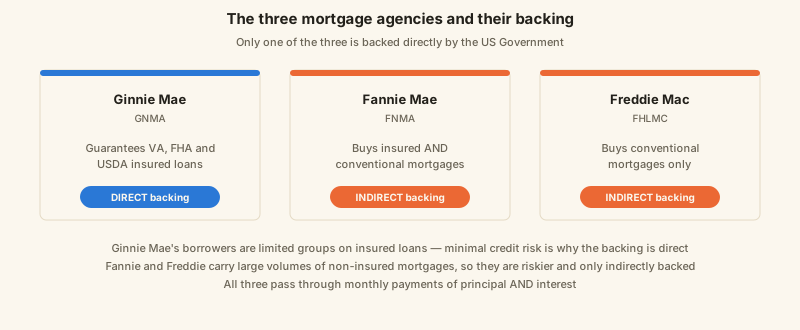
Memorize the mapping: Ginnie = guarantees insured loans + direct government backing. Fannie = insured and conventional. Freddie = conventional only.
Ginnie Mae’s loans are available only to certain groups of borrowers (for example, veterans and some low-income households). The minimal credit risk involved is why the US Government directly backs Ginnie Mae securities.
Because Fannie Mae and Freddie Mac handle a significant amount of non-insured mortgages, they’re considered riskier than Ginnie Mae and have only indirect backing from the US Government. In addition, both are publicly traded companies — although they were created by the US Government, they’re technically owned by their stockholders.
How the agencies work
- These agencies typically purchase mortgages from lenders using capital raised from investors.
- This gives lenders cash they can use to make new mortgage loans.
- The agencies then collect mortgage payments on the mortgages they’ve purchased and pass that income through to investors.
- Similar to how mortgages are paid off, mortgage agency securities typically make monthly payments to investors that include both principal and interest.
| Term | Definition | Example / detail |
|---|---|---|
| Mortgage-backed security (MBS) | The security investors buy, backed by a pool of purchased mortgages | Makes monthly payments of both principal and interest |
| Retail access | How individual investors typically access MBSs | Often through mutual funds (covered in a later section) |
The two unique MBS risks
With a typical (non-mortgage) bond, you know the bond’s maturity. For example, if a bond has a 20-year maturity, it can’t last longer than 20 years.
With an MBS, you don’t know the exact maturity. Even though many mortgages are written as 30-year mortgages, most don’t actually last 30 years. Homeowners may pay off the mortgage early, refinance, or sell the home and pay off the loan. In each case, the mortgage ends when the homeowner repays the principal.
| Risk | Triggered when | What happens | Why it hurts the investor |
|---|---|---|---|
| Prepayment risk | Interest rates FALL | Many homeowners refinance to get a lower rate; mortgages are paid off sooner than expected, so the MBS returns principal earlier than expected | The MBS may have been paying a higher yield than what’s available after rates fall |
| Extension risk | Interest rates RISE | Homeowners are less likely to refinance and more likely to keep existing mortgages; mortgages are paid off later than expected, so the MBS lasts longer than expected | The MBS may be paying a lower yield than what’s available in the current higher-rate market |
Rates fall → prepayment. Rates rise → extension.
US Government auction & quotes
- After US Government debt is sold at Treasury auctions, those securities trade in the over-the-counter (OTC) markets.
- An OTC trade is one that doesn’t take place on a physical exchange like the New York Stock Exchange.
Quote format
| Feature | Corporate bonds | US Government debt |
|---|---|---|
| Quote basis | Percentage of par | Percentage of par |
| Fractional increment | Eighths | 32nds |
| Fraction reduced? | Yes | ⚠️ No — the fraction is not reduced |
| Separators used | — | Dash, colon, or period |
Government bonds are quoted in 32nds because the market is larger and prices move in smaller increments. Quoting in 32nds creates more possible prices.
An investor finds three separate quotes for the same bond:
95-895:895.8
US Government quotes can be presented with a dash, colon, or period. Even though you don’t see a fraction written out, each quote translates to a bond price of 95 and 8/32 percent of par. The number on the right side of the quote (after the dash, colon, or period) is always assumed to be in 32nds.
Quote conversion — the “fraction-boot-scoot” method
Same method used with corporate bonds; the only difference is that the fraction is in 32nds.
A US Government bond is quoted at 95-8. What is its price?
Step 1: calculate the fraction
32 8 = 0.25
Step 2: boot the decimal back to the big number
95 + 0.25 = 95.25
Step 3: scoot the decimal once over to the right
$952.50
Practice: A US Government bond is quoted at 103:20. What is its price?
Step 1: calculate the fraction
32 20 = 0.625
Step 2: boot the decimal back to the big number
103 + 0.625 = 103.625
Step 3: scoot the decimal once over to the right
$1,036.25
The process is very similar to the way corporate bond quotes work. The quotes look different, but the method is the same. Both corporate and US Government securities are quoted in percentage of par format.
Treasury bill quotes — the exception
Treasury bill quotes are an exception. Because Treasury bills are short-term and zero-coupon, they’re quoted in “discount yield” form. Treasury bill quotes are provided in yield form, reflecting the rate of return the bill provides.
For example, a Treasury bill quote might look like 3.2%.
Instead of giving a dollar price, the quote tells the investor the overall return (yield) based on the bill’s discount. Remember, Treasury bills are bought at discounts, mature at par, and do not have a coupon.
Key points
Mortgage agencies
- Issue mortgage-backed securities
- Buy mortgages from financial institutions
Mortgage-backed securities
- Make monthly payments of interest and principal
- Subject to prepayment and extension risk
Prepayment risk
- Occurs when interest rates fall
- Homeowners pay off mortgages earlier than expected
Extension risk
- Occurs when interest rates rise
- Homeowners pay off mortgages later than expected
US Government debt market
- Treasury auctions new issues
- Traded in OTC markets after issuance
US Government debt quotes
- Percentage of par quotes (generally)
- Quoted in 32nds using a:
- Dash
- Colon
- Period
Treasury bill quotes
- Discount yield form
Practice questions
Q1. Match each agency to its role and government backing: Ginnie Mae, Fannie Mae, Freddie Mac.
Show answer
Ginnie Mae (GNMA) — guarantees VA/FHA/USDA insured loans; directly backed by U.S. Government. Fannie Mae (FNMA) — purchases insured and conventional mortgages; indirect backing. Freddie Mac (FHLMC) — purchases conventional mortgages only; indirect backing.
Q2. Why is Ginnie Mae considered virtually free of default risk while Fannie Mae and Freddie Mac carry more risk?
Show answer
Ginnie guarantees only government-insured loans to specific borrower groups and has direct U.S. Government backing. Fannie and Freddie handle significant non-insured conventional mortgages, have only indirect backing, and are publicly traded companies owned by stockholders.
Q3. How do mortgage-backed securities (MBS) typically pay investors, and how do retail investors usually access them?
Show answer
Monthly payments of both principal and interest (mortgage pass-through). Retail investors typically access MBS through mutual funds.
Q4. ⚠️ What is prepayment risk, and when does it occur?
Show answer
When interest rates fall, homeowners refinance and pay off mortgages early — the MBS returns principal sooner than expected while paying a higher yield than currently available. Rates fall → prepayment.
Q5. What is extension risk, and when does it occur?
Show answer
When interest rates rise, homeowners keep existing mortgages longer — the MBS lasts longer than expected while paying a lower yield than the current market. Rates rise → extension.
Q6. A U.S. Government bond is quoted at 95-8 (also written 95:8 or 95.8). Using the fraction-boot-scoot method, what is the dollar price?
Show answer
$952.50. 8/32 = 0.25 → 95 + 0.25 = 95.25 → scoot → $952.50. ⚠️ Government quotes use 32nds and fractions are NOT reduced.
Q7. A U.S. Government bond is quoted at 103:20. What is its dollar price?
Show answer
$1,036.25. 20/32 = 0.625 → 103 + 0.625 = 103.625 → scoot → $1,036.25.
Q8. How do corporate bond quotes differ from U.S. Government debt quotes in fractional increments?
Show answer
Both are percentage-of-par quotes, but corporates use eighths (fractions may be reduced) while government debt uses 32nds (fractions are not reduced). Government quotes may use a dash, colon, or period as separator.
Q9. ⚠️ How are Treasury bill quotes different from other government debt quotes?
Show answer
T-bills are quoted in discount yield form (e.g., 3.2%) — a yield percentage — not as a dollar price, because they are short-term zero-coupon instruments.
Q10. After Treasury auctions, where do government securities trade?
Show answer
In the over-the-counter (OTC) markets — trades that do not occur on a physical exchange like the NYSE.
Sources
Primary/official references for the material on this page. Every link was fetched and returned HTTP 200 on 2026-08-15.
| # | Source | Publisher |
|---|---|---|
| 1 | GNMA — full-faith-and-credit MBS guarantee | Ginnie Mae |
| 2 | T-bonds — 20 and 30 years | TreasuryDirect |
| 3 | Bonds — coupon, maturity, price/yield, credit risk | SEC / Investor.gov |
| 4 | Achievable Series 65 — chapter 1.2.7 | Achievable (course text) |