State Registration by Coordination
⚠️ The three state registration methods — where this chapter fits
| Method | This chapter? |
|---|---|
| Registration by filing (notice filing) | Separate chapter |
| Registration by coordination | ✅ This chapter |
| Registration by qualification | Separate chapter |
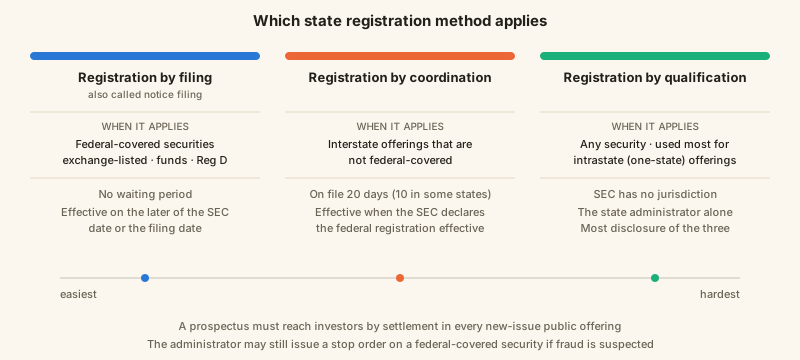
🔑 Registration by coordination at a glance
| Question | Answer |
|---|---|
| Which issuers may use it? | Issuers of securities sold in more than one state (interstate) that don’t meet the definition of a federal-covered security |
| What must be filed? | The security’s prospectus; articles of incorporation; any agreement with underwriters; any indenture or other instrument governing the issuance of the security to be registered; copy of any other information filed with SEC (if requested by state administrator); consent to service of process; filing fee |
| How long is the waiting period? | Documentation must be on file with the state administrator for at least 20 days (some states impose a 10-day requirement). The SEC side runs the 20-day cooling off period. |
| When does registration become effective? | When the SEC declares the federal registration effective, provided no stop orders are in place and the documentation has been on file for the required period |
State registration typically becomes effective when the SEC declares the federal registration effective.
Note the internal discrepancy on the page: the body text says documentation must be on file “for at least 20 days (some states impose a 10-day requirement),” while the page’s own Key points say “State registration paperwork on file at least 10 days.” Both are reproduced here as written.
🔑 Numbers & deadlines
| Item | Requirement |
|---|---|
| SEC processing / cooling off period | 20 days |
| Documentation on file with the state administrator before effectiveness (body text) | At least 20 days (some states impose a 10-day requirement) |
| Documentation on file with the state administrator (page’s Key points) | At least 10 days |
| Duration of a security’s registration | One full year from the effective date |
| Renewal at calendar year end (December 31st) | No renewal required |
| Governing federal law | Securities Act of 1933 |
| Boundary-setting law | National Securities Market Improvement Act of 1996 (NSMIA) |
| Escrow rule source | NASAA rule regarding promotional shares |
Overview
- Securities sold in more than one state (interstate) that don’t meet the definition of a federal-covered security are subject to registration by coordination.
- 🔑 This registration method involves both the SEC and the relevant state administrators. In other words, the issuer registers the security with federal and state regulators at the same time.
- The National Securities Market Improvement Act of 1996 (NSMIA) drew a clear boundary between federal and state regulations. NSMIA determined that federal rules supersede state rules when both levels regulate the same entity.
- That same idea shows up in registration by coordination: issuers primarily follow SEC registration requirements, which are largely established in the Securities Act of 1933.
- 📌 You may recognize this law from other exams, but the detailed provisions aren’t tested on this material.
The process
- The SEC typically processes registration paperwork in 20 days (the “20-day cooling off period”) and then declares the registration effective if the required documents are complete.
- While the SEC review is happening, the issuer also submits the following to the state administrator:
🔑 What must be filed with the state administrator
| Required item |
|---|
| The security’s prospectus |
| Articles of incorporation |
| Any agreement with underwriters |
| Any indenture or other instrument governing the issuance of the security to be registered |
| Copy of any other information filed with SEC (if requested by state administrator) |
| Consent to service of process |
| Filing fee |
Definitions
| Term | Definition | Example |
|---|---|---|
| Prospectus | Disclosure document that provides details on the security being sold and the issuer | The prospectus filed with the state administrator during coordination |
| Underwriter | A financial firm hired by an issuer to market and sell their securities to investors | The firm party to the “agreement with underwriters” filed with the administrator |
| Indenture | A legal agreement between an issuer and the investors of its securities | The “indenture or other instrument governing the issuance of the security to be registered” |
| Stop order | Order from a securities regulator prohibiting the sale of a specific security | No stop orders may be in place before the state grants effective registration |
🔑 Effectiveness
State registration typically becomes effective when the SEC declares the federal registration effective.
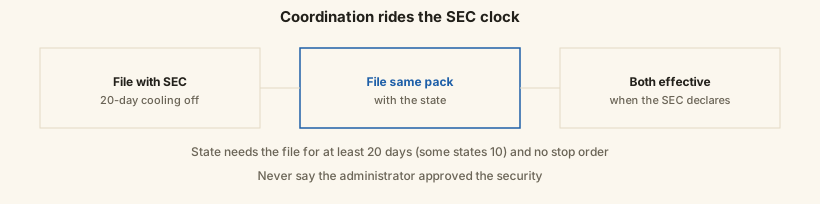
Before the state will grant effective registration, state administrators generally require the following:
| Condition |
|---|
| No stop orders in place by state administrators or other regulators |
| Required documentation has been on file with the state administrator for at least 20 days (some states impose a 10-day requirement) |
- ⚠️ As with rules that apply to registered persons, the issuer, underwriter, or anyone connected with the sale of newly registered securities may not imply that the state administrator has approved the security.
Escrow requirements (promotional shares)
- Some securities registered by coordination may be subject to state-enforced escrow requirements.
- The North American Securities Administrators Association (NASAA) maintains a rule regarding promotional shares. These are generally equity shares (stock) issued by smaller companies with weak financials.
- If a security meets the definition of promotional shares, the issuer may be required to hold offering proceeds for a specified period of time.
| Term | Definition | Purpose |
|---|---|---|
| Escrow account | Holds funds with a third party while an offering is in progress | For promotional shares, an administrator may require the issuer to place the proceeds of a new issue into escrow until a specified amount of money is raised |
- This helps prevent an issuer from raising only a small amount and then misusing or disappearing with the funds.
- Once the specified amount is raised, the escrowed funds are released to the issuer.
Duration of registration
- ⚠️ Unlike the registration of persons, a security remains registered for one full year from the effective date.
- There is no renewal required at the end of the calendar year (December 31st).
- Registration continues only if the offering has not sold out.
- In most cases, public offerings last days or weeks, so they don’t extend past one year. However, if shares are still unsold one year after the effective date, the registration will continue.
| Registration type | Renewal timing |
|---|---|
| Registration of persons | Renewed at calendar year end (December 31st) |
| Registration of a security | One full year from the effective date; no December 31st renewal |
Key points
Registration by coordination
- SEC (federal) and state registration simultaneously
- Required items to be submitted to the administrator:
- The security’s prospectus
- Articles of incorporation
- Any agreement with underwriters
- Any indenture or other instrument governing the issuance of the security to be registered
- Copy of any other information filed with SEC (if requested by state administrator)
- Consent to service of process
- Filing fee
- State registration is effective when SEC registration is effective, as long as:
- State registration paperwork on file at least 10 days
- No stop orders exist
- Administrator may require proceeds to be placed in escrow for a short period
Sources
Primary/official references for the material on this page. Every link was fetched and returned HTTP 200 on 2026-08-15.
| # | Source | Publisher |
|---|---|---|
| 1 | Uniform Securities Act 1956 with NASAA updates — the tested statute | NASAA |
| 2 | Securities Act 1933 — definition of security, issuer | Cornell LII (15 U.S.C. 77b) |
| 3 | Achievable Series 65 — chapter 4.3.5.4 | Achievable (course text) |
172