Traditional vs. Roth IRAs
Scope
Individual retirement accounts (IRAs) allow investors to save for retirement outside of employer-sponsored plans.
The two types are:
- Traditional IRAs
- Roth IRAs
🔑 Numbers, ages & limits
| Item | Number | Notes |
|---|---|---|
| IRA contribution limit (2026) | Lesser of $7,500 or earned income for the year | Applies to traditional and Roth combined |
| IRA contribution limit (2025, referenced) | $7,000 | Used in the Feb 1, 2026 first-contribution example |
| Catch-up provision age | Age 50 or older | |
| Catch-up amount (2026) | $1,100 per year | |
| Total contribution age 50+ (2026) | $8,600 | $7,500 + $1,100 catch-up |
| Prior-year contribution deadline | Tax-filing deadline the following year — typically April 15th | Pushed back when April 15th falls on a weekend (e.g., April 15, 2023 was a Saturday → deadline extended to the 18th) |
| Traditional IRA deduction phaseout — single (2026) | Full deduction < $81,000; phaseout $81,000–$91,000; no deduction > $91,000 | 📌 “You do not need to memorize these numbers.” |
| Traditional IRA deduction phaseout — married filing jointly (2026) | Full deduction < $129,000; phaseout $129,000–$149,000; no deduction > $149,000 | 📌 Not required to memorize |
| Roth IRA contribution phaseout — single (2026) | Full contribution < $153,000; phaseout $153,000–$168,000; no contribution > $168,000 | 📌 “You won’t need to know the specific numbers for the exam” |
| Roth IRA contribution phaseout — married filing jointly (2026) | Full contribution < $242,000; phaseout $242,000–$252,000; no contribution > $252,000 | 📌 Not required to memorize |
| Early withdrawal penalty age | 59 ½ | |
| Early withdrawal penalty rate | 10% | |
| Roth five-year aging period | 5 years | Starts on the first day of the tax year (typically January 1st) of the first contribution |
| RMD age | 73 | Roth IRAs are not subject to RMDs |
| Roth 401(k) RMDs | No longer required starting in 2024 | |
| Inherited IRA full-distribution window | 10 years | Alternative to annual RMDs, depending on beneficiary type |
| Eligible designated beneficiary age gap test | Not more than 10 years younger than the decedent | |
| Divorce statistic cited | Roughly 50% of all marriages end in separation in the United States | Context only |
| IRA-prohibited strategies | Short sales, margin, and some option strategies | In particular, cannot sell uncovered (naked) options |
⚠️ TRADITIONAL vs ROTH IRA — side-by-side (guaranteed exam topic)
| Feature | Traditional IRA | Roth IRA |
|---|---|---|
| Plan classification | Non-qualified retirement plan (not workplace-sponsored), though it works similarly to qualified plans | Non-qualified retirement plan; created in the 1990s, named after Senator William Roth |
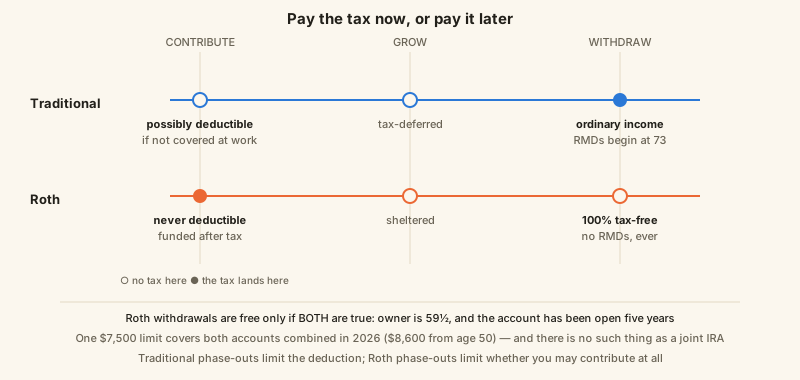
| Contribution deductibility | Potentially deductible against earned income — depends on workplace-plan coverage and income | Never deductible — contributions are made after-tax |
| Contribution limit (2026) | Lesser of $7,500 or annual earned income | Lesser of $7,500 or annual earned income |
| Combined limit | ⚠️ The limit applies to both IRAs combined — $3,000 to a traditional IRA leaves only $4,500 for a Roth | ⚠️ Same combined limit |
| Catch-up (age 50+) | Additional $1,100 (total $8,600) | Additional $1,100 (total $8,600) |
| Income phase-outs | Phase out deductibility of contributions (only if covered by a qualified workplace plan). Single: $81,000–$91,000. MFJ: $129,000–$149,000 | Phase out eligibility to contribute at all. Single: $153,000–$168,000. MFJ: $242,000–$252,000 |
| Growth | Tax-sheltered / tax-deferred | Tax-sheltered |
| Taxation of withdrawals | Distributions typically fully taxable as ordinary income. If non-deductible contributions were made, only the growth is taxed — the basis is returned tax-free | 100% tax-free if requirements met |
| Requirements for tax-free withdrawal | N/A — distributions are taxable | Both must be met: (1) account owner at least 59 ½; (2) account open at least five years |
| RMD rules | Subject to RMDs at age 73 | ⚠️ Not subject to RMDs — since taxes are not assessed when distributions occur, the IRS doesn’t require Roth IRA owners to take distributions |
| Early-withdrawal penalty | 10% penalty if under 59 ½ | 10% penalty if under 59 ½. ⚠️ Over 59 ½ but inside the five-year aging period: ordinary income taxes on the gains above basis, but no 10% penalty |
| Earned income required | Yes — no contribution without reportable earned income | Yes |
| Spousal contribution | Working spouse may contribute to a non-working spouse’s IRA (spousal IRA) | Same concept applies |
| Joint ownership | ⚠️ There is no such thing as a joint IRA — accounts are always separate | ⚠️ Same |
Traditional IRAs
- Traditional IRAs are non-qualified retirement plans because they aren’t workplace-sponsored, even though they work similarly to qualified plans.
- Like most qualified plans, contributions are deductible against earned income.
- Example: an investor earning $50,000 who contributes $4,000 to a traditional IRA is taxed on $46,000 of earned income.
- Distributions are typically fully taxable as ordinary income.
Contribution limit
- 🔑 The contribution limit for IRAs in 2026 is the lesser of $7,500 or the amount of earned income during the year.
- To contribute, investors must have earned income. A contribution can’t be made if an investor has no reportable earned income.
- Example: a person unemployed throughout the year is ineligible to make an IRA contribution.
- Example: a person earning $3,000 from a part-time job throughout the year can contribute a maximum of $3,000 to their IRA.
- Investors may make IRA contributions annually up to the contribution limit.
- 🔑 They may also contribute for a specific tax year up until the tax-filing deadline the following year (typically April 15th).
- Example: an investor can contribute toward 2025’s contribution limit until April 15th, 2026.
- Contributions made between January 1st, 2026 and April 15th, 2026 must be specifically assigned to 2025 or 2026.
Footnotes
| Footnote | Detail |
|---|---|
| Deadline * | “Normally, the cutoff date is April 15th (Tax Day). However, it is pushed back when this day falls on the weekend. April 15th, 2023 fell on a Saturday, so the deadline was extended to the 18th in 2023.” |
| Assignment ** | Assume an investor makes their first-ever IRA contribution on February 1st, 2026. They must determine if the contribution will count toward 2025’s $7,000 limit or 2026’s $7,500 limit. 📌 “In most circumstances, it’s better to contribute to the previous year’s limit until it is reached.” |
Spousal IRAs
- Only individuals with earned income may contribute to IRAs. However, the IRS allows a working spouse to contribute to a non-working spouse’s IRA.
- Example: Parsa works and is married to John, who is unemployed. Although John has no reportable income, Parsa can contribute to John’s IRA on his behalf. This is referred to as a spousal IRA contribution.
- ⚠️ “Regardless of the name, the accounts are separate - there is no such thing as a joint IRA.”
Catch-up provision
- 🔑 Investors age 50 or older are eligible for a catch-up provision, allowing an additional contribution of $1,100 per year.
- This lets investors who missed contributions in earlier years build retirement savings faster.
- 🔑 In 2026, a person age 50 or older may contribute up to $8,600 ($7,500 + $1,100 catch-up).
Deductibility of contributions
⚠️ Traditional IRA contributions are not always deductible. Three situations determine the tax status of a contribution:
| Situation | Result |
|---|---|
| Investor is not covered by a qualified workplace plan | Contributions are always deductible |
| Investor is covered by a qualified workplace plan and low income | Contributions are always deductible |
| Investor is covered by a qualified workplace plan and high income | Contributions are partially deductible or not deductible |
Covered by a qualified workplace plan means the investor can access a qualified retirement plan through work.
- Example: an investor working at a corporation that can contribute to a 401(k) is covered by a qualified plan.
- If an investor has no access to a qualified workplace plan like a 401(k), they can always deduct their contributions.
- If they do have access, deductibility depends on income level. In general, the higher the income, the less likely the investor can deduct the contribution.
- 📌 “You won’t need to know specific numbers, but you may see exam questions testing the general concept.”
Sidenote — Traditional IRA phaseouts
“Sometimes it’s helpful to see the actual numbers to understand what test writers consider low and high income. Although there are more than two tax statuses, the tables below show the ranges for those filing single and married filing jointly. You do not need to memorize these numbers.”
Taxpayers filing single (2026)
| Income | Result |
|---|---|
| < $81,000 | Full deduction |
| $81,000 - $91,000 | Phaseout range |
| > $91,000 | No deduction |
- Investors filing single can make a fully tax-deductible contribution if earning less than $81,000 annually. A phaseout begins between $81,000 and $91,000, meaning the investor may only deduct part of the contribution. Above $91,000, none of the contribution is tax-deductible.
Married taxpayers filing jointly (2026)
| Income | Result |
|---|---|
| < $129,000 | Full deduction |
| $129,000 - $149,000 | Phaseout range |
| > $149,000 | No deduction |
- Investors filing jointly can make a fully tax-deductible contribution if earning less than $129,000 annually. A phaseout begins between $129,000 and $149,000. Above $149,000, contributions are not tax-deductible.
Non-deductible contributions and rollovers
- ⚠️ Investors making non-deductible contributions to a traditional IRA are only taxed on the growth when a distribution (withdrawal) is taken. The basis (amount contributed) is returned to the investor tax-free upon withdrawal.
- When retiring or leaving a job with a qualified plan, many investors roll their retirement plan assets into IRAs.
- ⚠️ When money is rolled from one retirement plan to another, it is not a tax-reportable event (no taxes due).
- Moving retirement assets to an IRA keeps the assets tax-sheltered and can provide additional investment options.
Permitted / prohibited investments
| Account | Investment restrictions |
|---|---|
| Most qualified plans | Limit the types of investments they allow |
| IRAs | Only prohibited from short sales, margin, and some option strategies |
- ⚠️ Uncovered (naked) option writing is not allowed in an IRA because the potential loss is too large.
Roth IRAs
- Roth IRAs are a newer retirement account created in the 1990s. Named after Senator William Roth, this type of IRA uses a “reverse” tax structure compared with many retirement plans.
Contributions
- Contributions are made after-tax, which means they are not deductible.
- Roth IRA assets grow tax-sheltered and can be withdrawn in retirement tax-free if specific requirements are met.
- 🔑 The same traditional IRA contribution limit of $7,500 per year applies to Roth IRAs.
- ⚠️ The contribution limit applies to both IRAs combined.
- Example: an investor contributing $3,000 to a traditional IRA may only contribute $4,500 to a Roth IRA. If the account owner is age 50 or older, they could contribute an additional $1,100.
- ⚠️ Not all investors are eligible to contribute to Roth IRAs — in particular, investors with high incomes cannot contribute.
- 📌 “You won’t need to know the specific numbers for the exam, but they are included below for context.”
Sidenote — Roth IRA phaseouts
These are the phaseout limits for being eligible to contribute to a Roth IRA:
Taxpayers filing single (2026)
| Income | Result |
|---|---|
| < $153,000 | Full contribution |
| $153,000 - $168,000 | Phaseout range |
| > $168,000 | No contribution |
- Investors filing single can make a full Roth contribution if earning less than $153,000 annually. A phaseout begins between $153,000 and $168,000, meaning the investor may only make a partial contribution (of the $7,500 limit, or $8,600 if age 50 or above). Above $168,000, no Roth contributions may be made.
Married taxpayers filing jointly (2026)
| Income | Result |
|---|---|
| < $242,000 | Full contribution |
| $242,000 - $252,000 | Phaseout range |
| > $252,000 | No contribution |
- Investors filing jointly can make a full Roth contribution if earning less than $242,000 annually. A phaseout begins between $242,000 and $252,000, meaning the investor may only make a partial contribution (of the $7,500 limit, or $8,600 if age 50 or above). Above $252,000, no Roth contributions may be made.
Distributions
🔑 Roth IRA owners must meet two requirements to avoid taxes on distributions:
| # | Requirement | If failed |
|---|---|---|
| 1 | Account owner must be at least 59 ½ years old | A 10% early withdrawal penalty is assessed |
| 2 | The account must be open for at least five years | See footnote below |
- Example: an investor opening their first Roth IRA at age 60 must wait until age 65 for tax-free withdrawals.
- 🔑 The five-year aging period for Roth IRAs starts on the first day of the tax year (typically January 1st) of their first contribution.
- ⚠️ A withdrawal after age 59 ½ but before the five-year aging period ends owes ordinary income tax on earnings above basis, with no 10% penalty.
- Example: a 60-year-old opens their first Roth IRA and contributes $5,000. Two years later the account is worth $8,000, and the investor requests a full withdrawal. They will pay ordinary income taxes on the $3,000 of growth, but no additional 10% penalty.
RMDs
- Most retirement plans are subject to required minimum distributions (RMDs) when the account owner turns 73.
- ⚠️ Roth IRAs are not subject to RMDs. Since taxes are not assessed when distributions occur, the IRS doesn’t require Roth IRA owners to take distributions.
Sidenote — Roth 401(k)s
| Feature | Roth 401(k) |
|---|---|
| Contributions | After-tax (non-deductible) |
| Growth | Tax-sheltered |
| Distributions | Tax-free in retirement if specific requirements are met |
| Qualified withdrawal rules | Investor must be 59 ½ and the account must satisfy the five-year aging requirement |
| Plan type | ⚠️ Unlike Roth IRAs, Roth 401(k)s are qualified workplace plans governed by ERISA |
| RMDs | 🔑 Starting in 2024, RMDs are no longer required from Roth 401(k) accounts |
Sidenote — Divorce & retirement plans
- Divorce is a fairly common event, with roughly 50% of all marriages ending in separation in the United States. One major issue in divorce is dividing jointly owned assets, and retirement plans are often part of that process.
| Order type | Applies to | ERISA compliance | Early withdrawal penalty on receipt |
|---|---|---|---|
| Qualified domestic relations order (QDRO) | Qualified plans | ⚠️ Must comply with ERISA | ⚠️ No early withdrawal penalty applies |
| Transfer incident to divorce order | Non-qualified plans, like traditional and Roth IRAs | ⚠️ Not required to comply with ERISA | ⚠️ Receiver may be subject to the 10% penalty if below age 59 ½ |
QDRO process
- If the two parties agree on the amount to be split (e.g., two former spouses agree to split both their 401(k) plans 50/50), the agreement is made in divorce court and the presiding judge signs off on the QDRO.
- If there is no agreement, the divorce proceedings determine how the retirement plan(s) will be split, and the judge signs off on the final QDRO.
- Regardless of agreement or disagreement, the QDRO must comply with ERISA.
- The transfer incident to divorce process is similar to the QDRO process, but the order is not required to comply with ERISA.
Taxation when a plan is split
| Event | Tax result |
|---|---|
| The distribution itself | ⚠️ The IRS does not tax the distribution. Original account owner is not assessed taxes (ordinary income or penalties) |
| Receiving spouse rolls funds into a similar retirement plan | Not taxed. Example: Former Spouse 1 distributes 50% of their 403(b) to Former Spouse 2, who deposits the funds into their traditional IRA |
| Receiving spouse does not deposit into a similar plan (e.g., pre-tax 403(b) → after-tax Roth IRA) or takes cash | ⚠️ Pays ordinary income taxes on the amount received. Example: funds placed into a (non-retirement) checking account |
| Receiver below 59 ½ under a transfer incident to divorce | 10% early withdrawal penalty applies |
| Receiver below 59 ½ under a QDRO | ⚠️ No early withdrawal penalty |
Inherited IRAs
- Many Americans die (hopefully at an old age) with balances in their IRAs. When this happens, beneficiaries (the people who inherit these accounts) must follow specific distribution rules.
- ⚠️ “The Internal Revenue Service (IRS) does not allow assets to remain in tax-sheltered accounts forever.”
Distribution rules fall into two categories based on the beneficiary:
- Spousal beneficiary
- Non-spouse beneficiary
Spousal beneficiary
One benefit of being married is added flexibility when inheriting IRA assets from a spouse.
| Option | How it works | Distributions required? | Penalty exposure |
|---|---|---|---|
| Claim the IRA as their own | Roll the inherited assets into their own IRA | If the spousal beneficiary is below age 73, they are not required to take distributions | ⚠️ May face the 10% early withdrawal penalty if a distribution is taken before age 59 ½ |
| Claim the assets into an inherited IRA | 📌 “If the spousal beneficiary is below age 59 ½ and plans to take a distribution, claiming the assets into an inherited IRA is likely the better choice.” | ⚠️ Tradeoff: inherited IRAs require distributions — elect annual RMDs or distribute all assets within 10 years | No 10% early withdrawal penalty |
Non-spouse beneficiary
There are two types of non-spouse beneficiaries:
| Type | Definition |
|---|---|
| Eligible designated beneficiary | A minor child of the decedent (deceased IRA owner); a permanently disabled person; a chronically ill person; a person not more than 10 years younger than the decedent |
| Designated beneficiary | Anyone who does not meet one of the attributes above |
Claim the assets into an inherited IRA — the primary option for non-spousal beneficiaries, although distribution methods may vary by beneficiary type:
| Beneficiary | Distribution options | Penalty |
|---|---|---|
| Eligible designated beneficiary | Annual RMDs over their lifetime, or distribute all assets within 10 years | ⚠️ Distributions are not subject to the 10% early withdrawal penalty |
| Designated beneficiary | Distribute all assets within 10 years | Not subject to the 10% early withdrawal penalty |
Distributions are not penalized, but distributions are required.
Key points
Traditional IRAs
- Potentially deductible contributions
- 100% taxable distributions
Traditional IRA contributions
- 2026 contribution limit is lesser of:
- $7,500
- Annual earned income
- Age 50+ can contribute $1,100 more
- Spousal IRA allows non-working spouse contribution
Deductible traditional IRA contributions
- Always allowed if not covered by a qualified plan
- If covered by a qualified plan:
- Deductible if low-mid income
- Non-deductible if high income
Roth IRAs
- Non-deductible contributions
- 100% tax-free distributions if:
- Age 59 1/2 or older
- Roth IRA is aged 5 years
Roth IRA contributions
- 2026 contribution limit is lesser of:
- $7,500
- Annual earned income
- Contribution limits apply to both Roth and traditional IRAs combined
- Cannot contribute if high income
Roth 401(k)s
- Qualified workplace plan
- Similar tax structure to a Roth IRA
Qualified domestic relations order (QDRO)
- Orders qualified retirement assets to be split
- Typically utilized during divorce proceedings
- Distribution not taxable
- Receipt of funds may be taxable
- Not taxable if placed into a similar retirement plan
- Taxable as ordinary income if not placed into a similar retirement plan
- No early withdrawal penalty
Transfer incident to divorce
- Orders non-qualified retirement assets to be split
- Utilized during divorce proceedings
- Distribution not taxable
- Receipt of funds may be taxable
- Not taxable if placed into a similar retirement plan
- Taxable as ordinary income if not placed into a similar retirement plan
- Early withdrawal penalty applies if receiver below age 59 1/2
Beneficiary choices
| Beneficiary | Choices |
|---|---|
| Spousal IRA beneficiary | Claim IRA as their own; or claim assets into inherited IRA, and — take RMDs annually, or distribute all assets within 10 years |
| Non-spouse eligible designated beneficiary | Claim assets into inherited IRA, and — take RMDs annually, or distribute all assets within 10 years |
| Non-spouse designated beneficiary | Claim assets into inherited IRA, and — distribute all assets within 10 years |
Sources
Primary/official references for the material on this page. Every link was fetched and returned HTTP 200 on 2026-08-15.
| # | Source | Publisher |
|---|---|---|
| 1 | Pub 590-A — IRA contributions, deductibility, phase-outs | IRS |
| 2 | Pub 590-B — IRA distributions, RMDs, 10% penalty exceptions | IRS |
| 3 | Roth IRA — income limits, qualified distributions, 5-year rule | IRS |
| 4 | IRA contribution limits and catch-up | IRS |
| 5 | 2026 retirement limits and IRA/Roth phase-out ranges | IRS (IR-2025-111) |
| 6 | Achievable Series 65 — chapter 2.6.4 | Achievable (course text) |