Dollar Cost Averaging & Fund Suitability
General suitability
The suitability of a fund, unit investment trust (UIT), or real estate investment trust (REIT) is closely tied to the individual securities held in its portfolio. For example, the suitability of a large-cap stock fund is generally similar to the suitability of a large-cap stock.
🔑 The main differences between funds/UITs and the individual securities they hold:
- Diversification
- Fees
| Factor | Detail |
|---|---|
| Diversification | Funds, UITs, and REITs can provide instant diversification. It’s common for a mutual fund to hold dozens — or even hundreds — of different securities. |
| Professional management | Rather than researching and selecting individual investments, an investor can buy a fund or UIT and have a professional manage the portfolio. |
| Who benefits most | Especially useful for retail investors who don’t have the time or expertise to research and monitor individual securities. |
| Costs | Diversification and professional management come with costs. |
⚠️ Diversification and professional management are not free. These products may charge:
- Expense ratio
- Sales charges
- 12b-1 fees
- Management fees
- Other expenses
Even when the benefits outweigh the fees, you still need to consider these costs when evaluating whether the investment is appropriate.
Dollar cost averaging
Dollar cost averaging is a common investment strategy used with investment companies, especially mutual funds. It involves investing a fixed dollar amount at regular intervals over time.
| Concept | Detail |
|---|---|
| What it does | Helps reduce market timing risk |
| Market timing risk | The risk of investing a large amount right before a market decline |
| Key mechanism | When prices fall, the same fixed dollar amount buys more shares; it spreads purchases across different price levels and tends to lower the investor’s average cost per share in a fluctuating market |
Lump sum vs. periodic investing
| Approach | Outcome described |
|---|---|
| One-time $100,000 investment right before the Great Recession of 2008 (such as in the summer of 2007) | It would’ve taken over 4 years to recoup the losses from the downturn. The larger the one-time investment, the more exposed the investor is to a sharp decline soon after investing. |
| $1,000 per week over 100 weeks (roughly 2 years) | When prices fall, the same $1,000 buys more shares — purchases are spread across different price levels. |
Worked example — ABC mutual fund during a market decline
| Date | Purchase amount | Price per share | Shares purchased |
|---|---|---|---|
| Jan 1 | $1,000 | $20 | 50 |
| Feb 1 | $1,000 | $16 | 62.5 |
| Mar 1 | $1,000 | $10 | 100 |
| Apr 1 | $1,000 | $8 | 125 |
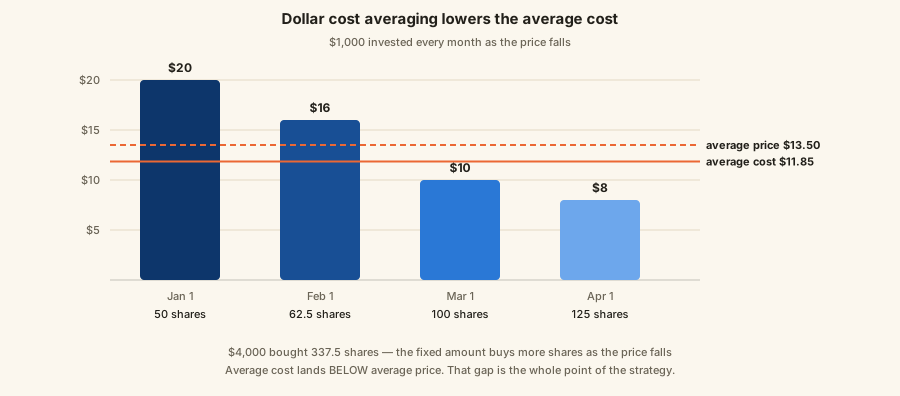
Overall, the investor purchased $4,000 of ABC mutual fund over a four-month period. During that time, they purchased 337.5 shares.
🔑 Formulas:
Average cost = Amount invested / Shares purchased
Average price = Combined market prices at purchase / Number of investments
Average cost Average cost = Amount invested / Shares purchased Average cost = $4,000 / 337.5 Average cost = $11.85
Average price Average price = Combined market prices at purchase / Number of investments Average price = ($20 + $16 + $10 + $8) / 4 Average price = $54 / 4 Average price = $13.50
Average cost vs. average price
| Measure | What it reflects | Result in this example |
|---|---|---|
| Average cost | Both the prices paid and the number of shares purchased at each price | $11.85 |
| Average price | The simple average of the prices at the time of each investment | $13.50 |
In a fluctuating market, the average cost will be lower than the average price because the fixed investment amount buys more shares when prices are lower. Even in a bear market, continuing to invest can reduce the investor’s average cost per share.
Key points
Investment company suitability
- Generally provide instant diversification
- Professional expertise and management
Dollar cost averaging
- Investing fixed amounts consistently over time
- More shares are purchased in market declines
- Results in lower average cost vs. the average price
Practice questions
Q1. What two main factors differentiate fund/UIT/REIT suitability from holding the same individual securities?
Show answer
Diversification and fees. Pooled vehicles provide instant diversification and professional management but charge expense ratios, sales charges, 12b-1 fees, management fees, and other costs.
Q2. Who benefits most from the professional management offered by investment companies?
Show answer
Retail investors who lack the time or expertise to research and monitor individual securities.
Q3. What is dollar cost averaging?
Show answer
Investing a fixed dollar amount at regular intervals over time to reduce market timing risk.
Q4. How does dollar cost averaging help when prices fall?
Show answer
The same fixed dollar amount buys more shares at lower prices, spreading purchases across levels and tending to lower the investor’s average cost per share.
Q5. In the ABC fund example ($1,000/month for four months at $20, $16, $10, $8), what are the average cost and average price?
Show answer
Average cost = $4,000 ÷ 337.5 shares = $11.85. Average price = ($20+$16+$10+$8) ÷ 4 = $13.50.
Q6. In a fluctuating market, how does average cost compare to average price?
Show answer
Average cost will be lower than average price because more shares are purchased when prices are lower.
Q7. Why is a lump-sum investment before the 2008 downturn riskier than periodic investing?
Show answer
A one-time $100,000 investment before the Great Recession took over four years to recoup losses. Larger one-time investments face greater exposure to a sharp decline soon after investing.
Sources
Primary/official references for the material on this page. Every link was fetched and returned HTTP 200 on 2026-08-15.
| # | Source | Publisher |
|---|---|---|
| 1 | Rule 2111 — suitability, reasonable-basis/customer-specific/quantitative | FINRA |
| 2 | Mutual funds and ETFs — NAV, fees, share classes | SEC / Investor.gov |
| 3 | Reg BI — the four obligations, Form CRS | FINRA |
| 4 | Achievable Series 65 — chapter 1.3.9 | Achievable (course text) |