Contributions, Distributions & Penalties
🔑 Numbers, ages & limits
| Item | Exact figure | Notes |
|---|---|---|
| 2026 IRA contribution limit | 🔑 $7,500 | Example used by the chapter |
| Excess contribution penalty | 🔑 6% annual penalty on the amount over the limit | Assessed until the excess is withdrawn |
| IRS-defined retirement age | 🔑 59 ½ or older | — |
| Early withdrawal penalty (before 59 ½) | 🔑 10% | In addition to applicable taxes |
| Early withdrawal worked example | $10,000 withdrawn at age 40 → $1,000 penalty (10%) + ordinary income taxes; 37% federal + 5% state + 10% penalty ≈ 52% of the distribution | — |
| QBAD (qualified birth or adoption distribution) limit | 🔑 Up to $5,000 per qualifying birth or adoption, penalty-free | Under the SECURE Act; still subject to ordinary income tax |
| Rollover redeposit deadline | 🔑 60 days | “60-day rollover”; missing it makes the distribution taxable and possibly subject to the 10% penalty (if under 59 ½) |
| Rollover frequency limit | 🔑 Once per year | Reportable to the IRS |
| Trustee-to-trustee transfer frequency | Unlimited | Not reportable to the IRS; no 60-day deadline |
| ACATS — delivering firm validation window | 🔑 One business day | Confirms assets are in the account and eligible to transfer |
| ACATS — delivering firm transfer window | 🔑 Three business days | After validation |
| RMD start age | 🔑 73 | Many retirement plans subject to RMDs |
| RMD annual deadline | 🔑 December 31st (end of the year) | — |
| First RMD deadline | 🔑 April 1st of the year after the investor turns 73 | Extra three months (January, February, March) |
| Missed RMD penalty | 🔑 25% general penalty, reduced to 10% if the investor takes the RMD within two years | — |
| RMD calculation example | 75-year-old, life expectancy factor 24.6, year-end balance $100,000 (Dec 31, 2025) → $100,000 ÷ 24.6 = $4,065 2026 RMD | Calculation details not important for test purposes |
Overview
Retirement plans encourage investors to save for retirement. When you retire, you’ll need enough money to cover living expenses for the rest of your life. While Social Security, Medicare, and other government benefits can help, many people need additional savings to maintain a comfortable lifestyle.
In this chapter, you’ll learn the general features of retirement plans. The following concepts are discussed in this chapter:
- Contributions
- Eligible investments
- Distributions
- Penalties
Contributions
Contributions are the funds you place into a retirement account. ⚠️ Contributions must be made in cash, regardless of the type of retirement account. You can’t contribute securities or other assets directly into a retirement plan.
Depending on the type of retirement account, contributions may be deductible or non-deductible (after-tax).
⚠️ Deductible vs. non-deductible contributions
| Feature | Deductible contribution | Non-deductible (after-tax) contribution |
|---|---|---|
| Immediate tax benefit | Yes — reduces taxable income | No |
| Example (investor earns $100,000 in wages, contributes $5,000) | Pays income taxes on $95,000 ($100,000 − $5,000) | Still pays income taxes on the full $100,000 of earnings |
| Who uses it | 📌 Almost all qualified retirement plans (discussed in ERISA, Qualified Plans & 404(c)) follow this tax structure | Plans made with after-tax dollars |
Tax deferral
After a contribution is made, the retirement plan assets can be invested according to the account owner’s instructions. In a non-retirement account, taxes are due when you receive income (like interest or dividends) or realize capital gains.
Most retirement plans are tax-deferred, meaning investment income and gains aren’t taxed until money is distributed (withdrawn). This tax structure applies to virtually all retirement plans except Roth IRAs or 401(k)s, which are discussed later in this unit.
Eligible investments
Most securities can be held in retirement plans, but some investments and strategies are prohibited. In general, strategies with unlimited risk are restricted. That means investors must avoid short sales, margin, and some option strategies. Investors also can’t invest in collectibles or art.
*In particular, an investor cannot sell uncovered (naked) options due to the significant risk involved.
| Allowed | Prohibited |
|---|---|
| Stocks (common and preferred) | Short sales |
| Bonds | Margin |
| Mutual funds | Uncovered (naked) options / some option strategies |
| Unit investment trusts (UITs) | Collectibles |
| US Government issued coins | Art |
Municipal bonds
While not explicitly prohibited, municipal bonds are generally unsuitable for retirement plans. Municipal bonds typically offer lower yields because of their tax benefits. But retirement plans already provide tax advantages (for example, interest isn’t taxed while it remains in the account). Because of that, it often makes more sense to consider higher-yielding taxable bonds — such as US Government bonds — if the goal is a relatively safe, income-producing investment.
Distributions
Distributions (withdrawals) are funds taken out of a retirement plan. These accounts are designed to provide income in retirement, but an investor can typically withdraw funds at any time. However, penalties may apply if withdrawals occur too early, and other penalties can apply if required withdrawals aren’t taken on time.
Most retirement plan distributions are taxable as ordinary income. Like wages from a job, ordinary income is taxed at the investor’s marginal tax bracket.
Penalties
Retirement plans are subject to many rules and regulations. If an account is managed incorrectly, the account owner may owe significant Internal Revenue Service (IRS) penalties.
Excess contribution penalty
Nearly every retirement plan has a contribution limit. The IRS allows only a certain amount of money to be contributed each year. For example, the 2026 contribution limit for individual retirement accounts (IRAs) is $7,500. If an investor contributes $10,000, the amount above the limit is an excess contribution and is subject to excess contribution penalties. 🔑 A 6% annual penalty is assessed on the amount over the limit until the excess is withdrawn.
Early withdrawal penalty
The IRS defines retirement age as 59 ½ or older. If an investor withdraws retirement plan money before this age, they’re generally subject to a 10% early withdrawal penalty in addition to applicable taxes.
Example: assume an investor withdraws $10,000 from a retirement plan at age 40. The investor owes a 10% penalty ($1,000) plus ordinary income taxes on the distribution. If the investor is in the 37% federal bracket and owes 5% state income tax, then roughly 52% of the distribution goes to taxes and penalties (37% + 5% + 10%).
Exceptions to the 10% early withdrawal penalty
When any of the following situations apply, distributions can be taken without the penalty. Ordinary income taxes are still due on the withdrawal.
| Exception | Detail |
|---|---|
| Disability | — |
| Death* | *The death exception applies to those inheriting retirement assets. For example, a 25 year old inheriting an older family member’s IRA can immediately distribute funds while avoiding the 10% early withdrawal penalty. |
| First-time home purchases | — |
| Educational expenses | — |
| Certain medical expenses | — |
| Birth or adoption of a child | 🔑 Under the SECURE Act, a qualified birth or adoption distribution (QBAD) lets an individual withdraw up to $5,000 per qualifying birth or adoption without paying the 10% penalty, though the distribution is still subject to ordinary income tax. |
| Rollovers and trustee-to-trustee transfers | Another exception to the early withdrawal penalty |
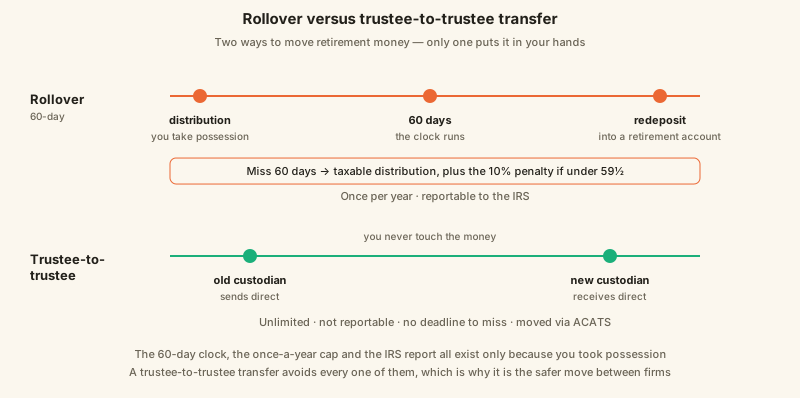
⚠️ Rollovers vs. trustee-to-trustee transfers
| Feature | Rollover (60-day rollover) | Trustee-to-trustee transfer |
|---|---|---|
| How it works | Investor requests a distribution (electronically or by check) from a retirement account and then redeposits the funds into a retirement account (which could be the same account) | Assets move directly between firms via ACATS; investor never takes possession |
| Deadline | 🔑 60 days — if the funds aren’t returned within 60 days, the distribution becomes taxable and may also be subject to the 10% early withdrawal penalty (if under 59 ½) | 🔑 No 60-day deadline — even if the process takes several weeks |
| Frequency | 🔑 Once per year only | Unlimited |
| Reportable to the IRS | Yes | No |
| Possession of funds | Investor takes possession (often depositing them into a bank account); sometimes used for short-term spending or to move assets between accounts | Investor never takes possession |
| Early withdrawal penalty | Avoided if completed within 60 days | Avoided |
ACATS process (trustee-to-trustee transfers)
Trustee-to-trustee transfers are generally a better way to move retirement assets between firms (for example, from a TD Ameritrade account to a Fidelity account, or vice versa). Brokerage firms typically use the Automated Customer Account Transfer Service (ACATS) system for these transfers.
| Step | Detail |
|---|---|
| 1 | The investor goes to the receiving firm (the firm where the assets are going; the new firm) and completes the ACATS paperwork, providing details about the account at the delivering firm (where the assets are coming from; the old firm) |
| 2 | The receiving firm submits the request through ACATS, which forwards it to the delivering firm |
| 3 | 🔑 The delivering firm has one business day to validate the request by confirming that: (a) the assets are in the account, and (b) the assets are eligible to be transferred |
| 4 | Account restrictions and proprietary products can cause a request to be denied. Proprietary products typically must be liquidated before transfer. If the request is in good order, it’s validated |
| 5 | 🔑 The delivering firm then has three business days to transfer the assets to the receiving firm |
| 6 | Once received, the assets are placed in the investor’s account at the new firm, and the transfer is complete |
Definitions
| Term | Definition | Example |
|---|---|---|
| Proprietary product | > A product only available and eligible to be held at the firm where the account is held | A Charles Schwab fund only available to Charles Schwab customers |
Required minimum distributions (RMDs)
Many retirement plans are subject to required minimum distributions (RMDs) when the account owner turns 73. The IRS doesn’t allow investors to keep money tax-sheltered indefinitely. Requiring distributions creates taxable income.
The IRS requires investors age 73 or older to calculate an annual RMD based on the account balance and a life expectancy factor*. While the calculation details aren’t important for test purposes, here’s an example. Assume a 75 year old has a life expectancy factor of 24.6 years and a year-end account balance of $100,000 on December 31st, 2025. The investor divides $100,000 by 24.6 to determine a 2026 RMD of $4,065.
*The IRS requires most investors to utilize their uniform life expectancy table to determine life expectancy. The older an investor, the lower their life expectancy, which results in a larger distribution.
RMD deadlines & penalties
| Item | Rule |
|---|---|
| Annual RMD deadline | 🔑 Must be taken by the end of the year (December 31st) in most cases |
| First RMD | 🔑 Can be delayed until April 1st of the year after the investor turns 73 — an extra three months (January, February, and March) |
| Missed RMD — general penalty | 🔑 25% |
| Missed RMD — reduced penalty | 🔑 10% if the investor takes the RMD within two years |
| Example | An 80 year old calculates a $20,000 RMD for 2025 but fails to take it by year-end. If the investor takes the distribution by December 31st, 2027, the penalty would be 10% |
Key points
Retirement plans overview
- Encourage saving for retirement expenses
- Supplement Social Security, Medicare, other benefits
- Key concepts: contributions, eligible investments, distributions, penalties
Contributions
- Must be made in cash only (no securities/assets)
- Deductible contributions: reduce taxable income immediately (used by most qualified plans)
- Non-deductible contributions: after-tax dollars, no immediate tax benefit
- Most plans are tax-deferred (gains/income untaxed until distribution)
- Exception: Roth IRAs/401(k)s
Eligible investments
- Allowed: stocks, bonds, mutual funds, UITs, US government coins
- Prohibited: short sales, margin, uncovered/naked options, collectibles, art
- Municipal bonds technically allowed but generally unsuitable
- Lower yields wasted since retirement accounts already tax-advantaged
Distributions
- Withdrawals can generally occur anytime
- Penalties apply for early or late (missed RMD) withdrawals
- Taxed as ordinary income at marginal tax bracket
Contribution limit penalties
- IRS sets annual contribution limits (e.g., 2026 IRA limit: $7,500)
- Excess contributions: 6% annual penalty until withdrawn
Early withdrawal penalty
- Retirement age defined as 59½
- 10% penalty on early withdrawals + ordinary income tax
- Exceptions (still taxed, no penalty):
- Disability
- Death (inheritance)
- First-time home purchase
- Educational expenses
- Certain medical expenses
- Birth/adoption (QBAD, up to $5,000 under SECURE Act)
Rollovers
- Investor takes possession of funds, must redeposit within 60 days
- Missed deadline: becomes taxable, possible 10% penalty
- Limited to once per year
- Reportable to IRS
Trustee-to-trustee transfers
- Assets moved directly between firms via ACATS
- Investor requests transfer at receiving firm; delivering firm validates within 1 business day, transfers within 3 business days
- Proprietary products usually must be liquidated first
- No 60-day deadline, not reportable to IRS, unlimited frequency
- Avoids early withdrawal penalty (investor never takes possession)
Required minimum distributions (RMDs)
- Begin at age 73
- Calculated using account balance ÷ life expectancy factor (uniform life expectancy table)
- Must be taken by December 31 annually
- First RMD can be delayed until April 1 of following year
- Missed RMD penalty: 25% (reduced to 10% if corrected within 2 years)
Sources
Primary/official references for the material on this page. Every link was fetched and returned HTTP 200 on 2026-08-15.