ISO vs. NSO Taxation
⚠️ THE exam question: ISO vs. NSO taxation (side-by-side)
| Non-qualified stock options (NSOs) | Incentive stock options (ISOs) | |
|---|---|---|
| Who may be granted | Any person providing services to the company — including contractors, consultants, and other non-employees | ⚠️ Company employees only. Cannot be granted to contractors, consultants, or other non-employee service providers |
| Taxation at GRANT | No tax consequence | No tax consequence |
| Taxation at EXERCISE | ⚠️ Taxed at exercise — the intrinsic value (“bargain element” / “compensation element”) is taxed as ordinary income (up to 37%), but only if there is intrinsic value | ⚠️ NOT taxed at exercise, even if there is significant intrinsic value. This is the first tax advantage over NSOs |
| Cost basis after exercise | Exercise price + intrinsic value taxed as compensation | Regular tax uses the exercise price; the market price at exercise does not matter for regular tax purposes because ISOs are not taxed at exercise |
| Taxation at SALE | Capital gain/loss measured from the cost basis. Short-term (held 1 year or less) → ordinary income rates (up to 37%). Long-term (held > 1 year) → 15% or 20%. Capital losses are deductible | Total benefit = liquidation value − exercise price. Taxed as long-term capital gain (15% or 20%) if BOTH holding requirements are met; otherwise taxed as ordinary income (up to 37%) |
| Holding period requirements | Standard capital gains holding period only: >1 year for long-term treatment | 🔑 BOTH required: (1) shares sold at least 2 years from the date of the GRANT, AND (2) shares sold over 1 year from the date of EXERCISE |
| AMT treatment | Not addressed on this page | Not addressed on this page |
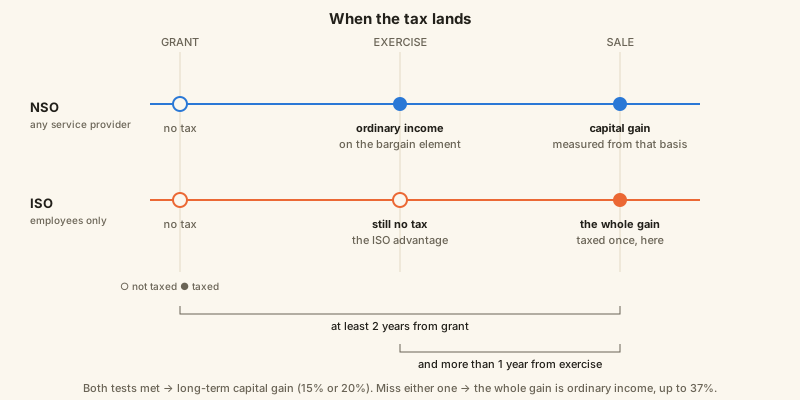
ISO holding-period rule (exact): preferential long-term capital gains rates (maximum of 15% or 20%) apply only if the shares are sold at least two years from the date of the grant AND over one year from the date of exercise.
*The shares must be held for at least one year and one day to qualify. Holding the shares for exactly one year post-exercise does NOT qualify for preferential tax treatment.
If either ISO requirement is not met, any gain from selling the shares is taxed at ordinary income rates (up to 37%).
NSO double ordinary-income trap: with NSOs, it’s possible for the same economic benefit to be taxed at ordinary income rates twice — once at exercise (intrinsic value) and again at sale (if the shares are sold within one year).
What employee stock options are
- Employers can get creative with compensation, especially when they want to keep their most valued employees. With roughly one out of every five millennials changing jobs annually, Generation Z appearing even more disconnected from their workplace, and the recent Great Resignation, retaining talent can be difficult. Employee stock options are a common “carrot-and-stick” approach employers use to encourage employees to stay.
- 🔑 Essentially long calls — they give you the right to buy company stock at a fixed price.
For example, assume an employee at Disney (ticker: DIS) receives stock options to purchase 1,000 shares of DIS at $120 in four years, while the stock currently trades near $90 per share. The options have no intrinsic value at the current market price, but the key question is: where will the stock be in four years?
If DIS rises to $150 by then, the employee has $30 of intrinsic value per share, resulting in $30,000 of compensation at exercise ($30 intrinsic value x 1,000 shares). The more options granted - and the higher the intrinsic value at exercise - the more valuable the compensation becomes.
Key vocabulary
| Term | Meaning |
|---|---|
| Grant | When options are provided |
| Exercise | When options are utilized to buy stock |
| Term | Amount of time until expiration of options |
| Vesting period | The period before the employee may exercise (four years in the DIS example) |
| Vesting cliff | Options become available in chunks after specific dates (e.g., 250 options vesting each year) |
- 📌 The vesting period is where the “carrot-and-stick” feature shows up. If an employee is granted options with a four-year vesting period, they forfeit at least some options if they resign before vesting.
- Two primary types of employee stock options exist. They’re similar in structure but differ in taxation (which matters for test purposes):
- Non-qualified stock options (NSOs)
- Incentive stock options (ISOs)
Non-qualified stock options (NSOs)
- Of the two types, NSOs are generally less tax-advantaged.
- 🔑 There is no tax consequence at the time of grant for either NSOs or ISOs. That makes sense: the options might end up worthless by the time they vest.
Returning to the DIS example: options to buy DIS at $120, with a four-year vesting period and a ten-year term. This means:
-
After four years, the employee can exercise the options.
-
Ten years after the grant, any unexercised options expire.
-
If DIS never rises above $120 during the 10-year term, the options would be worthless. This is why the IRS does not tax employee stock options when they’re granted.
NSO taxation at exercise
- NSOs are taxed when they’re exercised, but only if there is intrinsic value.
Continuing the DIS example (1,000 shares at $120), assume that after the four-year vesting period DIS is trading at $180. The intrinsic value is $60 per share.
When the employee exercises the NSOs, the intrinsic value is taxed as ordinary income. Here, $60,000 ($60 intrinsic value x 1,000 shares) is added to taxable income. Many employers withhold taxes at exercise to reduce the employee’s out-of-pocket tax bill later.
If the employee is in the 32% marginal bracket, the $60,000 of additional compensation creates $19,200 of federal income tax ($60,000 x 32%). The tax rate applied is the investor’s marginal income tax rate.
🔑 The intrinsic value taxed at exercise is also called the:
- “bargain element,” or
- “compensation element.”
Tax brackets (context only)
📌 The page states: Do not memorize these tax brackets; this chart is only for context. As of tax year 2026:
| Rate | Individuals | Married filing jointly |
|---|---|---|
| 10% | $0 | $0 |
| 12% | $12,401 | $24,801 |
| 22% | $50,401 | $100,801 |
| 24% | $105,701 | $211,401 |
| 32% | $201,776 | $403,551 |
| 35% | $256,226 | $512,451 |
| 37% | $640,601 | $768,701 |
Definitions
| Term | Definition |
|---|---|
| Marginal tax bracket | The tax bracket applied to the last dollar earned |
Example: An individual making $55,000 would pay a 10% tax on the first $12,400 earned, a 12% tax on additional income up to $50,400, and a 22% tax on the remaining income received. Although the investor is taxed at three different rates, they fall in the 22% tax bracket.
Cost basis after exercise
🔑 Once the options are exercised, the shares receive a cost basis. For NSOs, the cost basis equals:
- the exercise price, plus
- the intrinsic value taxed as compensation.
In the DIS example, the cost basis becomes $180 per share ($120 exercise price + $60 intrinsic value). That cost basis is what you’ll use later to calculate a capital gain or loss when the shares are sold.
Capital gains after the shares are sold
- Capital gains taxes apply when a security is liquidated.
- If you sell below cost basis, the capital loss is deductible and reduces taxes.
- If you sell above cost basis, the capital gain is taxable.
| Type | Holding period | Tax rate |
|---|---|---|
| Short-term capital gain | Sold at a profit after one year or less of ownership | Ordinary income rates (up to 37%) |
| Long-term capital gain | Sold at a profit after more than one year of ownership | Typically 15% or 20% — only taxpayers at the highest brackets (35% or 37%) pay 20% |
- 📌 Because the maximum long-term rate (20%) is lower than the maximum ordinary income rate (37%), investors often prefer holding securities for more than one year.
NSO worked example 1 — short-term sale
An employee of a large corporation is granted non-qualified stock options to purchase 500 shares of company stock at $50 after a vesting period of five years. At the end of the vesting period, the company stock is trading at $80, and the employee exercises the stock options. They hold the shares for nine months, then liquidate them in the market when the stock price is $100.
In this scenario, the employee encounters two tax events. Can you identify them?
The first tax event occurs when the NSOs are exercised. The stock options allow a stock purchase at $50 when the market price is $80, resulting in $30 of intrinsic value per share. Therefore, the first tax event is the additional compensation of $15,000 ($30 intrinsic value x 500 shares), subject to ordinary income tax rates (up to 37%).
The second tax event occurs when those shares are liquidated in the market nine months later. With an initial cost basis per share of $80 and sales proceeds per share of $100, the investor locks in a $20 capital gain per share. The capital gain is short-term as the shares were held for one year or less. The second tax event is the total short-term capital gain of $10,000 ($20 capital gain x 500 shares), also subject to ordinary income taxes (again, up to 37%).
The employee faces $25,000 of taxable ordinary income ($15,000 + $10,000), subject to a tax rate of up to 37%.
NSO worked example 2 — long-term sale
An employee of a large corporation is granted non-qualified stock options to purchase 800 shares of company stock at $120 after a vesting period of two years. At the end of the vesting period, the company stock is trading at $160, and the employee exercises the stock options. They hold the shares for 16 months, then liquidate them when the stock price is $190.
Again, the employee encounters two tax events. Can you identify them?
The first tax event occurs when the NSOs are exercised. The options allow a stock purchase at $120 when the market price is $160, resulting in $40 of intrinsic value per share. Therefore, the first tax event is the additional compensation of $32,000 ($40 intrinsic value x 800 shares), subject to ordinary income tax rates (up to 37%).
The second tax event occurs when those shares are liquidated in the market 16 months later. With an initial cost basis per share of $160 and sales proceeds of $190, the investor locks in a $30 capital gain per share. The capital gain is long-term, as the shares were held for over a year. The second tax event is the total long-term capital gain of $24,000 ($30 capital gain x 800 shares), subject to long-term capital gain tax rates (15% or 20%).
The employee faces $32,000 of taxable ordinary income, subject to a tax rate of up to 37%, plus $24,000 of taxable long-term capital gains, subject to a tax rate of 15% or 20%.
- 📌 NSOs may be granted to any person providing services to the company, including contractors, consultants, and other non-employees. This gives the company a way to compensate service providers without paying cash.
Incentive stock options (ISOs)
ISOs are similar in structure to NSOs, but differ in two important ways:
- ⚠️ ISOs may only be granted to company employees. They cannot be granted to contractors, consultants, or other non-employee service providers.
- ISOs are taxed differently than NSOs, and that difference can produce lower tax rates.
- Like NSOs, ISOs are not taxed when they’re granted.
- ⚠️ Unlike NSOs, ISOs are not taxed at exercise — even if there is significant intrinsic value at exercise, it is not taxable at that time. This is the first tax advantage over NSOs.
- 📌 ISOs don’t eliminate taxes — the taxes are delayed. The holding period determines whether the eventual sale is taxed at long-term capital gains rates.
🔑 An employee receives preferential long-term capital gains tax rates (maximum of 15% or 20%) only if the shares are sold:
- At least two years from the date of the grant
- Over one year* from the date of exercise
*The shares must be held for at least one year and one day to qualify. Holding the shares for exactly one year post-exercise does not qualify for preferential tax treatment.
If either requirement is not met, any gain from selling the shares is taxed at ordinary income rates (up to 37%).
ISO worked example 1 — both requirements met
An officer of a large corporation is granted incentive stock options to purchase 2,000 shares of company stock at $30 on January 25th, 2018. The options have a four-year vesting period and a 10-year term. On February 15th, 2022, the officer exercised the stock options while the company stock was trading at $45. On March 1st, 2023, the officer liquidated the shares in the market at $55.
Answer = $50,000 taxed at long-term capital gains rates (15% or 20%)
For ISOs to receive preferential long-term capital gain tax rates (15% or 20%), both requirements must be met:
- Shares sold at least two years from the date of the grant
- Shares sold at least one year from the date of exercise
The options were granted on January 25th, 2018, which is more than five years before the March 1st, 2023 liquidation date. The options were exercised on February 15th, 2022, which is more than one year before the March 1st, 2023 liquidation date. Both requirements were met.
To determine the taxable gain, compare the exercise price ($30 per share) to the liquidation price ($55 per share). The market price at exercise ($45 per share) does not matter for regular tax purposes because ISOs are not taxed at exercise.
The officer’s total gain is $25 per share ($55 - $30), so the taxable long-term capital gain is $50,000 (2,000 shares x $25).
ISO worked example 2 — only one requirement met
A director of a mid-sized corporation is granted incentive stock options to purchase 200 shares of company stock at $250 on September 10th, 2017. The options have a five-year vesting period and a ten-year term. On October 12th, 2022, the officer exercised the stock options while the company stock was trading at $300. On August 30th, 2023, the officer liquidated the shares in the market at $325.
Answer = $15,000 taxable at ordinary income rates (up to 37%)
For ISOs to receive preferential long-term capital gain tax rates (15% or 20%), both requirements must be met:
- Shares sold at least two years from the date of the grant
- Shares sold at least one year from the date of exercise
The options were granted on September 10th, 2017, which is nearly six years before the August 30th, 2023 liquidation date. The options were exercised on October 12th, 2022, which is less than one year before the August 30th, 2023 liquidation date. Only one requirement was met, so the sale does not qualify for preferential long-term capital gain treatment.
To determine the taxable amount, compare the exercise price ($250 per share) to the liquidation price ($325 per share). The market price at exercise ($300 per share) does not matter for regular tax purposes because ISOs are not taxed at exercise.
The director’s total gain is $75 per share ($325 - $250), so the taxable ordinary income is $15,000 (200 shares x $75).
Key points
Employee stock options
- A unique form of compensation to employees and service providers
- Provide the right to buy company stock at a fixed price
- Essentially long calls
- Grant = when options are provided
- Exercise = when options are utilized to buy stock
- Term = amount of time until expiration of options
Non-qualified stock options (NSOs)
- May be granted to any person providing services to the company
- No tax consequence upon grant
- Intrinsic value is taxable at exercise as ordinary income (up to 37%)
- When shares are liquidated in the market:
- Short-term capital gains (1 year or less) taxable as ordinary income (up to 37%)
- Long-term capital gains (> 1 year) are taxable at the capital gain rate (15% or 20%)
- Capital losses are deductible
Incentive stock options (ISOs)
- May only be granted to company employees
- No tax consequence upon grant or exercise
- Total benefit equal to the difference between liquidation value vs. exercise price
- Benefit taxable as long-term capital gain (15% or 20%) at share liquidation if:
- Shares sold at least 2 years from the date of the grant
- Shares sold after 1 year from the date of exercise
- Benefit taxable as ordinary income (up to 37%) if:
- Both requirements above are not met
Sources
Primary/official references for the material on this page. Every link was fetched and returned HTTP 200 on 2026-08-15.
| # | Source | Publisher |
|---|---|---|
| 1 | Topic 427 — statutory and nonstatutory stock options | IRS |
| 2 | Pub 525 — taxable/nontaxable income, ISOs and NQSOs | IRS |
| 3 | Options fundamentals, strategies and the ODD | OCC / Options Industry Council |
| 4 | Achievable Series 65 — chapter 1.4.1.13 | Achievable (course text) |