Intrinsic Value & Time Value
Premiums
The premium is the current market price of an options contract. Like any market price, it’s influenced by supply and demand:
- If more investors want to buy an option, the premium tends to rise.
- If more investors want to sell an option, the premium tends to fall.
Market demand for an option is generally driven by two components: intrinsic value and time value.
⚠️ Intrinsic value vs. time value — the two components of every premium:
| Component | Definition (per this page) | Effect on premium | Example |
|---|---|---|---|
| Intrinsic value | > “the amount of profit the holder would have if the option were exercised right now” | In general, the more intrinsic value an option has, the higher its premium | An option that gives you the right to buy a stock at $50 when the stock is currently $60 has $10 of intrinsic value |
| Time value | > “the portion of the premium that reflects how much time is left until the option expires” | More time until expiration means more opportunity for the market price to move, which makes the option more valuable; more time value generally means a higher premium | A nine-month option usually costs more than a one-week option with the same type and strike |
🔑 Option premiums can be calculated using this formula:
Premium = intrinsic value + time value
Intrinsic value is also called the “in the money” (ITM) amount of the contract. An option is in the money when exercising it would produce a positive return for the holder.
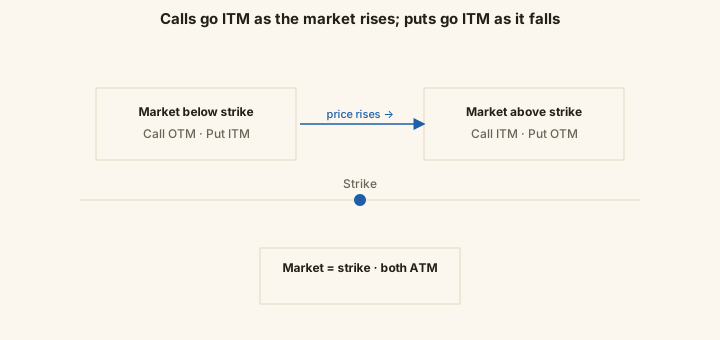
How intrinsic value behaves for calls and puts
Calls:
- Go in the money (gain intrinsic value) when the market rises
- Go out the money (lose intrinsic value) when the market falls
Puts:
- Go in the money (gain intrinsic value) when the market falls
- Go out the money (lose intrinsic value) when the market rises
⚠️ To represent this visually — the page’s ITM / ATM / OTM grid:
| Market | Calls | Puts |
|---|---|---|
| Market rises (above the strike) | ITM | OTM |
| Market equals the strike (—) | ATM | ATM |
| Market falls (below the strike) | OTM | ITM |
- ITM = In the money
- OTM = Out the money
- ATM = At the money
- If a contract is in the money, it has intrinsic value.
- If a contract is out of the money, it has no intrinsic value.
- A contract is at the money when the strike price and the market price are the same.
Market prices fluctuate daily, so an option can move in and out of the money many times before expiration. A lot can change in the nine months* that options exist, which is why time value is such an important part of an option’s premium.
*Standard options maintain expirations of up to nine months from issuance. However, LEAPS options maintain expirations of up to 3 years from issuance.
Calculating intrinsic value
🔑 Calculating intrinsic value is straightforward once you know three things:
- The option type (call or put)
- The strike price
- The market price of the underlying security
Let’s work through a few examples.
1 ABC Jan 50 call when the market price is $55
This option has $5 of intrinsic value (it’s “in the money” by $5).
1 ABC Jan 50 call when the market price is $70. How much intrinsic value does the option have?
$20 of intrinsic value (“in the money” by $20)
1 ABC Jan 50 call when the market price is $40. How much intrinsic value does the option have?
No intrinsic value (“out the money” by $10)
1 ABC Jan 50 call when the market price is $50. How much intrinsic value does the option have?
No intrinsic value (“at the money”)
A call’s intrinsic value depends on ABC’s market price relative to the $50 strike price:
- If the market price is above the strike price, the call has intrinsic value (it’s ITM).
- If the market price is at or below the strike price, the call has no intrinsic value.
Some test takers remember this with the phrase “call up.”
Notice that we haven’t used the premium to determine intrinsic value. Also, being “in the money” or “out of the money” doesn’t automatically mean you’ve made or lost money on the trade. Intrinsic value only describes what the option is worth if exercised right now. Your overall gain or loss depends on the full picture, including the premium you paid or received.
Now let’s look at puts using similar numbers.
1 ABC Jan 50 put when the market price is $55
This option has no intrinsic value and is “out of the money” by $5.
1 ABC Jan 50 put when the market price is $70. How much intrinsic value does the option have?
No intrinsic value (“out of the money” by $20)
1 ABC Jan 50 put when the market price is $40. How much intrinsic value does the option have?
$10 intrinsic value (“in the money” by $10)
1 ABC Jan 50 put when the market price is $50. How much intrinsic value does the option have?
No intrinsic value (“at the money”)
A put’s intrinsic value depends on ABC’s market price relative to the $50 strike price:
- If the market price is below the strike price, the put has intrinsic value (it’s ITM).
- If the market price is at or above the strike price, the put has no intrinsic value.
Some test takers remember this with the phrase “put down.” ⚠️ As you can see, puts move opposite of calls.
⚠️ Mirror-image summary using the same 50 strike:
| Market price vs. $50 strike | 50 call | 50 put |
|---|---|---|
| $70 | $20 intrinsic value — ITM by $20 | No intrinsic value — OTM by $20 |
| $55 | $5 intrinsic value — ITM by $5 | No intrinsic value — OTM by $5 |
| $50 | No intrinsic value — ATM | No intrinsic value — ATM |
| $40 | No intrinsic value — OTM by $10 | $10 intrinsic value — ITM by $10 |
| Rule | ITM when market is above the strike; no intrinsic value at or below (“call up”) | ITM when market is below the strike; no intrinsic value at or above (“put down”) |
Time value
Intrinsic value is one part of the premium; time value is the other. The more time an option has until expiration, the more opportunity the stock price has to move above or below key levels.
Assume you can choose between buying an option that expires in one week and an option that expires in nine months. If both cost the same, the nine-month option would usually be more attractive because it gives the market more time to move in your favor.
In practice, though, the nine-month option will usually cost more (assuming the same option type and strike price). From the writer’s perspective, a longer-lived option creates more risk, so writers typically demand higher premiums. 🔑 Bottom line: the longer the time until expiration, the more expensive the option tends to be.
Time value isn’t directly calculated in this course without more advanced formulas. However, you can find an option’s time value using simple algebra and the premium formula:
Premium = intrinsic value + time value
Let’s look at some examples.
1 ABC Mar 35 call @ $5 when ABC’s market price is $36. What is the intrinsic value and time value?
The option has $1 of intrinsic value (“call up”). To find the time value:
Premium = intrinsic value + time value $5 = $1 + time value $4 = time value
In summary:
- Intrinsic value = $1
- Time value = $4
If you purchased this call for $500 ($5 x 100 shares), $100 ($1 x 100 shares) pays for the immediate benefit provided by intrinsic value. The remaining $400 ($4 x 100 shares) pays for time, which gives the market price a chance to rise further.
1 ABC Dec 70 call @ $3 when the market price is $68. What is the intrinsic value and time value?
The option has no intrinsic value (“out of the money”). To find the time value:
Premium = intrinsic value + time value $3 = $0 + time value $3 = time value
In summary:
- Intrinsic value = $0
- Time value = $3
When an option has no intrinsic value, the premium is 100% time value. If you purchased this option, you’re not paying for any immediate exercise value. The $300 premium ($3 x 100 shares) pays only for time, which gives the market price a chance to rise above $70.
1 ABC Apr 95 put @ $9 when the market price is $92. What is the intrinsic value and time value?
The option has $3 of intrinsic value (“put down”). To find the time value:
Premium = intrinsic value + time value $9 = $3 + time value $6 = time value
In summary:
- Intrinsic value = $3
- Time value = $6
If you purchased this put for $900 ($9 x 100 shares), $300 ($3 x 100 shares) pays for the immediate benefit provided by intrinsic value. The remaining $600 ($6 x 100 shares) pays for time, which gives the market price a chance to fall further.
1 ABC Aug 20 put @ $4 when the market price is $21. What is the intrinsic value and time value?
The option has $0 of intrinsic value (“out of the money”). To find the time value:
Premium = intrinsic value + time value $4 = $0 + time value $4 = time value
In summary:
- Intrinsic value = $0
- Time value = $4
Again, when an option has no intrinsic value, the premium is 100% time value. If you purchased this put, you’re not paying for any immediate exercise value. The $400 premium ($4 x 100 shares) pays only for time, which gives the market price a chance to fall below $20.
Contract multiplier reminder: premiums are quoted per share; every dollar figure above is multiplied by 100 shares to get the contract amount.
Exercise
When an option is “in the money,” holders may consider exercising their options contracts. Exercising usually involves a quick phone call or an online request. However, not every option can be exercised at any time. Options can have two different exercise styles: American and European.
American vs. European exercise styles:
| Style | When exercise is allowed | Typical for | Why |
|---|---|---|---|
| American style | Exercise can occur at any time | Equity (stock) options are American-style | — |
| European style | Exercise only at expiration | Index options, which derive their value from fluctuating index values, are almost always European-style | Introduced to reduce the anxiety of option writers — although an option may go in the money, the writer knows they don’t need to be concerned about an exercise until expiration |
American and European-style options only relate to the ability to exercise a contract. Both allow option trades to occur at any time leading up to expiration. Therefore, an investor who wants to “get out” of a European-style option does not necessarily need to wait until expiration. They can simply perform a closing transaction!
Key points
Option premiums
- Premium = intrinsic value + time value
- Longer expiration, higher time value
Call options
- In the money (ITM) when the market rises above the strike price
- Out the money (OTM) when the market falls below the strike price
Put options
- In the money (ITM) when the market falls below the strike price
- Out the money (OTM) when the market rises above the strike price
American style options
- Can be exercised at any time
- Typical for stock (equity) options
European style options
- Can only be exercised at expiration
- Typical for index options
Sources
Primary/official references for the material on this page. Every link was fetched and returned HTTP 200 on 2026-08-15.
| # | Source | Publisher |
|---|---|---|
| 1 | Premium = intrinsic + time value; pricing inputs | OCC / Options Industry Council |
| 2 | Exercise and assignment mechanics, American vs European style | OCC / Options Industry Council |
| 3 | Listed options contract specs and index options | Cboe |
| 4 | Achievable Series 65 — chapter 1.4.1.5 | Achievable (course text) |