The Three-Prong ABC Rule
Overview
- Broker-dealers and agents (previous two sections) are transaction-focused roles: investors typically use them when they already know which securities they want to trade.
- Investment advisers come in when an investor needs professional guidance — what to buy or sell, how much risk to take, or whether their portfolio fits a specific goal.
🔑 Definitions
| Term | Definition (statutory, word-for-word) | Example |
|---|---|---|
| Investment adviser | > Any person who, for compensation, engages in the business of advising others, either directly or through publications or writings, as to the value of securities or as to the advisability of investing in, purchasing, or selling securities, or who, for compensation and as a part of a regular business, issues or promulgates analyses or reports concerning securities | Blackrock, Vanguard, Fidelity Investments, State Street Global Advisors, J.P. Morgan Asset Management (five largest IA firms as of 2024). |
| Power of attorney | > Legal authority provided to a third party to take action on behalf of an individual | A professional obtains power of attorney and then places trades for the client — still securities advice. |
Investment adviser — word-for-word:
Any person who, for compensation, engages in the business of advising others, either directly or through publications or writings, as to the value of securities or as to the advisability of investing in, purchasing, or selling securities, or who, for compensation and as a part of a regular business, issues or promulgates analyses or reports concerning securities
Power of attorney — word-for-word:
Legal authority provided to a third party to take action on behalf of an individual
Investment advisers are (almost always) firms
- Investment advisers are almost always firms (companies), even though the law refers to them as persons.
- ⚠️ “Person” is a legal term that can include business entities — do not read “person” as meaning “human being” here.
- Exception: sole proprietorships. In a sole proprietorship, the owner and the business are essentially the same legal entity.
- Because of liability concerns (not tested in detail), it’s uncommon for an investment adviser business to operate as a sole proprietorship.
- 📌 For exam purposes, it’s generally safe to treat investment advisers as business organizations.
🔑 The three-prong test (ABC Rule)
A firm’s activities determine whether it meets the definition of an investment adviser. There’s a three-prong test a firm must meet in order to be regulated as an investment adviser.
| # | Prong | ABC mnemonic | What it requires |
|---|---|---|---|
| 1 | Provides advice or analysis on securities | A — Advice on securities | Advice or analysis specifically about securities |
| 2 | As a regular part of business | B — Business activity (regular) | Provided on an ongoing basis; “regular” ≠ primary or majority |
| 3 | For compensation | C — Compensation | Compensation of any kind; anything of value |
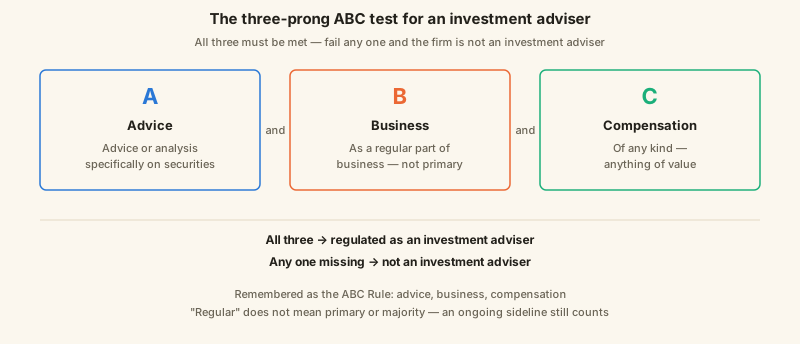
Many test takers remember this as the ABC Rule: advice, business, compensation.
All three prongs must be met. Fail any one prong and the firm is not regulated as an investment adviser.
Prong A — Advice and analysis
Advice and analysis are familiar words, but in securities regulation they have a specific focus.
Discretionary accounts and the “three A’s”
- Discretionary accounts allow a financial professional to make investment decisions for a client.
- 🔑 A discretionary trade occurs when the professional decides one or more of the following during a securities transaction:
| The “three A’s” of discretion | Meaning |
|---|---|
| Action | Buy or sell |
| Amount | How much |
| Asset | What security |
- 🔑 Discretionary transactions are considered advice. Firms offering discretionary services must be properly registered as investment advisers.
- More broadly, most securities-related advice ties back to these “three A’s”: the action, amount, and/or asset.
- ⚠️ It doesn’t matter whether the advice is:
- given directly in conversation, or
- the professional obtains power of attorney and then places trades for the client.
- In either case, the client is receiving securities advice.
Advice can be impersonal
- Example: if you invest in an actively managed Blackrock fund, your money is being invested by professionals at Blackrock.
- They’re making investment decisions for many investors at once, not in a one-on-one relationship.
- ⚠️ Even so, the firm is still making securities decisions on behalf of customers, which is treated as investment advice.
Analysis
| Advice | Analysis |
|---|---|
| Often involves taking action for the client (including discretionary trading) | Usually stops short of taking action for the client |
| Delivered directly in conversation or via power of attorney | Often delivered through a research report |
| One-on-one or impersonal (e.g., managing a fund) | Reports commonly include a buy, sell, or hold recommendation and are distributed to clients |
| Adviser typically maintains client relationship | The analyst who writes the report typically doesn’t follow up with individual clients afterward (many analysts focus on market data rather than sales) |
- Other financial professionals and self-directed investors may use the analysis to evaluate an investment.
- 📌 Depending on the nature and focus of the analysis, the firm producing these reports may be legally considered an investment adviser. The details are covered in a later section.
Prong B — As a regular part of the business
- A firm must provide securities advice or analysis on an ongoing basis to be regulated as an investment adviser.
- If advice is provided only occasionally and isn’t a continuing part of the business, the firm may not be subject to investment adviser regulation.
- ⚠️ Providing advice as a small part of a business model does NOT avoid the investment adviser designation.
- 🔑 Example: even if only 1% of a firm’s revenue comes from investment advice, it can still be a regular part of the business if the advice is provided consistently.
- 🔑 “Regular” doesn’t mean primary or majority; it means ongoing.
Prong C — For compensation
- If securities advice or analysis results in compensation of any kind, this prong is met.
- Investment advisers are most often compensated through one of the following three legitimate and legal methods:
| Compensation method | How it works | Example |
|---|---|---|
| Assets under management (AUM) | Charge a percentage of the client’s portfolio each year; most advisers use this model | A 2% AUM fee on a $1 million portfolio results in $20,000 in annual advisory fees |
| Fixed fees | Flat charges | $5,000 per year to manage a client’s portfolio |
| Hourly fees | Charged by the hour | Meetings with securities analysts for $150 per hour |
- ⚠️ Compensation doesn’t have to be cash. Example: an advisory firm could provide investment advice to a law firm in exchange for legal services.
- 🔑 The Uniform Securities Act makes clear that compensation can take many forms. If anything of value is provided in return for securities advice or analysis, it’s compensation.
Industry context
Five largest investment adviser firms (as of 2024)
| Rank | Firm |
|---|---|
| 1 | Blackrock |
| 2 | Vanguard |
| 3 | Fidelity Investments |
| 4 | State Street Global Advisors |
| 5 | J.P. Morgan Asset Management |
IA and BD businesses under one roof
- Many investment adviser firms are part of a larger company that also includes a broker-dealer.
- Example: Fidelity has both a broker-dealer business and an investment adviser business under one parent company known as FMR (Fidelity Management & Research) LLC.
| Customer activity | Which side of the business |
|---|---|
| Customer receives investment advice | The investment adviser side |
| Customer implements the advice by placing trades | The broker-dealer side executes the transactions |
- Smaller investment advisers commonly use an unaffiliated broker-dealer for:
- custodial services (holding customer assets), and
- trade execution.
- Example: a small local “mom and pop” investment adviser may hire Charles Schwab’s broker-dealer business to custody client assets and execute trades.
Sidenote — SEC Release IA-1092
- In the late 1980s, the Securities and Exchange Commission (SEC) and the North American Securities Administrators Association (NASAA) jointly developed Release IA-1092.
- Intent: to reinforce and amend the current legal definition of an investment adviser.
- At the time, there were numerous entities essentially operating as investment advisers, but claiming registration and regulation did not apply to them.
- IA-1092 reaffirmed the investment adviser definition and explicitly identified certain entities as meeting the definition, requiring them to comply with relevant rules and laws.
🔑 Parties explicitly identified by IA-1092 as investment advisers
| Party | Why they meet the definition | Key detail / trap |
|---|---|---|
| Financial planners | Considered investment advisers regardless of how much securities advice they provide | 🔑 Even if securities recommendations represent 1% of a financial planner’s duties, they are subject to investment adviser registration and regulation. ⚠️ It’s possible for a financial planner to avoid investment adviser regulation if they do not discuss securities at all — but the SEC and NASAA generally view financial planners as investment advisers unless proven otherwise. |
| Pension consultants | Pensions are retirement plans that generally pay their retirees through the end of their life. To ensure a pension plan has enough funds to meet its obligations, organizations often hire consultants for guidance. Because one of the primary ways to grow assets over time is by investing in securities, pension consulting commonly involves securities advice (and sometimes securities management). | As a result, pension consultants are required to register and are regulated as investment advisers. |
| Entertainer & athlete advisers | Many celebrities and professional athletes earn significant sums during their careers (LeBron James has earned nearly $1 billion over his career). Their representatives often provide more than contract advice — in many cases they also provide securities advice as a regular part of the relationship. | IA-1092 explicitly includes these advisers as investment advisers. Especially relevant for athletes: between 2004 and 2019, it’s estimated professional athletes lost roughly $600 million to some form of fraud (often related to investing). |
⚠️ Exempt vs. excluded
⚠️ This page defines who falls within the investment adviser definition (the ABC three-prong test) and who IA-1092 pulls into it. The exclusions from the definition and the exemptions from registration are covered in the separate “Exempt & excluded” section of Definitions linked at the end of this page. Keep the distinction straight — it is a classic exam trap:
| Concept | Meaning |
|---|---|
| Excluded | The person/firm never falls within the definition at all |
| Exempt | The person/firm meets the definition but is relieved from the registration requirement |
Key points
Investment adviser
- Firms that provide securities advice as a regular part of their business for compensation
- ABC rule:
- Advice on securities
- Business activity (regular)
- Compensation
Discretionary order
- A financial professional chooses any of the following for a client:
- Action (buy or sell)
- Amount (how much)
- Asset (what security)
IA-1092
- Additionally defined as investment advisers:
- Financial planners
- Pension consultants
- Athlete & celebrity advisers
More from Definitions: Persons · Exempt & excluded · Issuers & securities · Broker-dealers · Agents
Sources
Primary/official references for the material on this page. Every link was fetched and returned HTTP 200 on 2026-08-15.
| # | Source | Publisher |
|---|---|---|
| 1 | Advisers Act 1940 — investment adviser definition and exclusions | Cornell LII (15 U.S.C. 80b-2) |
| 2 | Investment Advisers Act rules (206(4)-x, custody, brochure) | eCFR (17 CFR Part 275) |
| 3 | Uniform Securities Act 1956 with NASAA updates — the tested statute | NASAA |
| 4 | Achievable Series 65 — chapter 4.2.6 | Achievable (course text) |