The Four Regulation BI Obligations
What Regulation BI is
Regulation Best Interest (BI) is an amendment the Securities and Exchange Commission (SEC) recently added to the Securities Exchange Act of 1934. The rule is designed to ensure broker-dealers and their agents put the customer’s interests ahead of their own when making recommendations. Regulation BI applies specifically when these professionals make recommendations to retail investors*.
*Regulation BI does not apply to interactions with institutional investors (financial organizations investing on behalf of their clients).
🔑 Who is covered by which standard
| Party | Standard applied | Notes |
|---|---|---|
| Broker-dealers and their agents (reps) | Regulation BI (best interest standard) | Applies only when making recommendations to retail investors; does not apply to institutional investors |
| Investment advisers (and IARs) | Fiduciary standard | “Strict fiduciary laws”; a fiduciary manages assets on behalf of another person. Investment adviser regulations require extensive disclosures and thorough IAR training to protect clients |
| Federal covered advisers | Fiduciary standard, plus Form CRS delivery | Form CRS disclosure is also required for federal covered advisers |
⚠️ Heavily tested distinction: broker-dealers/agents are held to the Regulation BI best interest standard when recommending to retail customers, while investment advisers/IARs are held to the fiduciary standard. Regulation BI does not convert a broker-dealer into a fiduciary — it is a separate, recommendation-triggered obligation, and it does not apply to institutional investors at all.
🔑 Definitions
| Term | Definition | Example |
|---|---|---|
| Fiduciary | A fiduciary manages assets on behalf of another person. | An investment adviser managing a client’s assets is a fiduciary to their client. |
| Institutional investor | Financial organizations investing on behalf of their clients. | Regulation BI does not apply to interactions with these investors. |
| Conflict of interest | Any circumstance that puts the priority to the client at risk. | A representative recommends the stock of a company they have family ties to (e.g., their sister is the CEO). |
| Proprietary product | A product created by the same institution that recommends it to its clients. | A Vanguard mutual fund recommended to clients by Vanguard advisers. |
| Non-cash compensation | Compensation that is not cash. | A firm gives a representative a free all-paid vacation as a bonus. |
| Form CRS | Customer relationship summary — the written disclosure document. | Charles Schwab’s Form CRS: first two pages are the broker-dealer portion; the last two pages cover the firm’s investment advisory services. |
Why the rule exists
Broker-dealers are best known for executing transactions (helping customers buy and sell securities). Most trades processed by broker-dealers are unsolicited, meaning the firm did not recommend the transaction. Instead, the investor typically directs the trade or receives the recommendation from a third party (for example, the customer’s investment adviser).
When recommendations aren’t a primary part of a firm’s business, the firm generally avoids the rules that apply to investment advisers, who must follow strict fiduciary laws.
📌 Why do recommendation rules matter so much? The financial industry has a history of unethical conduct, especially when compensation creates incentives to recommend unsuitable products. Examples given:
- Firm executive recommends nearly $3 million of unsuitable securities to an athlete with no investment experience, resulting in nearly $1 million in losses
- Broker suspended one year for recommending illiquid investments to elderly clients with conservative investment objectives, resulting in significant losses
- Elderly investor awarded $2.6 million through arbitration after unsuitable recommendations made by a now-imprisoned former broker
For decades, investment adviser firms have been subject to recommendation-based regulations intended to reduce this kind of misconduct. Broker-dealers largely avoided those rules by emphasizing that their business was transaction execution, not advice.
Over time, that distinction often didn’t match what was happening in practice. In the examples above, broker-dealer representatives earned large commissions after clients accepted their (unsuitable) recommendations. In effect, some broker-dealers and their representatives were acting as investment advisers* without being regulated as such.
*To be considered an investment adviser, a client must pay specifically for investment advice. Some broker-dealers and representatives providing advice were “skirting” the rules by claiming their commissions were payment for the transaction execution, not the advice. As long as broker-dealers implied that distinction, they were not regulated as investment advisers.
Regulation BI is the SEC’s attempt to close this “loophole.”
🔑 The four Regulation BI obligations
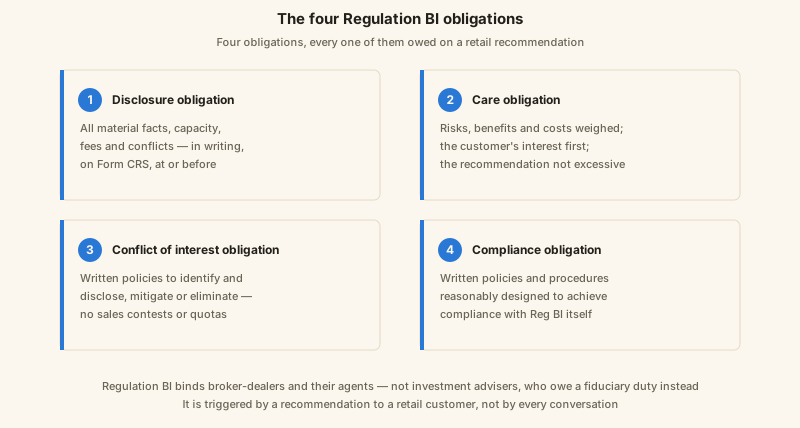
When broker-dealers and agents recommend securities or strategies to retail customers, they must follow specific rules and protocols in four categories.
| # | Obligation | What it requires |
|---|---|---|
| 1 | Disclosure obligation | Disclose in writing at or before any retail customer recommendation: all material facts related to the relationship with the customer; the capacity the broker-dealer and/or representative(s) are acting in (e.g., agency or principal); all associated fees and costs; the type and scope of services provided; any conflicts of interest associated with the recommendation. Delivered on Form CRS. |
| 2 | Care obligation | Before making a recommendation, determine: potential risks, benefits, and costs related to the recommendation; that the recommendation is in the client’s best interest and does not prioritize the broker-dealer’s or representative’s interests; that the recommendation is not excessive. |
| 3 | Conflict of interest obligation | Establish, maintain, and enforce written policies and procedures to identify and disclose or eliminate all conflicts of interest; mitigate conflicts creating an incentive to put firm/rep interests ahead of the retail customer; eliminate sales contests, sales quotas, bonuses, and non-cash compensation based on sales of specific securities or specific types of securities. |
| 4 | Compliance obligation | Establish, maintain, and enforce written policies and procedures reasonably designed to achieve compliance with Regulation BI. |
Disclosure obligation
Transparency matters whenever a financial professional makes a recommendation. If important parts of a broker-dealer’s business are hidden, customers can’t evaluate whether the recommendation is truly being made for them.
For example, imagine your representative recommends only products that pay them large commissions. If better options exist but aren’t recommended because they pay less, you’d have a hard time trusting the recommendation.
🔑 To help retail customers make informed decisions, Regulation BI requires broker-dealers and their representatives to disclose the following in writing at or before any retail customer recommendation:
- All material facts related to the relationship with the customer
- The capacity the broker-dealer and/or representative(s) are acting in (e.g., agency or principal)
- All associated fees and costs
- The type and scope of services provided
- Any conflicts of interest associated with the recommendation
Form CRS
Broker-dealers provide these disclosures in writing on Form CRS (customer relationship summary). The form is divided into these sections:
- What investors should consider when choosing Schwab
- Investment services and advice Schwab provides
- Fees their customers pay
- Existing legal obligations and conflicts of interest
- How Schwab’s representatives make money
- Legal and disciplinary history of Schwab representatives
To comply with Regulation BI, broker-dealers like Charles Schwab must deliver this customer relationship summary during or before making recommendations.
Sidenote — Form CRS requirements for advisers
While Regulation BI primarily targets broker-dealers and agents, Form CRS disclosure is also required for federal covered advisers. The details in the form are essentially identical to the ones listed above. For reference, the last two pages of Schwab’s Form CRS cover the firm’s investment advisory services.
Care obligation
🔑 Before making a recommendation, broker-dealers and agents must determine the following:
- Potential risks, benefits, and costs related to the recommendation
- The recommendation is in the client’s best interest and does not prioritize the broker-dealer or representative’s interests
- The recommendation is not excessive*
*Although a security or strategy may be in a client’s best interest, it shouldn’t be over-recommended. For example, a specific mutual fund may be suitable and in the client’s best interest, but recommending too much of it is unethical.
Conflict of interest obligation
A conflict of interest is any circumstance that puts the client’s interests at risk because the financial professional has an incentive to put their own interests first.
Common conflicts of interest in the industry
| Conflict | Explanation |
|---|---|
| Recommending proprietary products | A product created by the same institution that recommends it to its clients is a proprietary product. For example, a Vanguard mutual fund recommended to clients by Vanguard advisers. The firm (Vanguard) can make two forms of income with these products. First, it collects investment advisory fees, especially when managing client assets on a discretionary basis. Second, the proprietary product will make additional money for the firm. Using our Vanguard example, the fund collects fees to cover its expense ratio. |
| Recommending securities the firm or representative is tied to | Assume you have an account at a broker-dealer and regularly discuss investment strategies with your assigned representative. Now suppose they recommend the stock of a company their spouse is the CEO of, without telling you. Is the recommendation being made because it fits your needs, or because it benefits the representative’s family? |
| Recommending securities as part of a sales contest | Many securities firms run sales contests to motivate representatives. For example, a firm may pay a bonus to the representative who convinces the most clients to open discretionary accounts. A contest like this can create pressure to “sell sell sell,” even when that isn’t in the client’s best interest. |
While all the conflicts of interest listed above can be problematic, they’re allowed with proper disclosures.
Rule language (word-for-word)
The [broker-dealer] establishes, maintains, and enforces written policies and procedures reasonably designed to:
- Identify and at a minimum disclose … or eliminate, all conflicts of interest associated with such recommendations
- Identify and mitigate any conflicts of interest associated with such recommendations that create an incentive for a [representative] to place [their or their firm’s interests] ahead of the interest of the retail customer
- Identify and eliminate any sales contests, sales quotas, bonuses, and non-cash compensation* that are based on the sales of specific securities** or specific types of securities**
*Non-cash compensation is exactly what it sounds like. For example, a firm gives a representative a free all-paid vacation as a bonus.
**Sales contests are not prohibited as long as the firm discloses properly, but centering a contest around recommending one specific product or type of security creates a bad incentive structure. Firms should not engage in these types of competitions.
Bottom line: firms must identify conflicts of interest, eliminate them when possible, and disclose them when they can’t be eliminated.
Compliance obligation
This one is straightforward. Broker-dealers must:
- Establish, maintain, and enforce written policies and procedures reasonably designed to achieve compliance with Regulation BI
Key points
Regulation BI
- Applies to broker-dealers and reps making recommendations to retail investors
- General requirements:
- Disclose material facts, fees, trading capacity, and conflicts of interest
- Determine the risk & benefit profiles of recommendations
- Ensure recommendations are in the client’s best interest
Conflict of interest
- Any circumstance that puts the priority to the client at risk
Regulation BI components
- Disclosure obligation (Form CRS)
- All material facts
- The trade capacity (agency or principal)
- All associated fees and costs
- The type and scope of services provided
- Any conflicts of interest associated with the recommendation
- Care obligation
- BD and/or rep must understand risk & benefit profile of recommendations
- Conflict of interest obligation
- Identify, eliminate if possible, and disclose if not eliminated
- Compliance obligation
- Broker-dealer must establish, maintain, and enforce written policies and procedures to ensure compliance
Form CRS
- CRS = customer relationship summary
- Must be provided by broker-dealers and federal covered advisers recommending securities
Sources
Primary/official references for the material on this page. Every link was fetched and returned HTTP 200 on 2026-08-15.
| # | Source | Publisher |
|---|---|---|
| 1 | Regulation Best Interest — full rule text | eCFR (17 CFR 240.15l-1) |
| 2 | Reg BI — the four obligations, Form CRS | FINRA |
| 3 | Rule 2111 — suitability, reasonable-basis/customer-specific/quantitative | FINRA |
| 4 | Achievable Series 65 — chapter 4.6.5 | Achievable (course text) |