Investment Objectives Ranked by Risk
What an investment objective is
When you see recommendation-based questions on the exam, you’ll often be given an investor’s investment objective.
“An investment objective describes the investor’s overall goal for their invested capital (money).”
🔑 Financial professionals use investment objectives to:
- Evaluate whether an investor’s current asset allocation is suitable
- Decide which investments are appropriate to recommend
You’ll want to know what each objective means in plain language and how it affects suitability.
Objective vs. other profile factors: the objective is the investor’s overall goal for invested capital. Factors that shape which securities fit that objective include time horizon (short-term vs. long-term), risk tolerance / aggressiveness, need for current income, liquidity needs, tax bracket, and age. These are the investor circumstances that determine which objective and which securities are suitable.
🔑 The investment objectives covered in this section:
- Preservation of capital
- Safety of principal
- Tax-advantaged income
- Moderate income
- Moderate growth
- High-yield income
- Aggressive growth
- Speculation
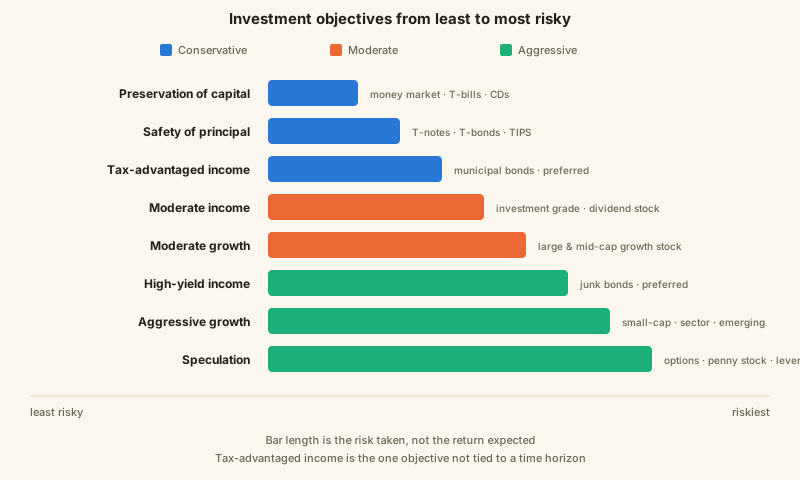
🔑 Master objective comparison table (least risky → riskiest)
| Objective | What the investor wants | Risk level | Typical investor / time horizon | Typical securities |
|---|---|---|---|---|
| Preservation of capital | To invest while taking as little risk as possible; little to no risk of losing money | ⚠️ The least risky investment objective | Elderly investors; investors who need funds to stay safe and liquid (e.g., someone planning to buy a home within a year). Short-term, high-quality investments | Money market funds; Treasury bills; Certificates of deposit (CDs) |
| Safety of principal | Stable income over long periods of time | A small step up the risk spectrum from preservation of capital | Older investors in retirement are most likely to identify this as their overall objective. Longer-term, high-quality income investments | Treasury notes; Treasury bonds; TIPS |
| Tax-advantaged income | Income that’s taxed at lower rates or is tax-free | — | Investors in high tax brackets or organizations with large tax liabilities. ⚠️ Not tied to a specific time horizon (short-term vs. long-term), although recommendations often favor longer-term fixed-income securities to seek higher rates of return | Municipal bonds; Preferred stock |
| Moderate income | Moderate levels of income, accepting some risk | Some risk in return for higher income | Typically older, but not in a situation where they must be completely risk averse. Example: a 60-year-old recent retiree with a funded retirement plan wanting to replace employment income with fixed-income securities that aren’t extremely safe but also aren’t highly risky | Investment grade corporate bonds; Preferred stock; Dividend-paying common stock |
| Moderate growth (capital appreciation; sometimes simply “growth”) | Capital appreciation (buy low, sell high) from common stocks without taking on significant risk | At least a moderate amount of risk (investing in common stock typically involves this) | Younger-to-middle-age investors with long time horizons and no need for current income | Large and mid-cap common stocks of growth companies; Defensive stocks |
| High-yield income | High yields from fixed-income securities | ⚠️ Willing to take on significant risk; considerable risk in return for high yields | Typically aggressive investors looking for higher returns from fixed-income securities. ⚠️ Elderly and conservative investors usually avoid this objective given the risks | Speculative (junk) bonds; Preferred stock |
| Aggressive growth | High growth from smaller companies with high growth potential | Considerable risk in return for high growth; ⚠️ only suitable for investors very comfortable with risk | Tend to be young and not focused on current income. Time horizons can be long or short, although ⚠️ it’s generally more prudent to use a long time horizon with risky strategies — a longer horizon gives more time to recoup losses | Common stock of small businesses and start-ups; Sector funds, especially technology and energy; Emerging market securities |
| Speculation | Betting on short-term price movements | ⚠️ The riskiest investment objective; requires the highest level of aggressiveness and risk tolerance | Younger investors with significant assets are the typical investors who apply this objective to their overall portfolio; only suitable for the most aggressive investors | Options; Penny stocks; Leveraged and inverse ETFs |
Preservation of capital
- Means the investor wants to invest while taking as little risk as possible.
- 🔑 This is the least risky investment objective and may involve insured investments (like a certificate of deposit (CD)).
- Securities suitable for this objective are generally short-term debt securities with minimal risk exposure.
- Investors most likely to choose preservation of capital:
- Elderly investors
- Investors who need funds to stay safe and liquid (for example, someone planning to buy a home within a year)
- Specific suitable investments: Money market funds, Treasury bills, Certificates of deposit
Safety of principal
- A small step up the risk spectrum from preservation of capital.
- Often leads to larger allocations in safe debt securities with longer time horizons.
- ⚠️ Longer-term debt securities generally have more price volatility than short-term debt securities.
- In most cases, investors with this objective want stable income over long periods of time. Older investors in retirement are most likely to identify safety of principal as their overall investment objective.
- Specific suitable investments: Treasury notes, Treasury bonds, TIPS
Tax-advantaged income
- Fits investors who want income that’s taxed at lower rates or is tax-free.
- Most common for investors in high tax brackets or organizations with large tax liabilities.
- ⚠️ This objective isn’t tied to a specific time horizon (short-term vs. long-term), although recommendations often favor longer-term fixed-income securities to seek higher rates of return.
- 🔑 In general, there are two primary investment products that provide tax-advantaged income:
- Municipal bonds
- Preferred stock*
*While dividends from stock are taxed at lower rates (15% or 20%) than interest from bonds (up to 37%), preferred stocks are especially suitable for corporate investors. Corporations are able to deduct at least 50% of the dividends they receive from taxation.
Moderate income
- Applies when an income-seeking investor is willing to accept some risk in exchange for moderate levels of income.
- The typical investor with this objective is older, but not in a situation where they must be completely risk averse.
- Example: a 60-year-old recent retiree with a funded retirement plan may want to replace employment income with fixed-income securities that aren’t extremely safe but also aren’t highly risky.
- Specific suitable investments: Investment grade corporate bonds, Preferred stock, Dividend-paying common stock
Moderate growth and capital appreciation
- Investing in common stock typically involves at least a moderate amount of risk.
- Investors seeking capital appreciation (buy low, sell high) from common stocks, but without taking on significant risk, tend to have a moderate growth objective (sometimes referred to simply as “growth”).
- Younger-to-middle-age investors with long time horizons and no need for current income are most likely to have a moderate growth objective.
- Specific suitable investments: Large and mid-cap common stocks of growth companies, Defensive stocks
Sidenote: Defensive stocks
- A sports analogy fits: “Defense wins championships” — when the other team is moving forward, a good defense stops their advances and may even find a way to score. Defensive stocks work in a similar way.
- Common stocks often experience significant losses during recessions.
“A defensive stock is one that maintains value, loses minimal value, or even increases in value during an economic downturn.”
- 🔑 Defensive stocks can come from many industries, but they share one key trait: their products or services stay in demand even when the economy weakens.
- 🔑 In general, these products maintain demand even in recessionary environments:
- Basic food items
- Basic clothing items
- Pharmaceuticals (medication)
- Utilities (electricity, water, etc.)
- Alcohol and tobacco products
- Companies that primarily offer these products are considered defensive.
- ⚠️ Trade-off: defensive stocks tend to have lower levels of risk (relative to other common stocks) because demand is more consistent. However, defensive stocks usually offer fewer capital appreciation opportunities than growth stocks — when the economy is booming, demand for these products typically doesn’t rise dramatically.
High-yield income
- Means the investor is willing to take on significant risk to earn high yields from fixed-income securities.
- 🔑 These investors primarily invest in junk bonds, which are rated BB or below by the rating agencies. In many cases, the issuers of these bonds are legitimately at risk of bankruptcy.
- 🔑 Junk bonds typically have two characteristics that contribute to high yields:
- They often have high coupons (interest rates).
- They commonly trade at large discounts as demand falls when default risk rises.
- Preferred stock — especially from distressed issuers — may also be suitable for this objective. Like junk bonds, this type of preferred stock tends to have higher dividend rates while trading at discounts.
- Investors seeking high-yield income are typically aggressive investors looking for higher returns from fixed-income securities. ⚠️ Elderly and conservative investors usually avoid this objective given the risks involved.
- Specific suitable investments: Speculative (junk) bonds, Preferred stock
Aggressive growth
- Growth (capital appreciation) involves buying securities at a low price and selling them later at a higher value. Growth-focused companies are businesses focused on increasing revenues through expanded operations.
- An aggressive growth objective focuses primarily on smaller companies with high growth potential.
- Example as stated — Amazon’s IPO in 1997, when it was an online bookstore:
- IPO price: $18 per share
- Later traded above $230 a share (as of mid-2026, reflecting the 20-for-1 stock split in June 2022)
- Total return of over 300,000% from its split-adjusted 1997 IPO price of about $0.075
- Amazon’s business model was largely unproven in the late 1990s, but it eventually became one of the largest companies in the world.
- ⚠️ For every Amazon, there are hundreds of companies that don’t become successful. In fact, only a third of small businesses survive their first 10 years of business. And survival isn’t the same as profitability — many small businesses and start-ups take several years to become profitable.
- Emerging markets: regions of the world that haven’t historically been major players in the global economy but are becoming more prominent. Countries like Mexico, Thailand, and South Africa are examples. As these economies grow, companies in those regions may grow as well.
- ⚠️ Investors in emerging market securities also need to account for risks beyond typical business and financial risks. Many of these regions face governmental issues (corruption, “red tape,” etc.), economic problems, and weak infrastructure for business.
- Sector funds invest primarily in stocks of companies from a specific industry. Technology and energy tend to be among the most aggressive sectors, offering higher risk and higher return potential.
- An investor with this objective is willing to take chances. Many of the companies or securities in the portfolio may end in bankruptcy, but the expectation is that the winners (like Amazon) will more than offset the losers.
- 🔑 These investments tend to have high betas, meaning their market prices have historically moved faster than the general market.
- ⚠️ Only suitable for investors who are very comfortable with risk. Time horizons can be long or short, although it’s generally more prudent to use a long time horizon with risky strategies — if an investment loses significant value, a longer time horizon gives the investor more time to recoup losses.
- These investors also tend to be young and not focused on current income. 🔑 Remember, growth companies generally don’t pay dividends.
- Specific suitable investments: Common stock of small businesses and start-ups, Sector funds (especially technology and energy), Emerging market securities
Speculation
- Involves investing, but it can resemble gambling because it often depends on short-term market direction, which is highly unpredictable. Speculative investors typically bet on short-term price movements.
- 🔑 This objective requires the highest level of aggressiveness and risk tolerance:
- If the “bet” is right, the investor may make significant money quickly.
- ⚠️ If the “bet” is wrong, the investor could lose more than the account is worth.
- ⚠️ Speculation is the riskiest investment objective and is only suitable for the most aggressive investors. Younger investors with significant assets are the typical investors who apply this objective to their overall portfolio.
- Specific suitable investments: Options, Penny stocks, Leveraged and inverse ETFs
🔑 Numbers & thresholds
| Item | Exact figure / criterion as stated |
|---|---|
| Junk bond rating | Rated BB or below by the rating agencies |
| Dividend tax rates (stock) | 15% or 20% |
| Bond interest tax rate | Up to 37% |
| Corporate dividends received deduction | Corporations can deduct at least 50% of the dividends they receive from taxation |
| Moderate income example investor age | 60-year-old recent retiree |
| Amazon IPO year / price | 1997, $18 per share |
| Amazon later price | Above $230 a share (as of mid-2026) |
| Amazon stock split | 20-for-1 in June 2022 |
| Amazon split-adjusted IPO price | About $0.075 |
| Amazon total return | Over 300,000% |
| Small business survival rate | Only a third of small businesses survive their first 10 years |
| Speculation downside | Investor could lose more than the account is worth |
| Preservation of capital liquidity example | Someone planning to buy a home within a year |
Key points
Preservation of capital
- Little to no risk of losing money
- Short-term, high-quality investments
- Typical securities:
- Money market funds
- Treasury bills
- Certificates of deposit (CDs)
Safety of principal
- Willing to take a small amount of risk
- Longer-term, high-quality income investments
- Typical securities:
- Treasury notes
- Treasury bonds
- TIPS
Tax-advantaged income
- Income-based investments with tax benefits
- Typical securities:
- Municipal bonds
- Preferred stock
Moderate income
- Taking some risk in return for higher income
- Typical securities:
- Investment-grade corporate bonds
- Preferred stock
- Dividend-paying common stock
Moderate growth
- Taking some risk in return for higher growth
- Typical securities:
- Large and mid-cap growth stocks
- Defensive stocks
High yield income
- Taking considerable risk in return for high yields
- Typical securities:
- Speculative (junk) bonds
- Preferred stock
Aggressive growth
- Taking considerable risk in return for high growth
- Typical securities:
- Small-cap or start-up common stock
- Sector funds
- Emerging market securities
Speculation
- Betting on price movements
- Significant risk involved
- Typical securities:
- Options
- Penny stocks
- Leveraged and inverse ETFs
Sources
Primary/official references for the material on this page. Every link was fetched and returned HTTP 200 on 2026-08-15.
| # | Source | Publisher |
|---|---|---|
| 1 | Rule 2111 — suitability, reasonable-basis/customer-specific/quantitative | FINRA |
| 2 | Reg BI — the four obligations, Form CRS | FINRA |
| 3 | Uniform Prudent Investor Act — portfolio-level fiduciary standard | Uniform Law Commission |
| 4 | Achievable Series 65 — chapter 2.2.1 | Achievable (course text) |