Subscription Rights & Warrants
We’ll cover rights and warrants in this section. Both are equity-related securities that let you purchase common stock at a fixed price. They’re similar in some ways, but 📌 the differences show up often on the exam.
Rights
Share terminology and dilution
Authorized shares are set when a business incorporates (officially forms as a corporation). This is the maximum number of shares the company is allowed to sell to investors. For example, if a company authorizes 1 million shares, it can sell up to 1 million shares of stock. Companies give up ownership (stock) in exchange for capital (money).
Most companies don’t sell all of their authorized shares during their initial public offering (the first public sale of their shares). That leaves room to raise additional capital later by selling the remaining authorized shares.
The number of shares a company sells during its initial public offering (IPO) is called issued shares. Once shares are issued, they trade in the secondary market among investors.
| Term | Definition | Example |
|---|---|---|
| Authorized shares | The maximum number of shares the company is allowed to sell to investors; set when a business incorporates | A company authorizes 1 million shares, so it can sell up to 1 million shares of stock |
| Issued shares | The number of shares a company sells during its initial public offering (IPO) | The company issues only 500,000 of its 1 million authorized shares |
| Initial public offering (IPO) | The first public sale of a company’s shares | Once shares are issued, they trade in the secondary market among investors |
Assume a company authorizes 1 million shares but issues only 500,000 shares. If you purchase 50,000 shares, you own 10% of the outstanding shares.
Now assume several years pass and the company needs to raise additional capital. It still has 500,000 authorized shares available to sell, so it decides to sell all of them. If you don’t buy any of the new shares, your ownership percentage is diluted from 10% to 5%.
| Shares owned | Shares outstanding | Percent ownership | |
|---|---|---|---|
| Before | 50,000 | 500,000 | 10% |
| Diluted | 50,000 | 1,000,000 | 5% |
Your ownership percentage drops because the total number of shares outstanding increases while your share count stays the same. That also reduces your voting power.
The pre-emptive right
To protect existing stockholders from this kind of dilution, companies generally can’t issue new shares without first offering them to current stockholders.
This protection is the pre-emptive right. It gives current stockholders the right to buy newly issued shares before they’re offered to the public. In our example, you owned 10% of the company before the new issuance, so you’ll have the opportunity to buy 10% of the new offering to maintain your ownership percentage.
Here’s how the process works:
- The company issues rights to current stockholders.
- 🔑 Investors receive one right for every share of stock owned.
Since you owned 50,000 shares, you receive 50,000 rights.
Each right has a specific value because it can be used (often in combination with other rights) to buy new shares at a set price. For example, you might need 5 rights to buy 1 new share. 📌 You won’t be asked to derive that ratio on the exam - questions will provide it.
Intrinsic value at issuance
For this rights distribution, we’ll keep it simple and assume:
- 1 right needed to purchase 1 new share
- Current market price of stock = $50
- Rights exercise price = $40
Rights have intrinsic value, meaning they have immediate value at issuance.
Each right lets a stockholder buy 1 new share for $40 when the market price is $50. That’s a $10 discount, so the right is issued with $10 of intrinsic value.
Why the discount is possible
One reason companies can offer this discount is that they may avoid hiring an underwriter.
You learned about underwriters when you prepared for the SIE exam. As a reminder, underwriters help organizations market and sell securities to the public. For example, when Facebook went public in 2012, they hired Morgan Stanley, JP Morgan, and Goldman Sachs as their lead underwriters.
As a social media company, Facebook didn’t have the resources or distribution network to sell its stock broadly in the financial markets. That’s why it hired large investment banks (underwriters). Underwriters are expensive; Facebook’s underwriters collected hundreds of millions of dollars for their services.
If a company sells new shares primarily to current stockholders through a rights offering, it may not need an underwriter. In that case, some of the cost savings can be passed to stockholders through a discounted subscription (exercise) price.
The three outcomes
🔑 When you receive rights, you typically have three choices:
| Outcome | What happens |
|---|---|
| Exercise | Exercise the rights and buy the new shares at the exercise price |
| Sell (trade) | Sell (trade) the rights in the market |
| Expire | Let the rights expire |
Rights don’t last forever. 🔑 They typically expire within 60-90 days of issuance. If you let them expire, you receive no benefit.
Sidenote — Case study: Bain Capital rights offering
To better understand rights, let’s analyze a real-world rights offering conducted by Bain Capital (ticker: BCSF):
The Company will issue to stockholders of record on May 13, 2020 transferable rights to subscribe for an aggregate of up to 12.9 million shares of the Company’s common stock. Record stockholders will receive one right for each share of common stock owned on the record date. The rights will entitle the holders to purchase one new share of common stock for every four rights held.
The subscription price for the shares to be issued pursuant to the rights offering will be 92.5% of the volume-weighted average of the market price of the Company’s shares of common stock on the New York Stock Exchange (NYSE) for the five consecutive trading days ending on the Expiration Date.
Bain Capital is issuing up to 12.9 million new shares and giving current shareholders the first opportunity to buy them. Shareholders of record (settled shareholders) on May 13, 2020 receive rights that they can exercise, trade (transferable), or allow to expire.
Shareholders receive one right for every share owned, and they can purchase one new share for every four rights. The subscription price is 92.5% of the market price, which means the shares are offered at a discount.
Let’s assume an investor owns 100 shares of Bain Capital, which is trading at $10 per share. Can you figure out how many shares they can purchase and the price they’ll pay per share?
Answer: 25 shares at $9.25/share
The investor owns 100 shares, giving them 100 rights. They can purchase one new share for four rights.
100 shares owned ÷ 4 rights for each new share = 25 new shares
The subscription price is 92.5% of the market price, which is $10 per share.
Subscription price = $10 x 92.5%
Subscription price = $9.25
Warrants
Warrants are similar to rights because they give you the right to purchase shares from a publicly traded company at a fixed price. We’ll look at the key characteristics of warrants first, then compare them directly to rights.
Assume a company’s stock is trading at $50. A warrant will have a fixed exercise price, but it’s typically set above the current market price (at a premium). For example, a warrant might be issued with an exercise price of $60. At issuance, it usually doesn’t make sense to exercise the warrant because you could buy the stock in the market for $50 instead of paying $60.
Warrants have time value, meaning their value comes largely from the time remaining until expiration. Warrants often last five years or more.
The $60 exercise price stays fixed during that period, but the market price can change. If the market price rises to $80 after a few years, exercising at $60 becomes attractive. That potential is what gives warrants value over time.
Warrants are often issued as a sweetener when selling another security. For example, if a company is having trouble marketing a new bond, it may attach a warrant to make the bond more appealing.
The issuance of warrants is a dilutive action. If the warrants are exercised, new shares are created and outstanding shares increase. Because this can dilute existing stockholders, 🔑 issuing warrants requires stockholder approval.
⚠️ Rights vs. warrants
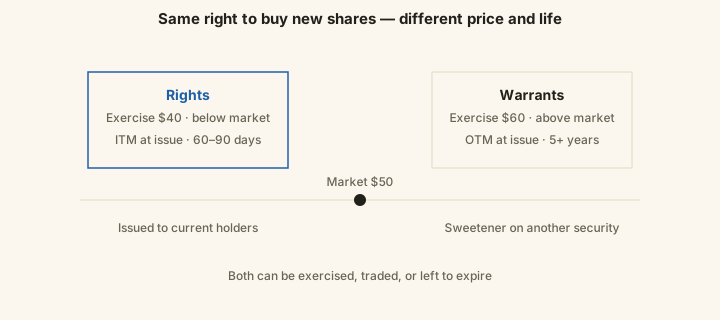
In conclusion, warrants are similar to rights but have important differences. 📌 Here are the key points to know for the exam:
| Feature | Rights | Warrants |
|---|---|---|
| Core feature | Right to purchase new shares at a fixed price | Right to purchase new shares at a fixed price |
| Exercise price vs. market at issuance | Below market — issued at a discount (e.g., $40 exercise vs. $50 market) | Above market — set at a premium (e.g., $60 exercise vs. $50 market) |
| Intrinsic value at issuance | Intrinsic value exists at issuance | No intrinsic value at issuance |
| Time value at issuance | Little time value at issuance | Significant time value at issuance |
| Typical life / duration | Short-term (typically 60-90 days or less) | Long-term (typically 5 years or longer) |
| How received | Provided to current stockholders during additional offerings; one right for every share owned (pre-emptive right) | Issued as a sweetener with other securities |
| Possible outcomes | Exercise / Trade / Expire | Exercise / Trade / Expire |
| Stockholder approval | — | Issuance is a dilutive action requiring stockholder approval |
Additionally, here’s a video that will help you understand the type of question to expect on rights and warrants.
Key points
Rights
- Right to purchase new shares at a fixed price
- Provided to current stockholders during additional offerings
- One right for every share owned
- Intrinsic value exists
- Little time value
- Short-term (typically 90 days or less)
- Possible outcomes:
- Exercise
- Trade
- Expire
Warrants
- Right to purchase new shares at a fixed price
- Issued as a sweetener with other securities
- No intrinsic value
- Time value exists
- Long-term (typically 5 years or longer)
- Possible outcomes:
- Exercise
- Trade
- Expire
Issuing warrants
- Dilutive action requiring stockholder approval
Sources
Primary/official references for the material on this page. Every link was fetched and returned HTTP 200 on 2026-08-15.
| # | Source | Publisher |
|---|---|---|
| 1 | Stocks — common vs preferred, dividends, voting | SEC / Investor.gov |
| 2 | Securities Act 1933 — definition of security, issuer | Cornell LII (15 U.S.C. 77b) |
| 3 | Options fundamentals, strategies and the ODD | OCC / Options Industry Council |
| 4 | Achievable Series 65 — chapter 1.4.1.2 | Achievable (course text) |