Closed-End & Interval Funds
General characteristics
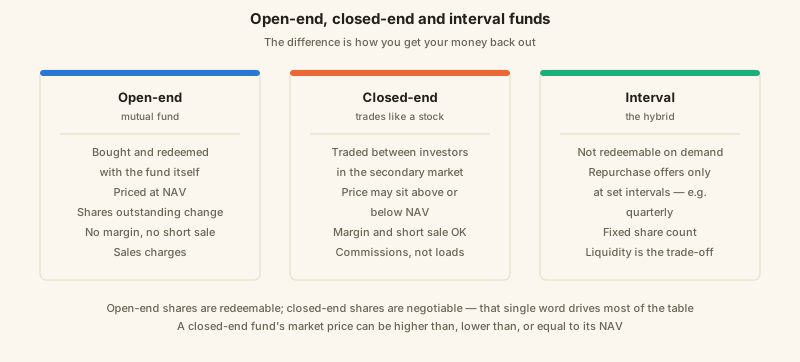
- Closed-end management companies are similar to open-end management companies in what they do: both pool investor money and invest according to the fund’s stated objectives in pursuit of returns.
- 🔑 The key difference is how investors buy and sell shares.
- Closed-end funds trade between investors in the secondary market, not directly with the issuer.
Life cycle of a closed-end fund share
| Stage | What happens | Market | Prospectus |
|---|---|---|---|
| Creation / IPO | Issuer prepares a prospectus and sells shares through an initial public offering (IPO); issuer receives the proceeds | Primary market | Required — every purchaser must receive a prospectus (the prospectus rule applies) |
| After IPO | Shares begin trading between investors; ownership is transferable, so shares are negotiable securities | Secondary market | Not required — prospectus delivery is no longer required after the IPO shares have been sold |
- The prospectus “provides detailed information about the issuer and the security being sold.”
Capitalization
- Like most negotiable securities, closed-end funds have a fixed (closed-ended) number of shares outstanding that trade in the secondary market.
- This is a different type of capitalization than open-end (mutual) funds, which continuously issue and redeem shares and therefore have a changing number of shares outstanding.
Definitions
| Term | Definition | Example |
|---|---|---|
| Capitalization | The method by which a corporation structures its capital (equity/stock, debt, and retained earnings). | Closed-end fund = fixed number of shares outstanding; open-end fund = changing number of shares outstanding |
| Repurchase offer | Occurs when an interval fund offers to repurchase shares that are redeemed by liquidating investors | An interval fund with quarterly redemptions makes a repurchase offer four times per year |
🔑 Open-end (mutual) funds vs closed-end funds
| Feature | Open-end fund (mutual fund) | Closed-end fund |
|---|---|---|
| How shares are priced | Based on NAV — NAV is the foundation for the transaction price. No sales charge → buy/redeem at NAV. Sales charge → added on top of NAV. The lowest price a mutual fund share can be purchased for is its NAV | At market price, set by supply and demand in the secondary market. NAV is only a reference point (“book value”), not the transaction price |
| Where shares trade | Directly with the fund/issuer (continuous issuance and redemption) | Secondary market, between investors (primary market only during the IPO) |
| Redeemable? | Yes — the fund continuously redeems shares | Shares are negotiable and sold to other investors in the market (not redeemed with the issuer). Exception: interval funds — see below |
| Managed? | Yes — management company; invests per the fund’s stated objectives | Yes — management company; invests per the fund’s stated objectives |
| Capitalization | Changing number of shares outstanding (continuously issues and redeems) | Fixed (closed-ended) number of shares outstanding |
| Transaction cost | May have sales charges | Subject to commissions (like stocks and bonds) — no sales charges, because investors aren’t buying from the fund itself |
| Margin / short sale | Cannot be purchased on margin or sold short | Can be purchased on margin (using borrowed money) and sold short — like stocks and bonds |
| Price vs NAV | Price is NAV (plus any sales charge) | Market price can be higher than, lower than, or equal to NAV |
Exam relevance: “On exam questions, this distinction is often tested: mutual funds may have sales charges, while closed-end funds are subject to commissions.”
Exam trap: Closed-end funds and mutual funds both calculate NAV — the difference is how NAV is used, not whether it exists.
Exam trap: Margin and short selling are available for closed-end funds (secondary-market securities, like stocks and bonds) but not for mutual funds.
NAV: how it is used
- Closed-end funds calculate net asset value (NAV) just like mutual funds. In both cases, NAV reflects the value of the assets held in the portfolio. The difference is how NAV is used.
For a mutual fund, NAV is the foundation for the transaction price. As covered in NAV, POP & Forward Pricing:
- If there’s no sales charge, investors buy and redeem at NAV.
- If there is a sales charge, it’s added on top of NAV.
- So, the lowest price a mutual fund share can be purchased for is its NAV.
For a closed-end fund, NAV is not the transaction price. Instead, NAV serves as a reference point (a “book value”) for the fund’s market price. Since shares trade in the secondary market, the price moves based on supply and demand. That means:
- Heavy buying interest can push the market price up even if NAV doesn’t change.
- Heavy selling pressure can push the market price down even if NAV doesn’t change.
A helpful comparison is Kelley Blue Book for cars. A car may have a “book value” of $10,000, but the actual selling price depends on what buyers are willing to pay. Closed-end fund NAV works the same way: it’s a benchmark, while the market sets the price.
- As a result, a closed-end fund’s market price can be higher than, lower than, or equal to its NAV.
Interval funds
- Interval funds are a unique type of closed-end fund* that share some characteristics of open-end funds.
- Unlike typical closed-end funds, interval funds do not trade on the secondary market.
- Instead, investors purchase shares directly from the issuer at NAV. Often, a sales charge is added on top of NAV.
*Although interval funds behave like open-end funds in several ways, they are legally structured as closed-end management companies. The key point to remember is the category of investment company they fall into.
Exam trap: Interval funds act like open-end funds (bought from the issuer at NAV, redeemable) but are legally closed-end management companies.
Redemption mechanics
- Investors can redeem shares later, but only at “specific intervals.”
- These scheduled redemption windows are called a repurchase offer.
- Most interval funds allow redemptions monthly, quarterly, semi-annually, or annually.
For example, an interval fund with quarterly redemptions allows investors to redeem shares only four times per year.
- Outside those windows, investors generally can’t liquidate their shares.
🔑 Redemption limits and pro-rata fulfillment
- Interval fund managers also limit how many shares they will redeem during each repurchase period.
- In most cases, the fund won’t allow more than 25% of outstanding shares to be redeemed at any repurchase offer.
- If investors request more redemptions than the fund is willing to repurchase, the fund typically fulfills requests on a pro-rata basis.
For example, if two investors each request to redeem 10 shares (20 total) but the fund will repurchase only 16 shares, each investor would be allowed to redeem 8 shares.
Risks and costs
| Cost / risk | Detail |
|---|---|
| Liquidity risk | Considerable — generally unsuitable for investors who need quick, easy access to their money |
| Redemption (repurchase) fees | Many interval funds charge redemption fees of up to 2%. Rules and regulations do not allow redemption fees above this amount |
| Sales charges | Often added on top of NAV at purchase |
| Expense ratios | Known for high expense ratios, often driven by significant management fees |
| 12b-1 fees | Also tend to be high |
- Bottom line: investors may face multiple layers of costs when investing in interval funds.
Why an investor might use one
-
Given the risks and costs, why might an investor consider an interval fund? The “lock-up” feature gives the fund manager more flexibility.
-
Instead of managing daily redemptions (as open-end fund managers do) or dealing with investors selling shares in the market (as typical closed-end fund managers do), interval fund managers can plan around scheduled repurchase periods.
-
This can make it easier to invest in less liquid, higher-risk investments that may offer higher yields.
-
As always, an investor needs to weigh potential returns against the fund’s costs and risks to decide whether it fits their portfolio.
-
(Text note: “If you’re curious and want to study a few real-world versions of this type of fund, check out Pimco interval funds.”)
Interval funds vs typical closed-end funds vs open-end funds
| Feature | Typical closed-end fund | Interval fund | Open-end fund |
|---|---|---|---|
| Legal category | Closed-end management company | Closed-end management company | Open-end management company |
| Trades in secondary market? | Yes | No | No |
| Purchase price | Market price | NAV (often plus a sales charge) | NAV (plus any sales charge) |
| Redeemable? | Sold in the market, not redeemed | Yes — redeemable securities, subject to repurchase offer limits, at specific intervals | Yes — daily |
| Redemption timing | n/a (sell in market) | Monthly, quarterly, semi-annually, or annually | Daily |
| Liquidity risk | Market liquidity | Considerable | Low |
Key points
Closed-end management company securities
- During IPO:
- Sold in the primary market
- Prospectus delivery required
- After IPO:
- Traded in the secondary market (negotiable)
- No prospectus delivery is required
Closed-end fund transactions
- Purchased at market price
- Subject to commissions
- NAV represents the fund’s book value
- Market price could be:
- Higher than NAV
- Same as NAV
- Lower than NAV
Interval funds
- Unique type of closed-end fund
- Do not trade in the secondary market
- Sold to investors daily at NAV plus a potential sales charge
- Considered redeemable securities (subject to repurchase offer limits)
- Redeemable at specific intervals (monthly, quarterly, semi-annually, or annually)
- Subject to considerable liquidity risk
- More capability to invest in illiquid investments with high returns
- Tend to be subject to high:
- Sales charges
- Expense ratios (high management fees)
- 12b-1 fees
- Redemption fees
Practice questions
Q1. What is the key difference between open-end and closed-end management companies?
Show answer
How investors buy and sell shares. Closed-end funds trade between investors in the secondary market; open-end funds transact directly with the issuer.
Q2. When is prospectus delivery required for a closed-end fund?
Show answer
During the IPO (primary market). After IPO shares are sold, no prospectus delivery is required for secondary market trades.
Q3. How is a closed-end fund share priced in the secondary market?
Show answer
At market price set by supply and demand. NAV is only a reference point (book value), not the transaction price.
Q4. Can closed-end fund shares trade at a premium or discount to NAV?
Show answer
Yes. Market price can be higher than, lower than, or equal to NAV.
Q5. Do closed-end funds or mutual funds typically have sales charges vs. commissions?
Show answer
Mutual funds may have sales charges. Closed-end funds are subject to commissions (like stocks and bonds) because investors buy from other investors, not the fund.
Q6. Can closed-end funds be purchased on margin and sold short?
Show answer
Yes. Unlike mutual funds, closed-end funds trade in the secondary market like other negotiable securities.
Q7. What is an interval fund, and what investment company category is it legally?
Show answer
A unique closed-end fund that does not trade on the secondary market. Investors buy from the issuer at NAV (often plus a sales charge) and redeem at scheduled intervals. Legally structured as a closed-end management company.
Q8. What is the typical maximum redemption limit per repurchase offer for interval funds?
Show answer
No more than 25% of outstanding shares. Excess requests are fulfilled pro-rata.
Q9. Why might an investor accept an interval fund’s liquidity risk?
Show answer
The lock-up gives the manager flexibility to invest in less liquid, higher-risk/higher-yield investments instead of managing daily redemptions or secondary-market selling pressure.
Sources
Primary/official references for the material on this page. Every link was fetched and returned HTTP 200 on 2026-08-15.
| # | Source | Publisher |
|---|---|---|
| 1 | Open-end vs closed-end vs UIT classification | Cornell LII (15 U.S.C. 80a-5) |
| 2 | Mutual funds and ETFs — NAV, fees, share classes | SEC / Investor.gov |
| 3 | EDGAR — 10-K/10-Q/8-K filings search | SEC |
| 4 | Achievable Series 65 — chapter 1.3.3 | Achievable (course text) |