Investment Company Categories
Why investment companies exist
- For many people, finance can feel large, complicated, and intimidating.
- If you don’t want to research and manage investments on your own, investment companies can fill that role.
- Investment companies are financial institutions that invest customers’ money on their behalf.
- A mutual fund is one type of investment company.
- When you buy shares of a mutual fund, you’re pooling your money with other investors and turning it over to professional managers who invest it according to the fund’s strategy.
- Products like mutual funds were designed for investors who don’t have the time, knowledge, or desire to build and manage a portfolio themselves.
Regulatory history
- Investment companies have existed since the 1920s, but they weren’t formally defined and regulated until 1940.
- In the early 1900s, financial markets often suffered from limited information, deception, and market manipulation.
- During and after the Great Depression, Congress passed several laws aimed at reducing fraud and improving market integrity.
- One of those laws was the Investment Company Act of 1940, which formally defined investment companies and set rules for how they operate.
Investment companies are regulated by the Investment Company Act of 1940.
🔑 The three categories of investment company
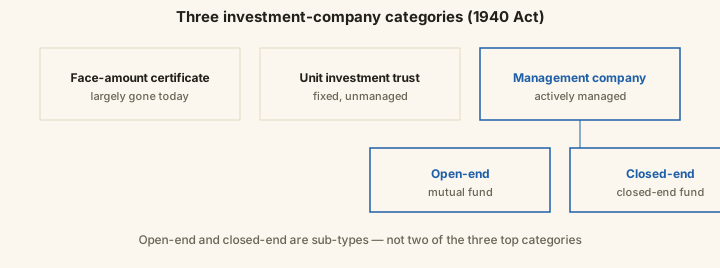
When investment companies were defined by the Investment Company Act of 1940, three separate categories were created. Recognize these three right away:
| # | Category | Also known as / includes |
|---|---|---|
| 1 | Management companies | Open-end management companies (mutual funds); Closed-end management companies (closed-end funds) |
| 2 | Unit investment trusts (UITs) | Fixed, unmanaged portfolios of securities |
| 3 | Face amount certificates | Largely non-existent today |
Definitions
| Term | Definition | Example |
|---|---|---|
| Investment company | A financial institution that invests its customers’ money on their behalf | A mutual fund company that pools investor money and invests it per the fund’s strategy |
| Investment Company Act of 1940 | The law that formally defined investment companies and set rules for how they operate | Created the three investment company categories |
| Management company | An investment company that actively manages customers’ money | Open-end (mutual fund) and closed-end (closed-end fund) management companies |
| Open-end management company | A management company also known as a mutual fund | Buying shares of a mutual fund pools your money with other investors under professional managers |
| Closed-end management company | A management company also known as a closed-end fund | — |
| Unit investment trust (UIT) | An investment company that invests customers’ money but typically holds a fixed, unmanaged portfolio of securities | — |
| Face amount certificate | A category of investment company that isn’t common today; historically used alongside certain mortgage structures at banks | A borrower paid into a certificate designed to grow to the amount needed to repay the mortgage principal |
Comparison: the three investment company types
Built from what this chapter states. (Pricing/trading/redemption mechanics for open-end vs closed-end funds are developed in NAV and POP and Closed-End & Interval Funds.)
| Feature | Face amount certificate | Unit investment trust (UIT) | Management company |
|---|---|---|---|
| Managed? | Not a managed portfolio — a certificate designed to grow to a set (face) amount | No — typically holds a fixed, unmanaged portfolio of securities | Yes — actively manages customers’ money |
| Structure | Certificate the investor pays into over time | Trust holding a fixed portfolio | Fund holding a portfolio of investments, seeking returns |
| Sub-types | — | — | Open-end (mutual funds); Closed-end (closed-end funds) |
| Common today? | Largely non-existent today (modern mortgages amortize principal over time) | In use | In use |
| Purpose noted in text | Ensure a lump-sum mortgage principal repayment would be available | Invest customers’ money via a fixed portfolio | Seek returns by holding a portfolio of investments |
Management companies in detail
Management companies are investment companies that actively manage customers’ money. There are:
- Open-end management companies, also known as mutual funds
- Closed-end management companies, also known as closed-end funds
These two structures work differently, but both are designed to seek returns by holding a portfolio of investments.
Exam trap: “open-end” and “closed-end” are both management companies — they are sub-types of one category, not two of the three top-level categories. The three categories are management companies, UITs, and face amount certificates.
Unit investment trusts (UITs)
- UITs also invest customers’ money, but they typically hold a fixed, unmanaged portfolio of securities.
Exam trap: The distinguishing feature of a UIT vs a management company is management — UIT portfolios are fixed and unmanaged.
Face amount certificates
- A category of investment company that isn’t common today.
- Historically, they were used alongside certain mortgage structures at banks.
- Before modern mortgages (with monthly payments that include both interest and principal), a borrower might pay only interest each month and then repay the entire principal in a lump sum at the end of the loan.
- To help ensure that lump-sum payment would be available, banks required borrowers to make ongoing payments into a face amount certificate.
- The certificate was designed to grow to the amount needed to repay the mortgage principal.
- Because modern mortgages amortize principal over time, face amount certificates are largely non-existent today.
Exam relevance (stated by the text): “For the exam, you’ll usually only need to know that they’re one of the three investment company categories.”
Key points
Investment companies
- Financial institutions that invest their customers’ money
- Regulated by the Investment Company Act of 1940
Investment company classifications
- Management companies
- Unit investment trusts (UITs)
- Face amount certificates
Management companies
- Open-end management companies
- A.k.a. mutual funds
- Closed-end management companies
- A.k.a. closed-end funds
Unit investment trusts (UITs)
- Fixed portfolios of securities
Practice questions
Q1. What is an investment company?
Show answer
A financial institution that invests its customers’ money on their behalf. Mutual funds are one type of investment company.
Q2. Which federal law formally defined and regulates investment companies, and when did it take effect?
Show answer
The Investment Company Act of 1940. Investment companies existed since the 1920s but were not formally defined until this law.
Q3. Name the three categories of investment company created by the Investment Company Act of 1940.
Show answer
Management companies, unit investment trusts (UITs), and face amount certificates.
Q4. A student says open-end and closed-end funds are two of the three investment company categories. Is that correct?
Show answer
No. Open-end and closed-end are both sub-types of management companies — one of the three top-level categories. The three categories are management companies, UITs, and face amount certificates.
Q5. How does a management company differ from a UIT?
Show answer
Management companies actively manage customers’ money. UITs typically hold a fixed, unmanaged portfolio of securities.
Q6. What are the two types of management company?
Show answer
Open-end management companies (mutual funds) and closed-end management companies (closed-end funds). Both seek returns by holding a portfolio of investments.
Q7. What were face amount certificates historically used for, and why are they largely non-existent today?
Show answer
Banks required borrowers to make ongoing payments into certificates designed to grow to the mortgage principal lump sum. Modern mortgages amortize principal over time, so face amount certificates are largely non-existent.
Q8. For exam purposes, what do you typically need to know about face amount certificates?
Show answer
That they are one of the three investment company categories — little more is usually tested.
Sources
Primary/official references for the material on this page. Every link was fetched and returned HTTP 200 on 2026-08-15.
| # | Source | Publisher |
|---|---|---|
| 1 | Investment Company Act — definition of investment company | Cornell LII (15 U.S.C. 80a-3) |
| 2 | Open-end vs closed-end vs UIT classification | Cornell LII (15 U.S.C. 80a-5) |
| 3 | Mutual funds and ETFs — NAV, fees, share classes | SEC / Investor.gov |
| 4 | Investment Company Act §14(a) — $100,000 net worth to make a public offering | Cornell LII (15 U.S.C. 80a-14) |
| 5 | Achievable Series 65 — chapter 1.3.1 | Achievable (course text) |