Federal Registration & Underwriters
🔑 Numbers & deadlines
| Item | Requirement / threshold |
|---|---|
| Cooling off period | 20 days, begins when the registration form is filed with the SEC |
| Effective date | Announced at some point during the cooling off period; first day the security may be legally sold to the public |
| Insiders defined on the registration form | Officers, directors, 10% shareholders |
| Governing law (interstate issuer transactions) | Securities Act of 1933 |
| Governing law (intrastate issuer transactions) | Uniform Securities Act (USA) |
Key documents/terms: registration form (filed with SEC), prospectus, preliminary prospectus (“red herring”), deficiency letter, tombstone, public offering price (POP).
Primary market and jurisdiction
- Primary market securities offered to the public are typically subject to registration requirements.
- Issuer transactions take place in the primary market. An issuer transaction occurs when the sales proceeds from a securities transaction are collected by the issuer.
| Scope of issuer transaction | Governing law |
|---|---|
| Interstate (more than one state) | Securities Act of 1933 — the federal law that governs primary market offerings |
| Intrastate (within one state) | Uniform Securities Act (USA) |
| Term | Definition |
|---|---|
| Issuer transaction | A transaction where the sales proceeds from a securities transaction are collected by the issuer |
| IPO (initial public offering) | The first public primary market offering an issuer participates in |
Real-world interstate IPO examples given in the text (each subject to the Securities Act of 1933):
| Issuer | Amount raised | Year |
|---|---|---|
| Doordash | $3.4 billion | 2020 |
| Airbnb | $3.5 billion | 2020 |
| Robinhood | $2 billion | 2021 |
- In each of these IPOs, the issuers had to follow protocols enforced by the Securities and Exchange Commission (SEC).
Why primary market laws exist
- The financial markets in the early 1900s included widespread fraud, deceit, and manipulation — some of which contributed to the Great Depression.
- Investors in that era had limited access to the information needed to make informed decisions (no internet or television).
- Signed into law to protect the investing public, the Securities Act of 1933 requires issuers to fully disclose the characteristics of the securities they intend to sell.
- To make sure potential investors can access this information, issuers and their underwriters must follow specific steps before and during the offering.
Underwriters
- Underwriters are hired by issuers to help manage the sale and marketing of securities to the public.
- Investment banking, also called underwriting, can be a major business. Example given: Facebook’s underwriters made over $100 million during their IPO in 2012.
- Underwriters can provide general advice, help structure the offering, and may also sell the securities.
| Real-world underwriter examples |
|---|
| Morgan Stanley |
| JP Morgan |
| Goldman Sachs |
- Issuers typically conduct an extensive search to find the right underwriter. After selecting an underwriter and signing a contract, the underwriter guides the issuer through the due diligence phase.
The registration form
- The Securities Act of 1933 requires the issuer to disclose a significant amount of information to the public.
- The issuer completes and files the SEC’s registration form, which requests items such as business history, information on officers and directors, and current financial status.
| Specific item detailed in the registration form |
|---|
| Use of proceeds |
| Description of securities |
| Risk factors |
| Financial statements (e.g. balance sheet) |
| Insiders (officers, directors, 10% shareholders) |
The 20-day cooling off period
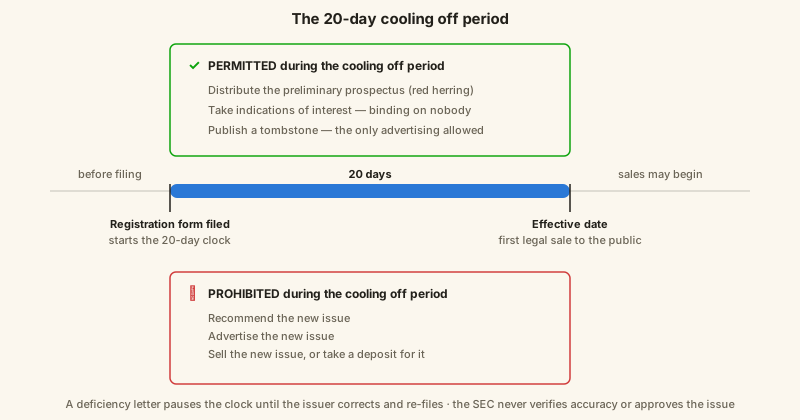
- 🔑 The filing of the registration form starts the 20-day “cooling off” period.
- During this time, the SEC reviews the filing to confirm it is complete. This review takes time, which is why the period lasts 20 days.
- The SEC’s goal is to ensure the public has access to the required disclosures before any sales activity occurs.
⚠️ As a result, the underwriter (and any other financial firm connected to the IPO) cannot:
- Advertise or recommend the new issue to customers
- Sell the new issue
- Take deposits for future sales
In other words, sales-related activity is off-limits during this 20-day period.
⚠️ Legal vs. illegal during the 20-day cooling off period
| Legal during 20-day cooling off period | Illegal during 20-day cooling off period |
|---|---|
| Distribute the preliminary prospectus | Recommend the new issue |
| Take indications of interest | Advertise the new issue |
| Publish a tombstone | Sell the new issue |
| — | Take a deposit for the new issue |
Prospectus and the preliminary prospectus (red herring)
- The information in the SEC registration form is compiled into a document called the prospectus. Investors learn about the issuer and the security by reading the prospectus.
- During the 20-day cooling off period, the registration materials are used to create a “preliminary” prospectus, which may be provided to potential investors on a solicited or unsolicited basis.
- This preliminary prospectus is sometimes called the “red herring.” The term comes from a message printed in red on the preliminary prospectus:
A Registration Statement relating to these securities has been filed with the Securities and Exchange Commission but has not yet become effective. Information contained herein is subject to completion or amendment. These securities may not be sold nor may offers to buy be accepted prior to the time the Registration Statement becomes effective.
- The text links to Robinhood’s preliminary prospectus for its 2021 IPO; similar language is shaded in red below the “Calculation of Registration Fee” section.
- In plain English: the preliminary prospectus hasn’t been finalized and may change.
- ⚠️ The SEC does not verify the accuracy of the information and does not guarantee anything about the new issue.
- If the issuer misleads investors or lies in the registration form, the issuer can face significant fines and sanctions. Jail time is also possible for anyone who knowingly lies while completing the form.
Deficiency letter
- 🔑 The SEC’s job is to determine whether the registration form is complete.
- If something is missing, the SEC sends a deficiency letter to the issuer identifying what must be corrected.
- This pauses the registration process until the issuer fixes the filing and re-files it with the SEC.
- Real-world example referenced: a deficiency letter related to The We Company (owner of WeWork), whose 2019 attempt to register securities for public sale is known for several missteps.
Pricing and indications of interest
- Part of the underwriter’s job is to price the new security. This can be especially difficult with stock, because its market value depends on demand.
- To estimate demand for the IPO, the underwriter may solicit or receive indications of interest from potential investors during the 20-day cooling off period.
Indications are just indications — they are not binding on either party.
| Party | Obligation |
|---|---|
| Customer who indicates interest | Has no obligation to buy |
| Underwriter who receives an indication of interest | Has no obligation to sell |
Tombstones
- To notify the public about the new issue, a tombstone may be published. The term “tombstone” refers to the ad’s appearance (it resembles a tombstone).
- Tombstones are typically published in newspapers and online outlets.
- 🔑 They are the only form of legal advertising the SEC allows during the cooling off period.
- A tombstone includes factual information and does not “pump up” or recommend the issue.
| Typical tombstone information |
|---|
| Name of issuer |
| Type of security |
| Number of shares or units to be sold |
| Gross proceeds of the offering |
| Name of lead underwriter |
| Name of syndicate members |
| Estimated public offering price |
Effective date and sale
- After the SEC reviews a completed registration form, it will effectively register the security.
- At some point during the cooling off period, an effective date is announced.
The effective date is the first day the security may be legally sold to the public.
- ⚠️ Similar to the rules covering registered persons, issuers and/or underwriters may not claim the registration has been approved.
- When a new issue becomes effective, the underwriter contacts customers who submitted indications of interest.
- If demand is high, the underwriter must decide which customers receive shares. There are not many guidelines here, so underwriters typically allocate shares to their most profitable customers.
Public offering price (POP)
- New issues are sold at the public offering price (POP). Similar to buying a mutual fund, IPO shares are purchased at the POP.
Final prospectus delivery
- The Securities Act of 1933 requires the underwriting syndicate to deliver a prospectus to each customer buying the IPO.
- The prospectus contains the information filed in the registration statement, plus the POP.
- ⚠️ The prospectus must be delivered in its original, unaltered form. Firms cannot highlight, summarize, or modify a prospectus in any way.
- After the issue is sold in the primary market, investors trade it in the secondary market.
Key points
Securities Act of 1933
- Governs the primary market
- Requires disclosures on new issues
Registration form
- Issuers file with SEC prior IPO
- Details issuer’s background and financials
- SEC checks completeness
- SEC does not check accuracy
Prospectus
- Created with registration form info
- Gives investors details on security
20-day cooling off period
- Begins when the registration form is filed
- Legal activities:
- Distribute preliminary prospectus
- Take indications of interest
- Publish a tombstone
- Illegal activities:
- Recommend the new issue
- Advertise the new issue
- Sell the new issue
- Take a deposit for the new issue
Indications of interest
- Collected to forecast demand
- Allowed during the cooling-off period
- Not binding on customer or firm
Tombstones
- Legal advertising in the cooling-off period
- Contains this information:
- Name of issuer
- Type of security
- Number of shares or units to be sold
- Gross proceeds of the offering
- Name of lead underwriter
- Name of syndicate members
- Estimated public offering price
Deficiency letter
- Issued by SEC
- Provided if the registration form is incomplete
Effective date
- First day the new issue can be legally sold
- SEC provides when the registration form is reviewed and deemed complete
- Issuer/underwriter may not claim registration “approved”
Public offering price (POP)
- Sale price of new issues
Prospectus
- Provided to investors buying IPOs
Sources
Primary/official references for the material on this page. Every link was fetched and returned HTTP 200 on 2026-08-15.
| # | Source | Publisher |
|---|---|---|
| 1 | Securities Act 1933 — definition of security, issuer | Cornell LII (15 U.S.C. 77b) |
| 2 | The federal securities statutes, in order | SEC |
| 3 | EDGAR — 10-K/10-Q/8-K filings search | SEC |
| 4 | Achievable Series 65 — chapter 4.3.5.1 | Achievable (course text) |