The Fed’s Dual Mandate
🔑 Who controls what (the #1 trap in this unit)
⚠️ MONETARY vs FISCAL POLICY is the top trap in Unit 3. Keep the controller straight:
| Policy | Who controls it | What it controls | Tools |
|---|---|---|---|
| Monetary policy | Federal Reserve Board (FRB / “the Fed”) | The money supply — how much currency is in the financial system | Loosening (expanding) and tightening (contracting) the money supply; specific tools are covered in the Federal Reserve tools chapter |
| Fiscal policy | Congress / the President (covered in the Fiscal policy chapter) | Not part of the Fed’s role | Not part of the Fed’s role |
“Have you ever wondered who decides how much money the government prints? That role belongs to the Federal Reserve Board (FRB).”
“The Fed (as it’s commonly called) sets monetary policy, which influences how much currency is in the financial system.”
This chapter is entirely about the Fed. Nothing covered here is controlled by Congress or the President.
The dual mandate
The money supply is used as a tool to influence two things:
- Economic growth (low unemployment)
- Inflation levels
Some economists describe the Fed’s responsibilities as a “dual mandate.”
- Supporting economic growth and employment — especially during a recession — can require enormous amounts of money to make a noticeable impact.
- Controlling inflation also requires a careful strategy and can involve large-scale changes to the money supply.
⚠️ The two goals pull in opposite directions
| Goal | Action | Side effect |
|---|---|---|
| Encourage economic growth | Expand the money supply | Can increase inflation |
| Reduce inflation | Contract the money supply | Can slow economic growth |
“Encouraging economic growth can increase inflation.”
“Reducing inflation can slow economic growth.”
How loosening works (the recession scenario)
Assume we’re in the middle of a recession. Thousands of jobs are being cut each week, and stock market values are dropping rapidly. One of the Fed’s goals is to stimulate economic growth, so it will try to revive economic activity.
The chain of effects:
- The Fed increases the money supply.
- This tends to lower interest rates — with more money available to lend, banks and other financial institutions can charge less to borrow it.
- Lower borrowing costs make it easier for businesses to invest and earn profits.
- That can lead to more job openings, more hiring, and more consumer spending.
“In that way, falling interest rates can create a ‘positive’ domino effect.”
Interest rate changes can reshape the economy because borrowing is central to the financial system. The government borrows money, businesses borrow money, and individuals borrow money.
Putting more money into the system loosens (expands) the money supply. Interest rates fall, which encourages businesses and consumers to buy more goods and services because borrowing is cheaper.
GDP
🔑 Definition:
“The health of the economy is often measured by Gross Domestic Product (GDP), which is the value of all domestic goods and services produced.”
| Term | Definition | Example / effect |
|---|---|---|
| Gross Domestic Product (GDP) | “the value of all domestic goods and services produced” | “When more goods and services are purchased and produced, GDP tends to rise.” |
Why the Fed can’t keep rates low forever: inflation
“In a world with limited resources, adding more money to the system can eventually push prices higher.”
The oil exercise: The world has a limited supply of oil. If every person in the world magically received $1 billion, oil prices would likely surge. Even though everyone would have more money, the amount of oil in the ground wouldn’t change.
🔑 Inflation definition and threshold:
“What exactly is inflation? Simply put, it’s when general prices rise, as discussed in depth in the equity securities unit.”
| Term | Definition | Stated benchmark |
|---|---|---|
| Inflation | “when general prices rise” | 🔑 “Inflation is generally considered acceptable when it’s around 2% annually.” |
Memorize the 2% annual acceptable inflation figure — it is the only numeric threshold stated in this chapter.
“When prices rise rapidly and unpredictably, it can create major economic problems.”
When inflation rises more than usual, the dual mandate pushes the Fed to shift attention away from stimulating growth and toward reducing inflation.
How tightening works
To manage inflation, the Fed does the opposite of loosening:
- It removes significant amounts of money from the financial system.
- With less money available, banks have less to lend, and interest rates tend to rise.
- 🔑 This is known as tightening (contracting) the money supply.
- Higher borrowing costs usually reduce spending on goods and services.
- That can slow economic growth (and often does), but it can also bring inflation down over time.
“When demand falls, prices tend to rise more slowly - and may even drop - especially when people have more incentive to save rather than spend.”
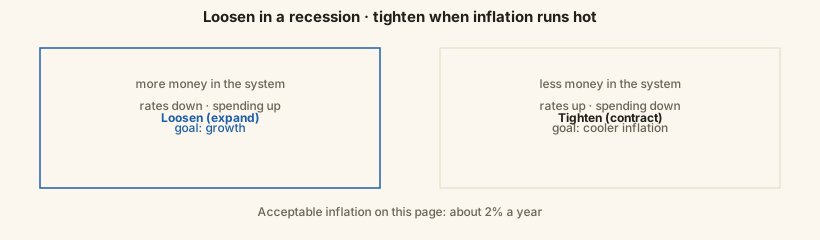
🔑 Loosening vs tightening — master table
| Loosening (expanding) | Tightening (contracting) | |
|---|---|---|
| Money supply | More currency placed in the economy | Less currency in the economy |
| Goal for interest rates | Drive interest rates down | Drive interest rates up |
| Primary purpose | Encourage economic growth | Manage / reduce inflation |
| Typically pursued when | In recessions | During high inflation |
| Effect on borrowing | Cheaper to borrow; more spending | More expensive to borrow; less spending |
| Effect on GDP | GDP tends to rise | Growth may slow |
| Risk / trade-off | May increase inflation | May slow growth |
“Expanding the money supply can support growth but may increase inflation.”
“Contracting the money supply can reduce inflation but may slow growth.”
Scale and influence
- Billions (if not trillions) of dollars can be involved when the Fed carries out its policies.
- Because its actions operate at such a large scale, the Fed can significantly influence the economy.
- Some economists even describe it as one of the most powerful organizations in the world.
Monetarist theory
| Term | Definition | Example |
|---|---|---|
| Monetarist theory | 🔑 “those who subscribe to Monetarist theory argue that the Fed’s actions are the primary driver of the economy” | Although many factors affect economic conditions, a Monetarist attributes economic outcomes chiefly to Fed action |
The Fed pursues its goals of economic growth and manageable inflation through monetary policy. The specific tools the Fed uses are covered in Open Market Operations & Reserve Requirements.
Key points
Monetary policy
- Controls money supply levels
- Executed by Federal Reserve Board
- Two goals:
- Economic growth (low unemployment)
- Manageable inflation levels
Loosening policies
- Encourage economic growth
- More currency placed in the economy
- Goal: drive interest rates down
- Typically pursued in recessions
Tightening policies
- Manages inflation levels
- Less currency in the economy
- Goal: drive interest rates up
- Typically pursued during high inflation
Monetarist theory
- Fed’s actions are the most significant economic influence
Sources
Primary/official references for the material on this page. Every link was fetched and returned HTTP 200 on 2026-08-15.
| # | Source | Publisher |
|---|---|---|
| 1 | Monetary policy — objectives and implementation | Federal Reserve |
| 2 | The Fed Explained — structure, tools, functions | Federal Reserve |
| 3 | How policy affects inflation and employment | Federal Reserve |
| 4 | Structure of the Federal Reserve System | Federal Reserve |
| 5 | Achievable Series 65 — chapter 3.1.1 | Achievable (course text) |