The Rate Ladder: Fed Funds to Prime
Overview
“When the Fed implements monetary policy, interest rates are directly affected.”
There are many different interest rates in the economy (for example, mortgage rates and car loan rates), but this chapter focuses on five key rates:
- Federal funds rate
- Discount rate
- Broker loan rate
- Prime rate
- Secured overnight financing rate (SOFR)
⚠️ MONETARY vs FISCAL POLICY reminder. Every rate in this chapter sits on the monetary side of the ledger:
| Policy | Who controls it | Relevance to this chapter |
|---|---|---|
| Monetary policy | Federal Reserve Board (the Fed) | The Fed directly sets the discount rate (its own lending rate to banks) and, through monetary policy, influences the federal funds rate, broker loan rate, and prime rate. SOFR is published daily by the New York Federal Reserve. |
| Fiscal policy | Congress / the President (taxing and spending) | No rate in this table is set by Congress or the President. |
🔑 THE RATE TABLE — ordered lowest to highest
The rate ordering is a guaranteed exam question.
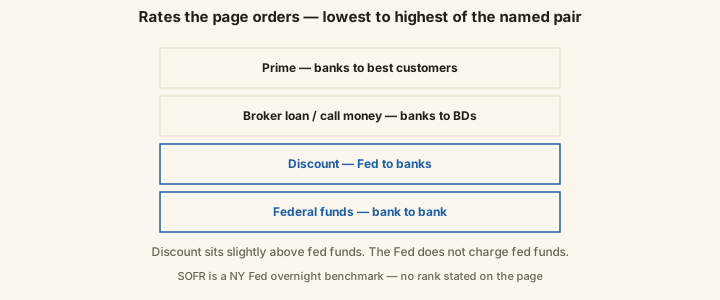
The discount rate is slightly higher than the federal funds rate, and both typically influence other interest rates.
| # | Rate | What it is | Who pays / who charges | Set or influenced by |
|---|---|---|---|---|
| 1 (lowest of the stated pair) | Federal funds rate | “the average rate banks charge each other for short-term loans” — bank-to-bank | Member bank borrows from member bank | Result of member-bank lending; influenced by Fed monetary policy. ⚠️ NOT a rate the Federal Reserve charges |
| 2 (“slightly higher than the federal funds rate”) | Discount rate | The rate the Fed charges when a bank borrows directly from the Fed | Bank borrows from the Fed | The Federal Reserve (“lender of last resort”) |
| 3 (influenced by 1 and 2) | Broker loan rate (a.k.a. call money market rate) | “the cost broker-dealers pay when borrowing from banks” | Broker-dealer borrows from a bank | Influenced by the federal funds rate and discount rate |
| 4 (influenced by 1 and 2) | Prime rate | “the interest rate banks charge their best customers, typically corporations and institutions” | Best/large customers borrow from a bank | “affected by monetary policy because changes in Fed-controlled rates tend to ripple through the rest of the lending market” |
| Benchmark (no ordering stated) | Secured Overnight Financing Rate (SOFR) | “a benchmark interest rate”; “a broad measure of the cost of overnight borrowing” | Reference rate, not a lender-borrower pair | Published daily by the New York Federal Reserve; reflects actual transactional data |
Definitions
| Term | Definition (word-for-word) | Example / detail |
|---|---|---|
| Federal funds rate | > “it’s the average rate banks charge each other for short-term loans” | Loans are usually very short-term (typically overnight); banks borrow this way to meet reserve requirements if they come up short at the end of the day |
| Member banks | > “assume member banks are large institutions that help the Federal Reserve carry out monetary policy” | Banks that are members of the Federal Reserve system |
| Reserve requirements | > “All banks are subject to reserve requirements, which require a certain amount of deposits to be kept in their vaults.” | Calculated daily; created to reduce the possibility of “runs on the bank” |
| Discount rate | > “A bank can borrow directly from the Fed when it urgently needs funds. The Fed charges the discount rate on these loans.” | 🔑 “The discount rate is slightly higher than the federal funds rate, which is why banks typically borrow from the Fed only when they can’t borrow from other banks.” |
| Lender of last resort | > “The Fed is sometimes called the ‘lender of last resort.’” | Used when a bank needs to borrow to meet reserve requirements but no other banks are willing to lend |
| Broker loan rate (call money market rate) | > “This rate reflects the cost broker-dealers pay when borrowing from banks.” | Broker-dealers aren’t banks and typically don’t have large amounts of cash to lend, so they borrow from banks and re-lend to customers |
| Broker-dealers | > “broker-dealers are institutions that help customers buy and sell securities” | Some investors use margin accounts |
| Margin accounts | > “margin accounts, which allow customers to borrow money for investment purposes (known as leveraging)” | The borrowed funds come from banks via the broker loan rate |
| Prime rate | > “The prime rate is the interest rate banks charge their best customers, typically corporations and institutions.” | Typically only available to institutions |
| SOFR | > “The Secured Overnight Financing Rate (SOFR) is a benchmark interest rate.” | Broad measure of the cost of overnight borrowing |
| LIBOR | > “SOFR replaced LIBOR (London Interbank Offered Rate), which was phased out because it relied on banks’ self-reported estimates that could be manipulated and lacked transparency.” | ⚠️ LIBOR is retired — SOFR is the current benchmark |
Federal funds rate — detail
- ⚠️ The name is misleading: “It isn’t a rate the Federal Reserve charges.” It is the average rate banks charge each other.
- The banks involved are members of the Federal Reserve system. You don’t need the membership details — just assume member banks are large institutions that help the Federal Reserve carry out monetary policy.
- Loans are usually very short-term (typically overnight).
- Purpose of borrowing: to meet reserve requirements if a bank comes up short at the end of the day.
Why reserve requirements exist
- Reserve requirements were created to reduce the possibility of “runs on the bank.”
- When money is deposited at a financial institution, most of those funds are either lent to other customers or invested.
- Without reserve requirements, a bank could lend or invest every dollar its depositors gave it.
- If many customers then tried to withdraw money at the same time, the bank might not be able to meet those requests because the funds would be tied up elsewhere.
- 🔑 By having reserve requirements, these problems are largely avoided (although not completely).
The daily reserve cycle
| Step | What happens |
|---|---|
| 1 | To ensure compliance, banks calculate their reserves daily |
| 2 | If a bank lends out too much and falls below its reserve requirement, it tries to borrow from another bank with excess reserves |
| 3 | These loans typically last less than 24 hours |
| 4 | The next day, the bank repays the short-term loan and continues managing its reserves to stay above the required level |
Discount rate — detail
- Scenario: a bank needs to borrow to meet reserve requirements, but no other banks are willing to lend. “It’s rare, but it can happen.”
- Example given: the “credit freeze” during the Great Recession of 2008. With widespread economic stress and large banks like Bear Stearns collapsing, banks became hesitant to lend to one another.
- In situations like this, the Federal Reserve can step in as the “lender of last resort.”
- 🔑 The discount rate is slightly higher than the federal funds rate — which is why banks typically borrow from the Fed only when they can’t borrow from other banks.
Broker loan rate — detail
- Also called the call money market rate.
- The federal funds rate and discount rate typically influence other interest rates; the broker loan rate is one of these.
- Chain of lending: Bank → Broker-dealer → Margin customer.
- Broker-dealers aren’t banks and typically don’t have large amounts of cash available to lend.
- Instead, they borrow from banks and then re-lend those funds to their customers.
Prime rate — detail
- The rate banks charge their best customers, typically corporations and institutions.
- Like the broker loan rate, the prime rate is affected by monetary policy because changes in Fed-controlled rates tend to ripple through the rest of the lending market.
- Typically only available to institutions.
SOFR — detail
| Attribute | Detail |
|---|---|
| What it is | A benchmark interest rate; “a broad measure of the cost of overnight borrowing” |
| Replaced | LIBOR (London Interbank Offered Rate) |
| Why LIBOR was phased out | “it relied on banks’ self-reported estimates that could be manipulated and lacked transparency” |
| Published by | The New York Federal Reserve |
| Publication frequency | Daily |
| Based on | Actual transactional data |
| Used as a reference rate for | Loans, derivatives, and floating-rate instruments; can serve as the key reference rate in many financial transactions, including loans, derivatives, bonds, and mortgages |
Exam trap: LIBOR was based on self-reported estimates; SOFR is based on actual transactions. That contrast is the reason for the switch.
Key points
Federal funds rate
- Rate for bank-to-bank loans
Discount rate
- Rate for Fed loans to banks
Broker loan rate
- Also known as the call money market rate
- Rate for bank-to-broker-dealer loans
Prime rate
- Rate for large bank customer loans
- Typically only available to institutions
Secured overnight financing rate (SOFR)
- Benchmark interest rate
- Key reference rate used in various loans, derivatives, bonds, and mortgages
Sources
Primary/official references for the material on this page. Every link was fetched and returned HTTP 200 on 2026-08-15.
| # | Source | Publisher |
|---|---|---|
| 1 | Effective federal funds rate — published daily | NY Fed |
| 2 | Discount window and the discount rate | Federal Reserve |
| 3 | Open market operations and the federal funds target | Federal Reserve |
| 4 | Achievable Series 65 — chapter 3.1.2 | Achievable (course text) |