Time Value & Discounted Cash Flow
Time value of money
If you’ve ever heard the phrase “a dollar received today is worth more than a dollar received tomorrow,” you’ve heard the basic idea behind the time value of money. The reason is opportunity cost — if you don’t have the money today, you can’t invest it today, so you give up potential returns.
Definitions
| Term | Definition | Example |
|---|---|---|
| Opportunity risk | The representation of missed returns on a considered, but ultimately avoided investment option | An investor is considering investing a Treasury bill or a common stock. The investor chooses the T-bill. Over the next year, the T-bill returns 3%, while the stock returns 10%. The investor experienced opportunity risk to the tune of 7% (missed out on 7% returns because they chose the T-bill). |
Worked illustration — $1,000 today vs. $1,000 in one year
Compare receiving $1,000 today versus receiving the same $1,000 one year from now, assuming a bank savings account earns 1% annually.
- If you receive $1,000 today, you can deposit it immediately. At 1% simple annual interest (assuming interest doesn’t compound monthly), it earns $10 over the year, so you’ll have $1,010 after one year.
- If you wait one year to receive $1,000, you miss the chance to earn that interest.
Even with a small return, money received today is more valuable because it can start earning returns right away.
Discounted cash flow
An investor can estimate what future money is worth today using discounted cash flow tools. When you perform a present value calculation, you’re “discounting” future cash flows back into today’s dollars.
🔑 Present value formula
PV = FV ÷ (1 + DR)ⁿ
where: PV = present value FV = future value DR = discount rate n = # of years
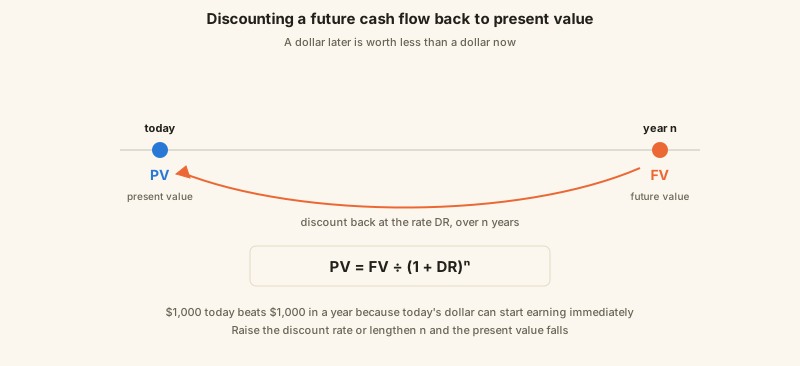
Future value goes on top. One plus the discount rate, raised to the number of years, goes on the bottom. For example, $50 / 1.06 = $47.17 and $1,050 / 1.1236 = $934.50.
What each piece means
| Variable | Meaning |
|---|---|
| Future value (FV) | The cash amount you’ll receive in the future |
| Discount rate (DR) | The market’s average rate of return (the return you could reasonably expect to earn elsewhere). It captures the opportunity cost of waiting |
| n | How many years you must wait to receive the cash flow |
Questions on this topic on discounted cash flow tend to be conceptual, although it’s possible you’re required to do a present value calculation. If this occurs, the calculation itself is typically simple.
Worked example — 2-year corporate debenture
An investor is considering the purchase of a $1,000 par, 2-year, 5% corporate debenture currently trading at 97. The rate of return in the market is 6%. What is the present value of the debenture?
Because this is a two-year bond, there are two cash flows to discount:
- The coupon payment received at the end of year 1
- The coupon payment plus principal received at the end of year 2
Present value — year 1
This bond pays a 5% coupon, and the coupon rate is always applied to the bond’s par value ($1,000). That means the annual interest payment is:
$1,000 × 5% = $50
In year 1, the investor receives only this $50 interest payment. Now discount it at the 6% market rate:
PV = FV ÷ (1 + DR)ⁿ
PV = $50 ÷ (1 + 0.06)¹
PV = $50 ÷ 1.06
PV = $47.17
So, if the investor must wait one year to receive $50 when the market return is 6%, that $50 is worth $47.17 today. Another way to see it is that $47.17 invested at 6% grows to about $50 after one year.
Present value — year 2
At the end of year 2, the investor receives:
- another $50 interest payment, plus
- the $1,000 par value at maturity
So the total cash flow at the end of year 2 is $1,050. Discount that amount back two years at 6%:
PV = FV ÷ (1 + DR)ⁿ
PV = $1,050 ÷ (1 + 0.06)²
PV = $1,050 ÷ 1.06²
PV = $1,050 ÷ 1.1236
PV = $934.50
So, $1,050 received in two years is worth $934.50 today when the market return is 6%. In other words, $934.50 invested at 6% (compounded for two years) grows to about $1,050.
Putting it all together
Total PV = Year 1 PV + Year 2 PV
Total PV = $47.17 + $934.50
Total PV = $981.67
| Year | Cash flow (FV) | Discount factor | Present value |
|---|---|---|---|
| 1 | $50 (coupon) | (1.06)¹ = 1.06 | $47.17 |
| 2 | $1,050 (coupon + par) | (1.06)² = 1.1236 | $934.50 |
| Total | $981.67 |
From a time value of money perspective, the bond’s present value is $981.67. This discounts the bond’s future cash flows back into today’s dollars, giving you a benchmark for value.
This present value can help you judge whether the bond looks attractive at its current market price.
The bond is quoted at 97 (i.e., $970) while its computed present value is $981.67 — the comparison of market price to present value is the point of the exercise.
Annuity vs. lump sum option
A common real-world situation where these ideas show up is a lottery payout. Lottery winners typically choose between two options:
| Option | Description |
|---|---|
| Annuity option | The full jackpot amount paid out over 30 years in annual installments |
| Lump sum option | A reduced amount paid immediately (often around half the advertised jackpot) |
To compare these options, you can use time value of money (TVM) and discounted cash flow (DCF) to see which choice has the higher present value. Because money received today can be invested, each future annuity payment is discounted back to today using an assumed rate of return (the discount rate).
For instance, suppose a $100 million jackpot offers either:
- $50 million today (lump sum), or
- $3.33 million per year for 30 years (annuity)
If a 5% discount rate gives the annuity a present value of $42 million, then the lump sum has the higher present value.
In practice, other factors — such as investment opportunities, inflation, and taxes — also affect the decision.
Key points
Opportunity cost
- Lost returns from a missed investing opportunity
Discounted cash flow
- Tool for determining the present value of future cash flows
- Factors in opportunity cost
Present value
- Value of future cash flows in today’s dollars
Present value formula
PV = FV ÷ (1 + DR)ⁿ
Practice questions
Q1. What does “a dollar received today is worth more than a dollar received tomorrow” illustrate?
Show answer
The time value of money — money today can be invested immediately, so waiting creates opportunity cost (missed returns).
Q2. State the present value formula and define each variable.
Show answer
PV = FV ÷ (1 + DR)ⁿ. PV = present value; FV = future cash amount; DR = discount rate (market return/opportunity cost); n = number of years until receipt.
Q3. You can receive $1,000 today or $1,000 in one year. A savings account earns 1% annually. How much will $1,000 today be worth in one year?
Show answer
$1,010 ($1,000 + $10 simple interest at 1%). Receiving $1,000 today is more valuable because you earn that $10 while waiting costs you the return.
Q4. A $1,000 par, 2-year, 5% corporate debenture trades at 97. The market discount rate is 6%. What is the year-1 coupon cash flow and its present value?
Show answer
Year-1 cash flow = $50 (5% × $1,000 par). PV = $50 ÷ 1.06¹ = $47.17.
Q5. What is the year-2 cash flow for the same bond, and what is its present value at 6%?
Show answer
Year-2 cash flow = $1,050 ($50 coupon + $1,000 par). PV = $1,050 ÷ 1.06² = $1,050 ÷ 1.1236 = $934.50.
Q6. What is the total present value of the 2-year debenture’s cash flows?
Show answer
$981.67 ($47.17 + $934.50). This benchmarks the bond’s value in today’s dollars against its market price of $970 (quoted at 97).
Q7. ⚠️ The bond trades at $970 but has a computed PV of $981.67. What does that comparison suggest?
Show answer
From a DCF perspective, the bond may be slightly undervalued at its current market price — present value exceeds market price. The comparison of PV to market price is the point of the exercise.
Q8. Why are there two separate cash flows to discount on a 2-year coupon bond?
Show answer
Year 1 pays only the coupon ($50). Year 2 pays the final coupon plus principal repayment ($1,050). Each future payment must be discounted back separately.
Q9. A $100 million lottery offers $50 million lump sum today or $3.33 million/year for 30 years. At a 5% discount rate the annuity PV is $42 million. Which option has higher present value?
Show answer
The lump sum ($50 million > $42 million annuity PV). DCF/TVM tools compare future payment streams to immediate cash.
Q10. What does the discount rate represent in a present value calculation?
Show answer
The market’s average rate of return — the return you could reasonably earn elsewhere. It captures the opportunity cost of waiting for future cash flows.
Sources
Primary/official references for the material on this page. Every link was fetched and returned HTTP 200 on 2026-08-15.
| # | Source | Publisher |
|---|---|---|
| 1 | Compound interest / time value of money calculator | SEC / Investor.gov |
| 2 | Interest-rate risk — bond prices fall when rates rise, duration | SEC |
| 3 | Bonds — coupon, maturity, price/yield, credit risk | SEC / Investor.gov |
| 4 | Achievable Series 65 — chapter 1.2.14 | Achievable (course text) |