SEC vs. State Administrator
🔑 Definitions
| Term | Definition (as stated by the text) | Example |
|---|---|---|
| Securities and Exchange Commission (SEC) | The primary securities regulator in the financial markets; an independent agency of the US Government, created by the Securities Exchange Act of 1934 | Enforces the Securities Act of 1933, the Securities Exchange Act of 1934, and other federal securities laws |
| State administrator | The entity responsible for interpreting and enforcing the rules and regulations in the Uniform Securities Act (USA) — each US state’s counterpart to the SEC | The Department of Financial Protection and Innovation is California’s state administrator |
The SEC
- The Securities and Exchange Commission (SEC) is the primary securities regulator in the financial markets.
- It operates as an independent agency of the US Government.
- 🔑 The SEC was created by the Securities Exchange Act of 1934.
- 🔑 It also enforces rules and regulations under the Securities Act of 1933 and other federal securities laws.
🔑 The SEC’s three primary goals
| # | Goal | What it means in practice |
|---|---|---|
| 1 | Protect investors | Reducing fraud and unethical behavior in the securities markets. In practice, the SEC’s investor-protection efforts often focus on smaller, retail investors. Large institutions typically have substantial legal and financial resources, which can make them less vulnerable to certain types of misconduct. |
| 2 | Maintain fair, orderly, and efficient markets | Supporting confidence in the financial markets. ⚠️ This goal applies mainly to the SECONDARY market and is closely tied to the Securities Exchange Act of 1934. |
| 3 | Facilitate capital formation | Maintaining and regulating a system that allows issuers to raise capital (money) by selling securities. Even though many rules make the process of registering securities difficult and costly, the SEC aims to balance necessary regulation with the ability of issuers to raise funds efficiently. |
⚠️ Exempt vs. non-exempt issuers (capital formation)
- Non-exempt issuers selling significant amounts of securities to the public often must complete the formal registration process.
- ⚠️ Many EXEMPTIONS exist for:
- smaller offerings, and
- securities sold to private audiences.
Trap: an exemption relieves an issuer/security from the registration requirement; it is not the same as being excluded from a definition entirely. Watch for question stems that swap the two words.
State administrator
- 🔑 The entity responsible for interpreting and enforcing the rules and regulations in the Uniform Securities Act (USA) is the state administrator.
- 🔑 Think of the state administrator as each US state’s counterpart to the SEC.
- As discussed earlier in this unit, the state administrator is an office dedicated to protecting investors and supporting the integrity of the securities system within that state.
- Example: The Department of Financial Protection and Innovation is California’s state administrator.
- 📌 To find the administrator in your state, search: “State securities administrator of [state]”.
📌 What the state administrator enforces
📌 This material covers many rules and regulations specific to the USA, and the state administrator enforces them. These regulations include:
| Area | Detail |
|---|---|
| Registration & regulation of persons | Focuses on four main categories of persons (often described as the “players in the game”) |
| Registration & regulation of securities | Registration and regulation apply to securities as well as to persons; issuers are often subject to rules enforced by the state administrator |
| Enforcement of general securities laws | The USA is broad legislation covering many aspects of the securities markets and their participants |
| Enforcement of anti-fraud provisions | A core responsibility of the state administrator |
🔑 Registration & regulation of persons — the four “players in the game”
| # | Category of person |
|---|---|
| 1 | Broker-dealers |
| 2 | Agents |
| 3 | Investment advisers |
| 4 | Investment adviser representatives (IARs) |
- 🔑 The legal definitions matter because registration requirements depend on them.
- 🔑 If a business or natural person (human being) meets one of these definitions, they’re legally required to register with the state administrator.
- Registration places them under a form of government supervision, since the administrator is part of each state’s government.
- 📌 The registration process and its requirements are covered later in this material.
Registration & regulation of securities
- Registration and regulation can apply to securities as well as to persons.
- In particular, issuers are often subject to rules enforced by the state administrator.
- In many cases, issuers must publicly disclose significant information about the securities they’re offering.
- 🔑 The goal is a transparent environment where investors have the information needed to make informed investment decisions.
Enforcement of general securities laws
- The USA is broad legislation that covers many aspects of the securities markets and their participants.
- Because there’s a lot to interpret and apply, each state relies on the state administrator to enforce the rules and regulations that apply in that jurisdiction.
Enforcement of anti-fraud provisions
- Preventing fraud is central to nearly every part of the USA, but it’s important enough to call out separately.
- 🔑 A core responsibility of the state administrator is enforcing the USA’s anti-fraud provisions.
- Without effective anti-fraud enforcement, confidence in the securities markets could decline, which could reduce investment in businesses (and even governments) and contribute to broader economic harm.
As you work through the rest of this material, remember that the rules, regulations, and laws discussed are generally enforced by the state administrator, although the administrator’s level of involvement depends on the situation.
SEC vs. state administrator (comparison)
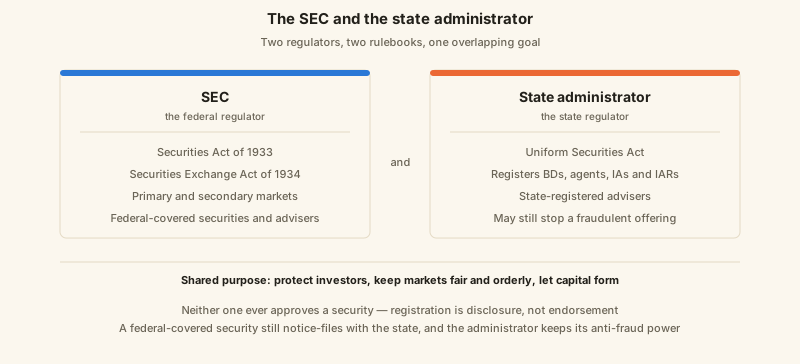
| SEC | State administrator | |
|---|---|---|
| Level | Federal — independent agency of the US Government | State — an office of government employees within a state |
| Created / governed by | Created by the Securities Exchange Act of 1934 | Interprets and enforces the Uniform Securities Act (USA) |
| Laws enforced | Securities Act of 1933, Securities Exchange Act of 1934, and other federal securities laws | The USA |
| Markets regulated | Primary and secondary markets | Securities markets within that state |
| Core goals / duties | Protect investors; maintain fair, orderly, and efficient markets; facilitate capital formation | Registration & regulation of persons; registration & regulation of securities; enforcement of general securities laws; enforcement of anti-fraud provisions |
| Relationship | The prominent securities industry regulator | Similar to the SEC, but at the state level |
Key points
Securities and Exchange Commission (SEC)
- Prominent securities industry regulator
- Regulates the primary and secondary markets
- Enforces:
- Securities Act of 1933
- Securities Exchange Act of 1934
- Main goals:
- Protect investors
- Maintain fair, orderly, and efficient markets
- Facilitate capital formation
State administrator
- State securities regulator (enforces the USA)
- An office of government employees tasked with regulating the securities markets
- Similar to the SEC, but at the state level
More from Definitions: Persons · Exempt & excluded · Issuers & securities · Broker-dealers · Agents
Sources
Primary/official references for the material on this page. Every link was fetched and returned HTTP 200 on 2026-08-15.
| # | Source | Publisher |
|---|---|---|
| 1 | Uniform Securities Act 1956 with NASAA updates — the tested statute | NASAA |
| 2 | The federal securities statutes, in order | SEC |
| 3 | Uniform Securities Acts (1956 / 1985 / 2002) index | NASAA |
| 4 | Achievable Series 65 — chapter 4.2.8 | Achievable (course text) |