State Registration by Qualification
Registration process
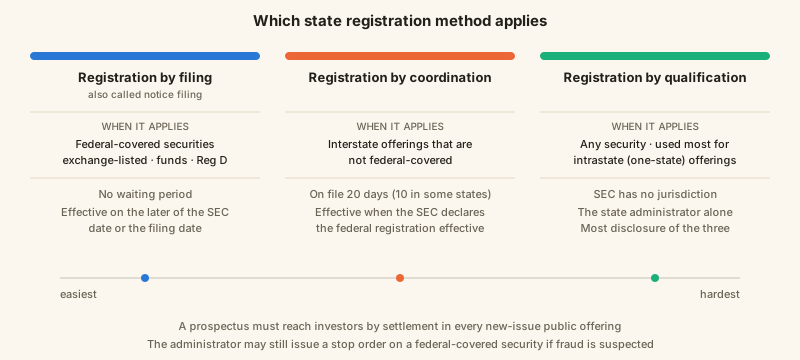
- While any security is eligible for registration by qualification, this method is used most often by issuers of intrastate securities (securities sold in one state only).
- 🔑 Unlike registration by filing (notice filing) or registration by coordination, the Securities and Exchange Commission (SEC) has no jurisdiction over securities registered this way. The process is handled entirely at the state level by the state administrator.
- Like the other registration methods, registration by qualification requires extensive disclosure on the registration paperwork.
Required documents:
You do not need to memorize every item below. What matters is that the state administrator can require a wide range of disclosures. Questions on specific items are uncommon.
Documents required by the Uniform Securities Act
| Category | Items required to be submitted to the state administrator |
|---|---|
| Business characteristics | Business name; Address; Business form (corporation, partnership, etc.); Business formation documents (e.g., articles of incorporation); State of organization; General character of the business; Description of business properties and equipment; Statement of industry’s competitive conditions; Any pending legal actions that may affect the business or security |
| Information on company insiders | Name, address, and occupation of officers and directors; Amount of issuer’s securities held by officers and directors; Amount of issuer’s securities that will be purchased by officers and directors; All of the information listed above, but for investors owning 10% or more of the issuer’s stock |
| Business disclosures | Business debt levels; Other securities offered by the issuer; Business financial statements (e.g., balance sheet) |
| Specifics of security to be offered | Security type (e.g., common stock, debenture); Amount of security to be offered; Proposed offering price of security; Estimated underwriting fees; Basic information on underwriter(s); Other fees associated with the offering; Estimated proceeds to be received by the issuer; Expected purpose of proceeds received; A copy of any prospectus or other document offered to investors |
| Typical registration requirements | Consent to service of process; Filing fee |
| Catch-all | Plus, anything else the administrator requests |
Definitions
| Term | Definition | Example |
|---|---|---|
| Prospectus | > Disclosure document that provides details on a security and its issuer, including the risks involved with the investment | A copy of any prospectus or other document offered to investors must be filed with the administrator |
| Underwriter | > A financial firm hired by an issuer to market and sell their securities to investors | Basic information on underwriter(s) and estimated underwriting fees must be disclosed |
Difficulty relative to other methods
- ⚠️ Because registration by qualification requires so many disclosures, it’s generally considered the most difficult state registration method.
- By comparison, registration by filing (notice filing) is considered the easiest (even though it’s not technically registration; it’s simply the easiest of the three processes).
| Method | Relative difficulty | Notes |
|---|---|---|
| Registration by filing (notice filing) | Easiest | Not technically registration; simply the easiest of the three processes |
| Registration by coordination | (Middle — SEC involved) | Issuer must properly involve the SEC |
| Registration by qualification | Most difficult | Requires the most disclosures; state-only, no SEC jurisdiction |
Escrow
- In addition to the required disclosures, securities registered by qualification are also subject to the same escrow requirements discussed in the registration by coordination chapter.
Effectiveness and amendments
- 🔑 If all required disclosures and documents are filed, the filing fee is paid, and no stop order or delay exists, the state administrator will grant effective registration on the 30th day after the initial filing.
- If the issuer later wants to sell more shares or change other terms of the offering, the issuer must file an amendment with the administrator.
Stop orders
- A stop order is an administrator-issued order requiring an issuer to stop issuing a security.
- A stop order may not be permanent, but it prevents the issuer from raising capital (money) from investors for at least some period of time.
- Stop orders are typically used to protect investors, most often when required disclosure is missing or the offering is otherwise improper. The goal is to ensure investors have enough information to make informed investment decisions.
Grounds for a stop order (USA)
According to the USA, the administrator may institute a stop order if:
- The order is in the public’s interest*, and
- One of the following circumstances exist:
| # | Circumstance permitting a stop order |
|---|---|
| 1 | The registration form is incomplete |
| 2 | The USA or any rule or regulation has been violated |
| 3 | The security is subject to an injunction or court order preventing the sale |
| 4 | The issuer’s business is engaged in illegal activities |
| 5 | The offering is fraudulent or unfair |
| 6 | The offering involves unjustifiable compensation to the underwriter |
| 7 | An issuer subject to registration by coordination does not properly involve the SEC |
| 8 | An issuer performs a notice filing when they’re not eligible** |
| 9 | A filing fee has not been paid |
*The USA does not allow the administrator to impose punishments (and a stop order is a punishment) unless doing so is in the “public’s interest.” If the action does not benefit the public in some way, it cannot be instituted.
**Only federal covered securities may perform a notice filing, which is the easiest way to offer a security in a state legally. An issuer may incorrectly claim its security is federal covered to avoid the work involved in registering a security by coordination or qualification. If the administrator suspects this is happening, the administrator may initiate a stop order.
Protocols the administrator must follow
🔑 When the administrator institutes a stop order, they must follow the following protocols:
| # | Required protocol |
|---|---|
| 1 | Notify the issuer of the stop order |
| 2 | Provide written findings of fact and law |
| 3 | Provide the opportunity for a hearing |
- In other words, the administrator must notify the issuer and explain the basis for the stop order (the findings of fact and law).
- If the issuer wants to challenge the order, the issuer can request a hearing.
- 🔑 If a hearing is requested, the administrator must hold it within 15 days of the request.
- If no hearing is requested, the stop order remains in effect until the administrator modifies or vacates (removes) it.
🔑 Numbers & deadlines
| Number | What it applies to |
|---|---|
| 10% or more | Investors owning 10% or more of the issuer’s stock must disclose the same information required of officers and directors (name, address, occupation; securities held; securities that will be purchased) |
| 30th day after the initial filing | Effective registration is granted on the 30th day after initial filing — if all necessary items are submitted, the filing fee is paid, and no stop order or delay exists |
| Within 15 days of the request | The administrator must hold a hearing within 15 days of a requested hearing on a stop order |
| 3 registration methods | Filing (notice filing) = easiest; coordination; qualification = most difficult |
| 9 circumstances | Number of listed circumstances, any one of which (plus public interest) permits a stop order |
Key points
Registration by qualification
- State registration only
- Items required:
- Business information
- Information on company insiders
- Business disclosures
- Specifics of security
- Consent to service of process
- Filing fee
- Anything else requested by state administrator
- Effective registration granted on 30th day after filing if
- All necessary items submitted
- No stop orders exist
Stop orders
- Order to stop issuance of a security
- Typically occurs if disclosures lacking or registration is improper
- To institute, administrator must:
- Notify the issuer
- Provide written findings of fact and law
- Provide opportunity for a hearing
Sources
Primary/official references for the material on this page. Every link was fetched and returned HTTP 200 on 2026-08-15.
| # | Source | Publisher |
|---|---|---|
| 1 | Uniform Securities Act 1956 with NASAA updates — the tested statute | NASAA |
| 2 | Uniform Securities Acts (1956 / 1985 / 2002) index | NASAA |
| 3 | Achievable Series 65 — chapter 4.3.5.5 | Achievable (course text) |